





































Address verification software
Verify and validate your addresses by running them against an official, authoritative database, like the USPS in the US, and update them to comply with the standardized USPS® format that highlights the ZIP+4 value along with the geocoded location.
Trusted By
Trusted By
DEFINiTION
What is address verification?
Address verification is the process of running addresses against an authoritative database – such as USPS in the US – and validating the realness of the information. This process verifies that the address is a mailable, accurate, and valid location within the country for delivering mail.
The process usually starts with address standardization, then goes on to parsing, geocoding, and formatting, etc.
Benefits
Why do you need an address verification tool?
Reduce mailing costs
Eliminate the cost and effort of mailing promotional materials to wrong or non-existent addresses.
Improve customer service
Higher mailing accuracy can lead to quicker deliveries which can improve brand perception and customer loyalty.
Identify households
Understand your customer-base in terms of households and run targeted campaigns to pitch relatable service offerings.
Understand customer behavior
Get accurate picture of your customer demographics with high quality, precise, and consistent address information.
Increase operational efficiency
Reduce manual labor, level up data quality, and optimize business processes with automatic address verification technology.
Ensure address standardization
Ensure that the addresses across all databases follow standardized format, such as the USPS address format.
Features
What DME’s address verification can do for you?
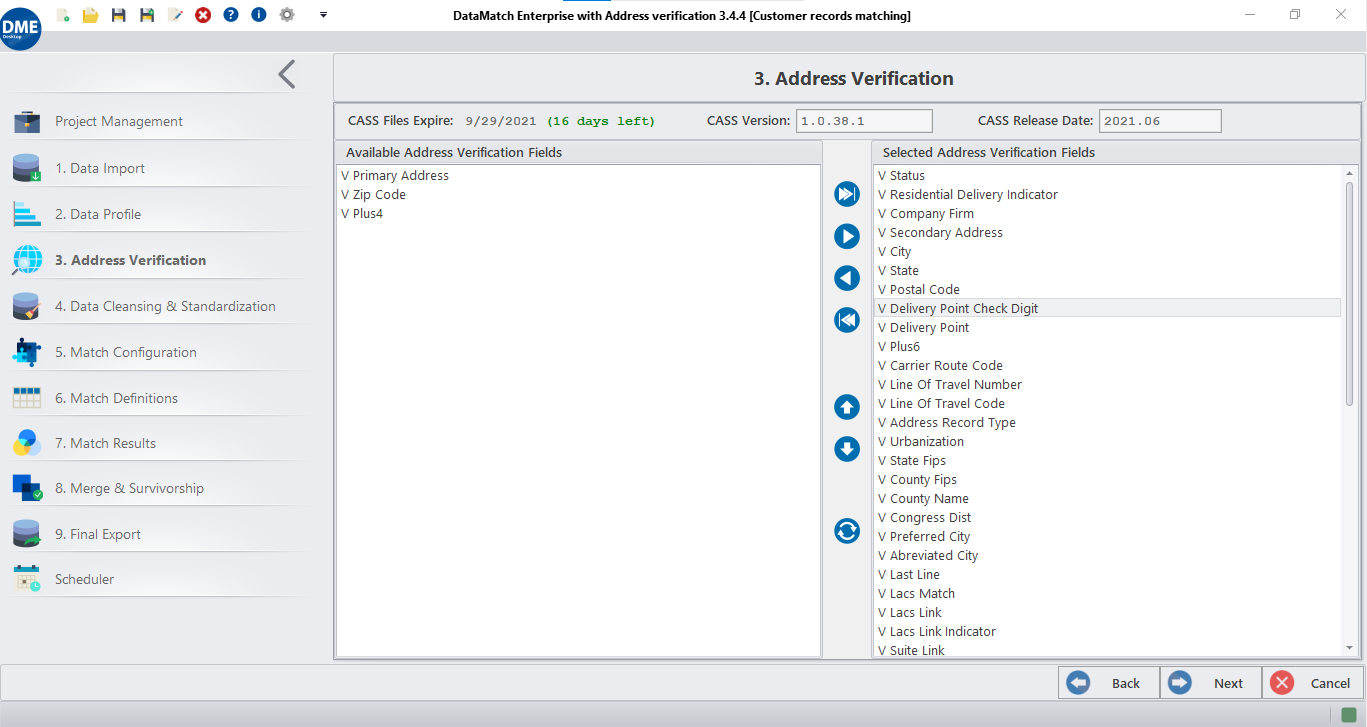
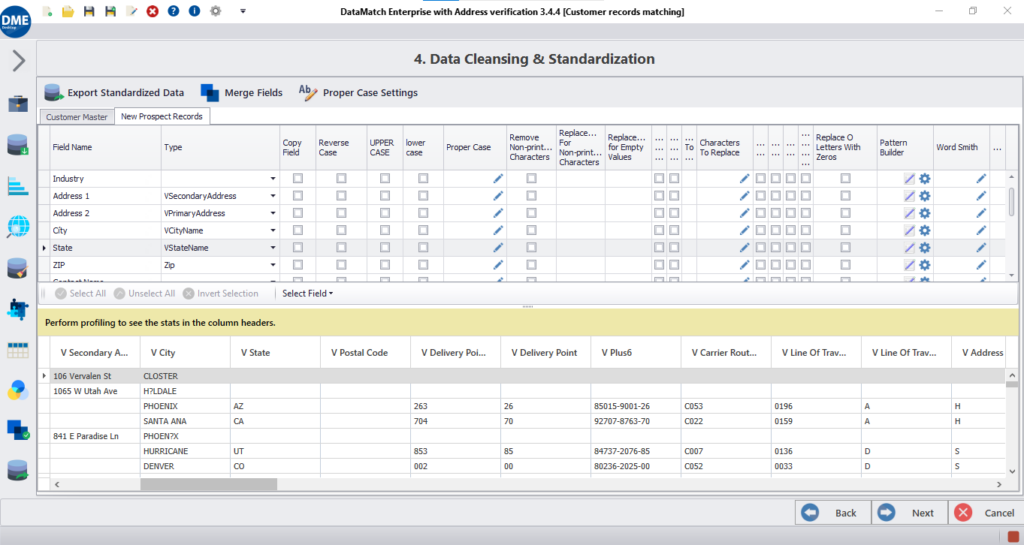
DME, a CASS-certified solution, parses address fields into its respective components such as street name and number, zip code, city name, state, and country, etc. Next, it matches each of them against the standardized USPS® database to validate their accuracy, and constructs the address in a way such that it follows the standardized address format.
There’s more
What else do you get out of the box?
- CASS-Certified™
- Residential Indicator (RDI™)
- Geocoding
- ZIP+4™
- Delivery Point Validation (DPV®)
- Enhanced Line of Travel (eLOT®)
- Locatable Address Conversion System (LACSLink®)
- SuiteLINK®
User roles
A tool made for everyone

Data analysts

Business users

IT Professionals

Novice users

Features
We take care of your complete DQM lifecycle
The DME API exposes data profiling, cleansing, matching, and deduplication as [VERIFY: REST/SOAP] endpoints, so you can call these functions directly from your own application, ETL pipeline, or CRM without opening the DME desktop interface.
Authentication
VERIFY: API key / OAuth / token-based — confirm method and add a one-line example
Example request
Automate data quality checks and get instant data profile reports
Example response
Standardize & transform datasets through various operations
Batch vs. real-time modes
Execute industry-grade, AI-powered data match algorithms on datasets
Supported integrations
Eliminate duplicate values and records to preserve uniqueness
Merge & purge
Configure merge and survivorship rules to get the most out of data
Want to know more?
Check out DME resources

Merging Data from Multiple Sources – Challenges and Solutions

Oops! We could not locate your form.

What’s New in DataMatch Enterprise: REST API, Docker Deployment, and a Rebuilt Matching Engine
Last Updated on September 7, 2026 DataMatch Enterprise just shipped a REST API, a containerized deployment, and a rebuilt matching engine. In internal testing, the

Build vs. Buy Entity Resolution: What’s the Better Option for Your Team?
Last Updated on August 7, 2026 Entity resolution is the process of identifying which records across one or more systems refer to the same real-world

What’s New in DataMatch Enterprise: REST API, Docker Deployment, and a Rebuilt Matching Engine
Last Updated on September 7, 2026 DataMatch Enterprise just shipped a REST API, a containerized deployment, and a rebuilt matching engine. In internal testing, the

Build vs. Buy Entity Resolution: What’s the Better Option for Your Team?
Last Updated on August 7, 2026 Entity resolution is the process of identifying which records across one or more systems refer to the same real-world

Deterministic vs. Probabilistic Matching: When to Choose Each Data Matching Type
Last Updated on August 6, 2026 Deterministic matching links two records only when specified fields agree exactly, like an identical account number. Probabilistic matching links
Frequently asked questions
Got more questions? Check this out
Address verification software checks whether address information is complete, correctly formatted, and recognized by an authoritative postal reference source. It can parse address components, correct formatting inconsistencies, append missing postal information, and flag records that require review. Organizations use it to improve mailing accuracy, customer records, deliveries, analytics, and regulatory communications.
Address standardization converts addresses into a consistent postal format. Address validation compares the standardized information against an authoritative reference source. Address verification determines whether the address can be recognized and used for its intended purpose. Address matching identifies records that refer to the same location despite spelling or formatting differences. Geocoding assigns geographic coordinates to an address. In practice, vendors sometimes use “validation” and “verification” interchangeably.
Address validation software first parses an address into components such as house number, street, city, state, and postal code. It then cleans and standardizes those components before comparing them with postal reference data. Depending on the available information, the software may correct formatting, add missing postal codes, identify incomplete addresses, and return validation details for review. Learn more about the address validation process.
Address matching software compares standardized address components instead of relying only on an exact full-address match. It can recognize differences involving abbreviations, punctuation, unit numbers, misspellings, reordered components, and ZIP Code formats. Matching rules can also combine address information with names, phone numbers, or account identifiers to determine whether two records represent the same household, customer, or location. Learn more about address data matching.
CASS certification allows USPS to evaluate the accuracy of address-matching software in applying postal information such as Five-Digit ZIP Codes, ZIP+4 Codes, delivery points, and carrier routes. Certification measures the software’s address-matching capabilities; successful results still depend on the completeness, quality, and timeliness of the source data. Learn more about CASS-certified address validation software.
Yes. DataMatch Enterprise can standardize address records, assign Five-Digit ZIP Codes and ZIP+4 Codes when suitable reference information is available, and generate latitude and longitude values for geocoding. These outputs can support mailing operations, geographic analysis, householding, service-area analysis, and location-based record matching.
Evaluate the geographic coverage, reference-data sources, parsing and standardization capabilities, ZIP+4 and geocoding support, batch-processing capacity, matching and deduplication features, integration options, and the clarity of returned validation results. Organizations using address data for U.S. mailing operations should also confirm whether the software holds current CASS certification.