



































Match IT / Syniti Replacement

The Modern Replacement for
Match IT and Synity

Synity was built for governance programs. Data Ladder is built for the 
teams doing the actual work. Faster matching, full transparency, no
platform dependency.

Recognized by Gartner as cutting edge  ·  500+ enterprise teams  ·  SOC 2 compliant

Trusted By

Trusted By

Here's what actually changes when you switch.

With Data Ladder. Without the Synity tax.

With Data Ladder Matching logic you can see and trust

Every match rule, weight, and score is visible, adjustable, and explainable to business users. You can prove a match to a regulator or a skeptical CFO without involving IT.

With Synity / Match IT Logic buried in workflows

Matching logic lives inside Synity Knowledge Platform workflows, typically managed by consultants. Business users have no direct visibility into why records matched or how scores were calculated.

With Data Ladder Live in days, not a project plan

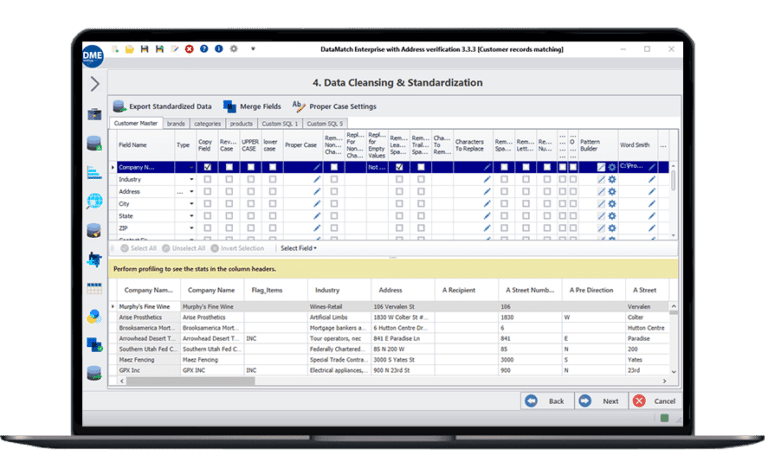
Import your data, configure match rules visually, preview results in real time, and export. Your team is matching production data within a week. No platform alignment needed.

With Synity / Match IT Weeks to months to first value

Synity deployments are service-led and governance-dependent. Timeline compression requires consultants, workflow configuration, QA cycles, and stewardship sign-off.

With Data Ladder Scale to 100M+ records. Predictable cost.

Fixed, volume-based licensing. You know what you pay before you sign. Performance holds at 10M records matched in 41 minutes across two match definitions.

With Synity / Match IT Module-by-module pricing

Enterprise TCO for Synity varies with scope, module selection, and professional services. Matching, deduplication, and MDM are often separate line items that add up fast.

With Data Ladder Business users stay in control

Non-technical teams run profiling, matching, and deduplication jobs independently. IT is optional, not a prerequisite. Adjust rules, tune thresholds, and validate results in a single session.

With Synity / Match IT Administrator- or consultant-driven

Synity's platform assumes technical ownership. Business teams typically depend on IT or external services to manage matching jobs, rule changes, and output validation.

“DataLadder is cutting edge for enterprise data matching and quality at scale.”

Ted Friedman, Former VP Analyst, Gartner

5–12%

More accurate than IBM and SAS

41 min

To match 10M records across 2 definitions

30–40%

Faster implementations vs. Synity deployments

Across the capabilities that matter most for enterprise data matching programs.

Data Ladder vs. Synity: Feature by Feature

Capability Data Ladder (DME) Synity / Match IT / Cortex
Fuzzy, phonetic, and ML-based matching ✓ Core strength Partial — rule-based within SKP workflows
No-code visual rule configuration ✓ Full GUI, no developers needed ✗ Requires technical setup or consultants
Match result explainability ✓ Every score visible and adjustable ✗ Logic dispersed across workflows
Scalability to 100M+ records ✓ Proven at enterprise scale Partial — performance varies by config
Time to first value ✓ Days (same-day for simple projects) ✗ Weeks to months
Deduplication and golden record ✓ Built in, no extra module Partial — extra cost depending on scope
API and CRM integrations ✓ REST API, HubSpot, Salesforce, SQL Partial — select connectors, services required
Cloud, on-prem, and hybrid deployment ✓ All three supported Partial — limited cloud options
Business user ownership ✓ Full — no IT dependency ✗ IT or consultant-led by design
Transparent, predictable pricing ✓ Fixed, volume-based license ✗ Opaque — varies with scope and modules

Teams replacing Synity and its variants use Data Ladder across these programs.

Find your use case

In their own words.

Why teams switch from Synity

* Quotes represent composite customer feedback. Real attributed case studies available upon request.

Synity has gone to market under multiple product and brand names. Data Ladder is the replacement regardless of which one you know.

You may know Synity by a different name

Synity

The parent brand and platform (Synity Knowledge Platform). Data Ladder is the focused, fast-to-deploy alternative for matching and data quality workloads.

Match IT

Synity's data matching module — now being sunset. DataMatch Enterprise is the direct replacement: same capabilities, faster deployment, full explainability.

360Science

The original name for Match IT before Synity acquired it. If you built workflows on 360Science, DataMatch Enterprise maps to the same match definitions and criteria logic.

Help IT Software

A market-specific Synity positioning. Same platform, same constraints. Data Ladder is the modern alternative for teams that have outgrown it.

360Sings

A Synity variant pitched for 360-degree customer view programs. Data Ladder delivers that with real-time matching, dedup, and golden record creation in one platform.

Cortex

Synity's analytics and data enrichment module. DataMatch Enterprise covers profiling, enrichment, and quality scoring without requiring the broader SKP environment.

Match ID

Identity resolution within the Synity ecosystem. Data Ladder's probabilistic and ML-based matching handles identity resolution at enterprise scale with full auditability.

Data 360

Synity's MDM-adjacent product. Data Ladder delivers golden record creation, deduplication, and stewardship workflows out of the box without the governance prerequisite.

Match IT is being sunset.
Your replacement is ready.

30-minute migration call. We will show you exactly 
how DataMatch Enterprise maps to your current Match IT or Synity
workflows — using your data, not a generic slide deck.

No commitment required · Enterprise pilots available · Typical
time to value: 1–2 weeks

Common questions from teams evaluating a Synity replacement.

Frequently asked questions

Most teams are running DataMatch Enterprise against production data within 1–2 weeks of starting. There is no prerequisite governance program or extended onboarding. You can replicate your existing Match IT definitions and criteria logic directly in DME’s visual rule builder, and run both systems in parallel during the transition if needed. Book a migration call and we will map your current workflows in the first session.

For teams prioritizing transparency, speed, and ease of use, Data Ladder (DataMatch Enterprise) is one of the strongest alternatives available. It offers same-day deployment, no-code matching, and fully explainable scoring logic with real-time previews. Business users stay in control without depending on IT or consultants.

Yes. Match IT is the data matching and entity resolution module within the Synity Knowledge Platform. Depending on how your vendor or reseller packaged it, you may know the same product as Match IT, Synity, Help IT Software, 360Sings, Cortex, Match ID, or Data 360. All are part of the same platform family.

Yes. While Synity is built for full ERP transformation programs, DataMatch Enterprise is purpose-built for the upfront data preparation work that makes migrations succeed: cleaning, matching, and deduplicating records before cutover. Most teams go from raw data to migration-ready records in 1–2 weeks, well ahead of what a full Synity onboarding requires.

Yes. All matching logic in DataMatch Enterprise is visual, adjustable, and explainable by business users. In Synity, matching logic is typically embedded in governance workflows or managed by services teams, making it hard to trace a specific match result without deep platform knowledge. With Data Ladder, you can show any stakeholder exactly why two records matched and adjust the rule on the spot.

Yes. DataMatch Enterprise includes full REST API support for real-time or scheduled matching in active data pipelines. You can trigger match jobs programmatically, integrate results back into your CRM or ERP, and automate recurring dedup runs without any manual intervention.

Most teams have DataMatch Enterprise running against production data within a week of starting. There is no prerequisite governance program, no extended implementation, and no services dependency. You can run both systems in parallel during transition if needed — DME does not require a rip-and-replace approach.

Data Ladder is well-suited for regulated environments because every match decision is auditable and explainable. In healthcare, financial services, and government settings where match rationale must be traceable, DME’s transparent scoring is a direct compliance advantage. Data Ladder is also SOC 2 compliant and supports on-premise deployment for data residency requirements.

No. Data Ladder does not have a direct services arm that competes with implementation partners. If your team works with a systems integrator on an ERP or data migration program, DataMatch Enterprise can be deployed alongside that engagement as the data matching layer. Many SIs use DME to deliver faster, higher-quality data cleansing as part of their program.