



































Successful AI Initiatives Begin with Better Data
DataMatch Enterprise cleans, matches, and standardizes data to make it ready for your AI pipelines.
Trusted By
Trusted By
Build AI Workflows with Data You Can Trust
DEFINiTION
Why clean, reliable data is the foundation for AI readiness
AI models need data that is consistent, complete, and free of errors. Feed them duplicates and format inconsistencies, and every insight they produce is built on a flawed foundation.
Data cleansing, data matching, and entity resolution aren’t just data management tasks. They’re what separates AI that performs from AI that misleads.
Whether you’re training models, building intelligent workflows, or looking to personalize at scale, DME gives you the clean, consistent data foundation your AI projects need for success.
Improve Data Quality with DataMatch Enterprise
Find and resolve duplicate records
Identify duplicate records even when there's not an exact match.
Match records
Across systems (CRMs, ERPs, spreadsheets, databases, among others.
Standardize inconsistent formats
Normalize names, addresses, dates, company names, phone numbers, etc.
Cleanse data
Remove noise, fix errors, and enforce validation rules across your dataset.
Build golden records
Merge attributes using survivorship and scoring logic.
Automate your data pipelines
Schedule and repeat data quality workflows without manual intervention.
Feed clean data
Into AI models, MDM platforms, or analytics tools.
Ensure auditability and explainability
Fuel your decisions with clean, accurate data.
Features
How DataMatch Enterprise Makes Your Data AI-Ready
Identify gaps, outliers, duplication levels, and structural inconsistencies in your data. Catch problems
before they corrupt training data or skew automated decisions.
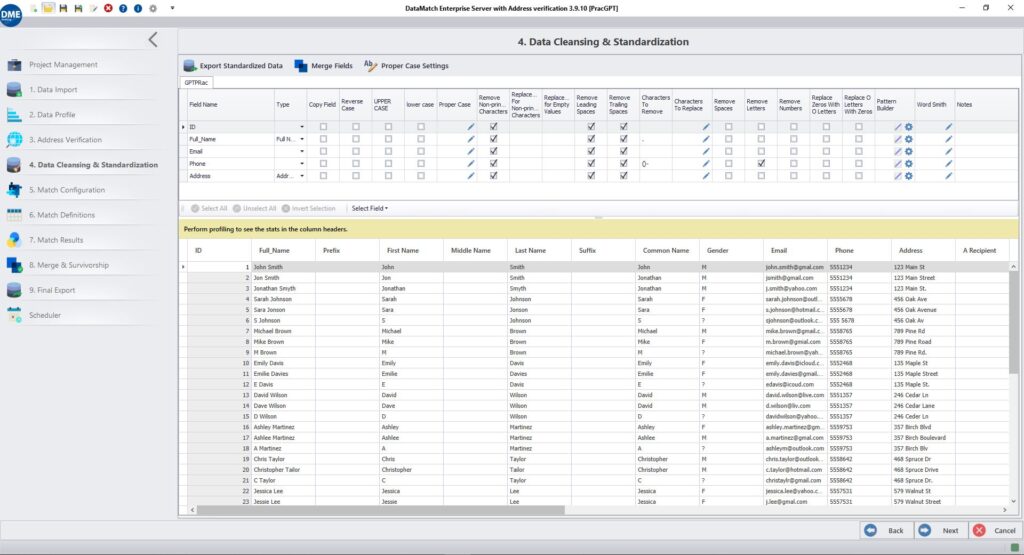
Standardize formats, clean text values, and apply consistent rules for how your data should look toensure uniformity before data hits your model or process
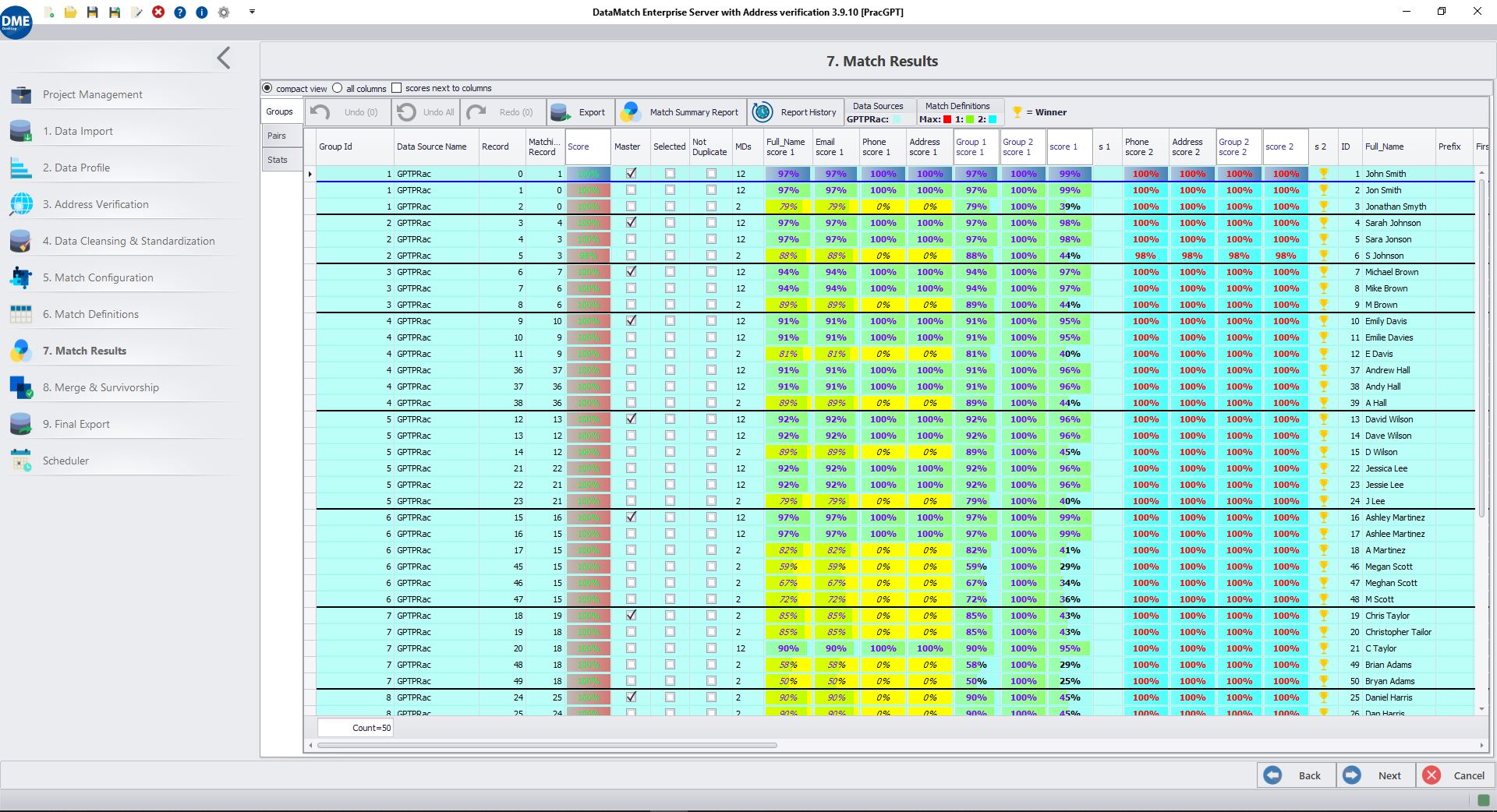
DME uses fuzzy, phonetic, numeric, and domain-specific logic to resolve duplicates and unify recordsacross sources. It helps you identify and link records that refer to the same thing even if the names,spellings, or formats don’t exactly match.
Role-based access, survivorship rules, match previews, and traceable changes ensure your AI workflows remain transparent, secure, and compliant.
Most AI models – especially in supervised learning – rely on labeled data. But if that data is inconsistent, incomplete, or duplicated, your model won’t learn the right patterns. You’ll end up training AI on flawed assumptions, which leads to bias, poor predictions, or even failed rollouts.
DataMatch Enterprise helps you solve these issues before labeling begins. By cleaning, matching, andstandardizing records upfront, DME ensures your training datasets are accurate, consistent, and readyfor annotation. That means:
• Less time spent labeling redundant or unclear data.
• Better inputs for supervised learning
• Higher-quality predictions from your AI models.
Whether your team is labeling data in-house or working with an external annotation partner, DME improves the input layer, so your AI model learns from the truth, not noise.

Common Use Cases
Where DME Fits into AI Workflows
Organizations across industries use DataMatch Enterprise to solve the data quality issues standing in the way of effective AI. Some common DME use cases include:
Customer intelligence and personalization
Consolidate customer data from multiple systems to build a true 360 view that is essential for customer scoring, segmentation, and AI-driven targeting.
Predictive Modeling and ML Training
Reduce noise and bias in training data by removing duplicates, correcting inconsistencies, and improving structure. Don’t forget, your model is only as good as your inputs.
Intelligent Automation
Ensure your automation logic runs on clean, consistent data to reduce exceptions, errors, and manual rework in AI-enhanced workflows.
Compliance, Risk, and Audit
Remove duplicates and feed traceable, compliant data into AI models to maintain defensibility in decisions.
Trusted by
Teams That Take Data Seriously
From finance to healthcare to retail, teams use DME to:
Datamatch Enterprise
Built for Scale, Designed for Trust
Capability
Multi-field, rule-based matching
In-memory, parallel architecture
Workflow builder + API automation
Structured, semi-structured data support
Role-based access + logs
What it Enables
Accurate entity resolution
Speed at scale (100M+ records)
Repeatable, auditable pipelines
Match across databases, files, apps
Governance and trust
AI-Readiness is a data problem first
Resolve It with DataMatch Enterprise
If your data is incomplete, inconsistent, or duplicated across silos, your AI measures won’t deliver the insights or outcomes you expect.
DataMatch Enterprise helps you solve these foundational issues early, so your AI systems can perform reliably, your decisions are backed by truth, and your teams can scale innovation with confidence.
Why DME?
DME is different. It's designed for:
Ease of use
No-code workflow builder and instant match previews
Easy integration
Works with your existing systems, on-prem or cloud
Speed
In-memory, multi-threaded engine gets results fast
Transparency
You control the rules, match logic, and outcomes
Enterprise-grade scalability
DME has been tested for handling 100M+ records without choking
AI-Ready Data without Any Code
AI success starts with clean, connected data. And that starts with DME.
Whether you’re just stepping into the AI world or scaling your AI initiatives, DME can help you:
Automate data preparation across workflows.
Identify and resolve entity duplication.
Clean and standardize key fields.
Push unified records into AI, BI, and MDM platforms.
Ready to get started?
Want to know more?
Check out DME resources

Merging Data from Multiple Sources – Challenges and Solutions

Oops! We could not locate your form.

Data Deduplication API vs Batch Deduplication: When to Use Each
Last Updated on June 29, 2026 The right choice between a deduplication API and batch deduplication comes down to when deduplication needs to happen. If

Best Financial Data Quality Software: Features, Pricing, and Use Cases (2026)
Last Updated on June 2, 2026 In 2025, over a quarter of organizations reported losing more than $5 million annually from poor data quality, according

Data Deduplication API vs Batch Deduplication: When to Use Each
Last Updated on June 29, 2026 The right choice between a deduplication API and batch deduplication comes down to when deduplication needs to happen. If

Best Financial Data Quality Software: Features, Pricing, and Use Cases (2026)
Last Updated on June 2, 2026 In 2025, over a quarter of organizations reported losing more than $5 million annually from poor data quality, according

How to Build a Financial Data Quality Management Program (2026 Guide)
Last Updated on May 25, 2026 Financial data quality management is the set of processes, ownership structures, and controls that finance and IT teams use