




































Last Updated on August 6, 2026
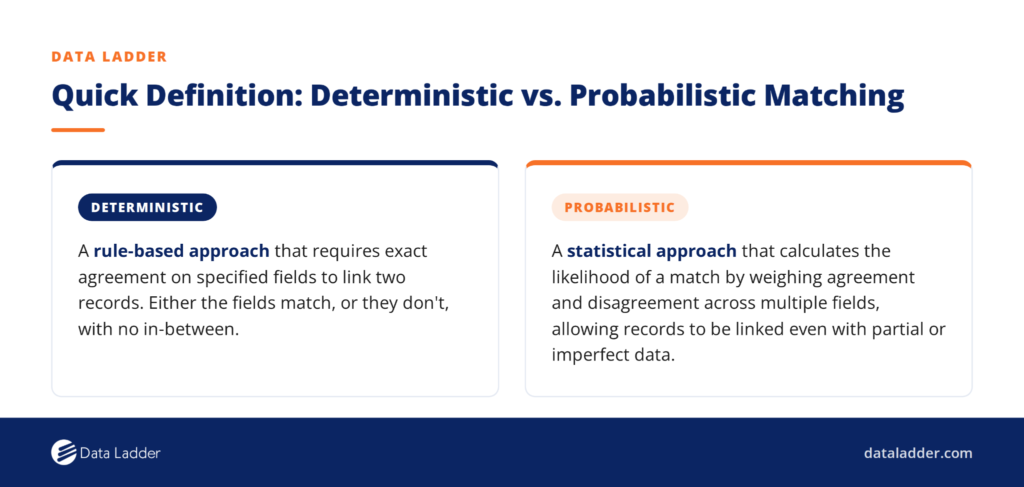
Deterministic matching links two records only when specified fields agree exactly, like an identical account number. Probabilistic matching links records based on a calculated likelihood that they refer to the same entity, scoring partial agreement across multiple fields even when nothing matches exactly, which is what lets it catch variations like “Jon Smith” and “Jonathan Smith” that an exact-match rule would miss entirely.
Which one to use isn’t a matter of preference.
Deterministic matching against inconsistent data misses real duplicates outright, since a single typo or formatting difference breaks the match.
Probabilistic matching without properly tuned thresholds can merge two different people into one record.
Both mistakes are costly, whether that shows up as a missed fraud pattern, a duplicate payment, or a compliance record built on the wrong identity.
How Deterministic Matching Works
Deterministic matching compares specified fields between two records and returns a binary result. Either the fields agree according to the defined rule, or they don’t. There’s no in-between and no scoring, just standardization followed by a direct comparison.
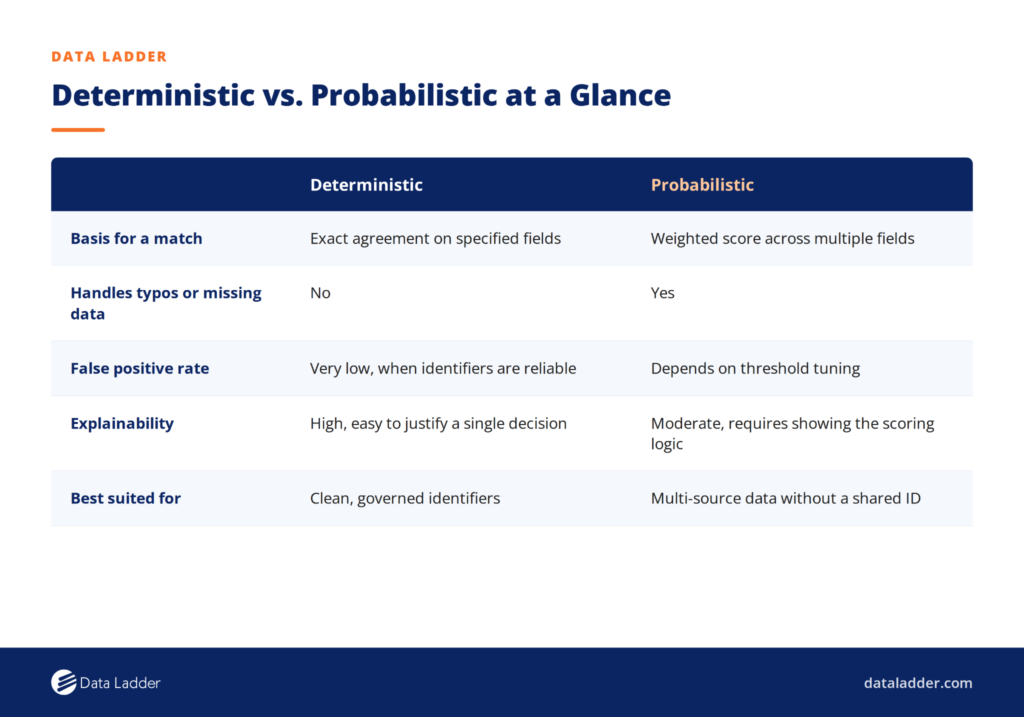
That simplicity is the appeal. A well-designed deterministic rule, run against clean, consistently formatted data, produces very few false positives. It’s also the easiest matching approach to explain to a non-technical stakeholder or an auditor because the explanation looks something like “two records matched because they shared an identical account number,” and that’s all that’s needed. This is one of the reasons why deterministic matching holds up well in financial reconciliation, where both sides of a transaction carry a shared account or transaction ID, in systems of record with a governed identifier like an internal employee number, and in any workflow where the match decision has to be defensible in an audit.
The tradeoff is that deterministic matching depends entirely on the reliability and consistency of the fields it’s comparing. The moment a name gets typed differently across two systems, a field goes missing, or a phone number carries different formatting, an exact-match rule returns nothing, even though the two records clearly describe the same person or organization. Three form submissions from the same prospect, entered as “Jon Smith,” “Jonathan Smith,” and “J. Smith,” produce three unconnected records under this approach, not because the data is unusable, but because the matching logic wasn’t built to handle variation.
How Probabilistic Matching Works
Probabilistic matching traces back to a 1969 paper by Ivan Fellegi and Alan Sunter, published in the Journal of the American Statistical Association, which formalized how to compare records across multiple fields and calculate the likelihood that a given pair refers to the same entity. That framework still underpins most modern record linkage systems, including the statistical agencies and health registries that pioneered its use.
Instead of requiring exact agreement, probabilistic matching assigns a weight to each field based on how much agreement or disagreement on that field actually tells you. Two records agreeing on an uncommon last name is stronger evidence of a match than two records agreeing on a common first name like “John.” The engine sums the weighted evidence across every compared field into a single score, then applies thresholds to decide whether a pair is a match, a non-match, or a case that needs manual review.
This is what makes it useful for consolidating records across systems that don’t share a common identifier, such as unifying a CRM, a support platform, and a billing system into one customer view. It’s also what makes it effective against fraud, where bad actors deliberately introduce small variations, a transposed digit, a dropped middle initial, specifically to avoid triggering exact-match rules, and against cross-border KYC and watchlist screening, where transliteration and varying name component orders mean the same identity rarely appears the same way twice.
The cost of that flexibility is a need for enough data volume and field variety to calculate reliable weights in the first place. On a small or narrow dataset, the statistics behind the scoring get shaky, and match decisions become less trustworthy than a simple rule would have been. It’s also harder to explain a single decision to a skeptical stakeholder. A match scored at 0.87 across five weighted fields is a less intuitive answer than “these two records had an identical tax ID.” In a compliance context, that gap matters, and it’s the reason probabilistic systems need clear audit trails showing which fields actually drove a given score.
How Fuzzy and Phonetic Matching Fit Into the Picture
Fuzzy and phonetic matching aren’t a third, fully separate category sitting next to deterministic and probabilistic. In most production systems, they’re the comparison logic that feeds a probabilistic score, or occasionally a looser rule bolted onto a deterministic pass. Fuzzy matching measures how similar two strings look, catching typos and transposed characters. Phonetic matching measures how similar two strings sound, catching spelling variants like “Catherine” and “Kathryn.”
A well-built matching engine uses these as inputs to the broader decision, not as a standalone method competing with deterministic or probabilistic matching for the whole job.
A Framework for Choosing an Approach
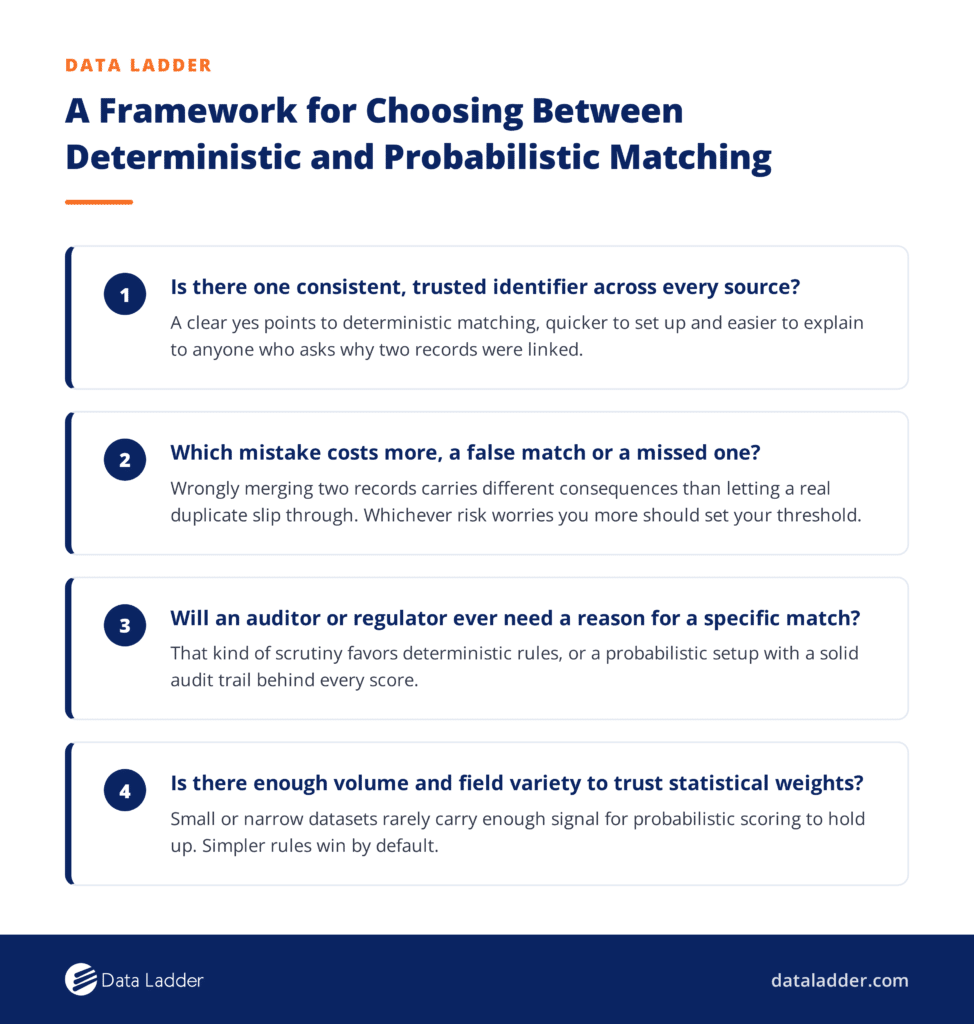
A few practical questions usually settle which approach fits a given dataset:
- Do all sources share a reliable, consistently governed identifier? If yes, deterministic matching is likely sufficient and will be the fastest, most explainable option.
- What does a false positive cost, compared to a false negative? A merged record that shouldn’t have been merged is a different kind of risk than a missed duplicate, and the answer changes which threshold and which approach makes sense.
- Does a regulator, auditor, or internal reviewer need to see why a specific pair was matched? That requirement pushes toward deterministic logic, or a probabilistic setup with strong audit logging.
- Is there enough data volume and field diversity to calculate trustworthy statistical weights? Thin datasets favor simpler rules.
Why a Blended Approach Usually Wins in Production
Most production-grade matching engines don’t force a binary choice between deterministic and probabilistic logic. They apply deterministic rules to the fields worth trusting completely, a verified tax ID or account number, while running fuzzy, phonetic, and probabilistic scoring on the fields that vary more, names, addresses, and free-text entries.
DataMatch Enterprise is built around that blend. The matching engine combines deterministic rules, fuzzy and phonetic algorithms, and probabilistic scoring within a single configurable workflow, rather than requiring a team to choose one paradigm and live with its limitations. In independent benchmark testing across 15 comparative studies, that combined approach found 5 to 12 percent more matches than IBM and SAS data quality tools, with the fewest false positives among the products tested. Head-to-head testing against WinPure showed 53 percent more matches.
For teams deciding between building a matching layer in-house or buying one, this is usually where the calculation shifts. Replicating a single paradigm, a deterministic rule engine or a basic fuzzy match, is a reasonable weekend project. Replicating a tuned, blended system that performs well across data types and volumes is a much longer undertaking.
Test Different Matching Approaches on Your Own Data
Compare deterministic rules, fuzzy and phonetic comparisons, and probabilistic scoring using representative records from your systems.
Start a Free TrialFrequently Asked Questions
What is the main difference between deterministic and probabilistic matching?
Deterministic matching links records only when specified fields agree exactly, producing a binary match or non-match result. Probabilistic matching scores the likelihood that two records refer to the same entity based on a weighted combination of fields, which allows it to catch matches even when the data isn’t identical.
Can probabilistic matching be as accurate as deterministic matching?
It depends on the data and the use case. On clean data with a reliable shared identifier, deterministic matching is typically more precise and has fewer false positives. On messier, multi-source data without a consistent identifier, probabilistic matching finds far more true matches, since deterministic rules simply return nothing when fields don’t agree exactly.
Which approach is better for fraud detection?
Probabilistic matching, usually combined with fuzzy and phonetic logic, tends to perform better for fraud detection because fraud rings deliberately introduce small variations in names, addresses, and other identity fields specifically to avoid exact-match detection. A purely deterministic system will miss most of that activity.
Does probabilistic matching require machine learning?
Not necessarily. The classical Fellegi-Sunter framework that underlies most probabilistic record linkage systems is a statistical model, not a machine learning model, and remains widely used today. Some newer systems layer machine learning on top for tasks like automatically tuning weights, but the core probabilistic approach doesn’t require it.
How do you set the right threshold for probabilistic matching?
Thresholds are typically tuned against a labeled sample of known matches and non-matches, then adjusted based on how costly false positives versus false negatives are for the specific use case. A fraud or compliance workflow usually needs a stricter threshold than a marketing deduplication project, since the cost of an incorrect merge is much higher.