


































Last Updated on July 30, 2026
Quick Verdict
The best data deduplication software depends on where duplicate records exist, how many systems must be reconciled, and the complexity of the matching requirements. For CRM deduplication specifically, Dedupely, Plauti, and DemandTools are suited to focused cleanup inside a single CRM, while RingLead extends deduplication into connected marketing automation platforms.
DataMatch Enterprise by Data Ladder is a stronger fit when customer records must be matched and consolidated across CRMs, ERPs, databases, spreadsheets, warehouses, and other sources using deterministic, fuzzy, phonetic, and probabilistic matching.
Broader platforms such as Informatica, IBM, Talend, and SAS are more appropriate when deduplication forms part of a wider enterprise data-governance, integration, analytics, or MDM program.
Editorial disclosure: This comparison is published by Data Ladder, the developer of DataMatch Enterprise. Products were evaluated using publicly available documentation, stated capabilities, deployment scope, supported data sources, matching methods, and published limitations. Readers should independently verify current product features and pricing before making a purchase decision.
Enterprise databases run duplicate rates between 5 and 10 percent, based on figures the American Health Information Management Association tracks across hospital patient records, with multi-facility organizations landing at the higher end of that range. The same pattern shows up in CRMs, ERPs, and any environment where multiple teams, systems, or acquired companies feed data into a shared source. At a 10 percent duplicate rate, a database of two million records is carrying roughly two hundred thousand duplicate entries, each one distorting reporting, wasting outreach spend, and undermining whatever “single customer view” the business believes it has.
This guide covers software built to find and resolve duplicates at the record level, inside databases, CRMs, spreadsheets, and flat files. It does not cover storage or backup deduplication tools like NetApp ONTAP or Veeam Backup & Replication, which reduce disk usage by eliminating redundant data blocks at the storage layer and solve an entirely different problem. If the goal is shrinking backup storage footprint, this isn’t the right list. If the goal is recognizing that “John Smith” and “J. Smith” are the same customer across three systems, then this is the blog for you.
We will discuss how matching methodology actually works, the criteria worth evaluating a vendor against, a decision tree for narrowing the field quickly, and a tier-by-tier comparison of the tools enterprise data teams most often end up considering.
How Matching Actually Works: Deterministic, Probabilistic, and AI-Assisted Methods
Every deduplication tool eventually has to answer the same question: are these two records the same entity or not? How a tool answers that question, its matching methodology, affects accuracy far more than any interface or integration list on a features page.
Deterministic matching: links records only when specified fields match exactly, such as an identical Social Security number or an identical email address paired with a last name. It’s fast and produces few false positives, but it misses matches whenever data contains typos, formatting differences, nicknames, or missing fields, which in most real-world databases is often.
Probabilistic matching: assigns a similarity score across multiple fields, weighting each by how reliable that field tends to be, then calls a match once the combined score clears a defined threshold. This catches variations like “Jon” versus “John” or transposed address components that deterministic rules miss entirely, though it requires careful threshold tuning to avoid over-matching.
AI-assisted matching: layers machine learning on top of probabilistic scoring, learning from confirmed matches and non-matches to refine its own field weighting over time. It tends to improve accuracy on large, messy datasets, but it needs enough training volume and transparency into how scores are generated to be trustworthy, which is where some vendor claims get vague fast.
Most tools built for enterprise use, including Data Ladder, combine all three approaches: deterministic rules where certainty is possible, probabilistic and fuzzy matching for everything else, with algorithm-level threshold tuning available by field or data domain. A vendor offering only one of the three is telling you upfront what kind of data problems it can’t solve.
Need to get rid of duplicate data?
Test DataMatch Enterprise on your own data to evaluate its matching, deduplication, and entity-resolution capabilities across complex systems.
Start a Free TrialEvaluation Criteria for Enterprise Deduplication Software
Not all deduplication software is built the same. Some may offer multi-domain support but skimp on governance, while others handle governance well but cap out long before enterprise-scale volume. Vendor feature lists rarely make these tradeoffs obvious, so the criteria below are built around the questions that actually predict whether a tool holds up once it’s running against real production data.
Matching accuracy and methodology transparency
Ask a vendor to explain exactly how their tool decides two records are a match, not just what accuracy percentage they advertise. A vendor that can walk through deterministic, probabilistic, and fuzzy logic in specific terms, and show how thresholds get tuned, is one whose accuracy claims can actually be verified.
Multi-source support
Confirm whether the tool matches records across databases, CRMs, spreadsheets, and flat files simultaneously, or whether it’s scoped to a single platform. CRM-native tools handle their one environment well but stop there. If duplicates need to be resolved across a CRM, a legacy database, and an ERP at once, the tool needs to support that natively, not through a workaround.
Scale ceiling
Ask what record volume the tool has actually been tested at, not what it’s theoretically capable of. A tool that performs well on fifty thousand records can behave very differently at five million, both in processing time and in match accuracy as more near-duplicate variations enter the dataset.
Deployment model
Determine whether deduplication logic is configured through a code-free interface or requires scripting and dedicated engineering time. Code-free platforms let data quality managers and analysts run and adjust matching rules directly, without waiting on a development sprint every time a rule needs adjusting.
Governance and audit trail
Check whether every merge is logged, reversible, and attributable to a specific rule or user. When a compliance officer or CDO asks why two records were merged, the tool needs to produce a clear answer, not a shrug. This matters most in regulated industries like healthcare, financial services, and insurance, but it’s good practice everywhere.
Integration and API availability
Confirm the tool can plug into existing pipelines, whether that means a native CRM connector, a batch import process, or an API for real-time matching at the point of data entry. A tool that only works through manual file uploads adds friction that erodes adoption over time.
Pricing transparency at scale
Ask how pricing changes as record volume, user count, or data source count grows. A tool that’s affordable for a single analyst working with a hundred thousand records can become considerably more expensive once the database reaches the millions or multiple teams need access.
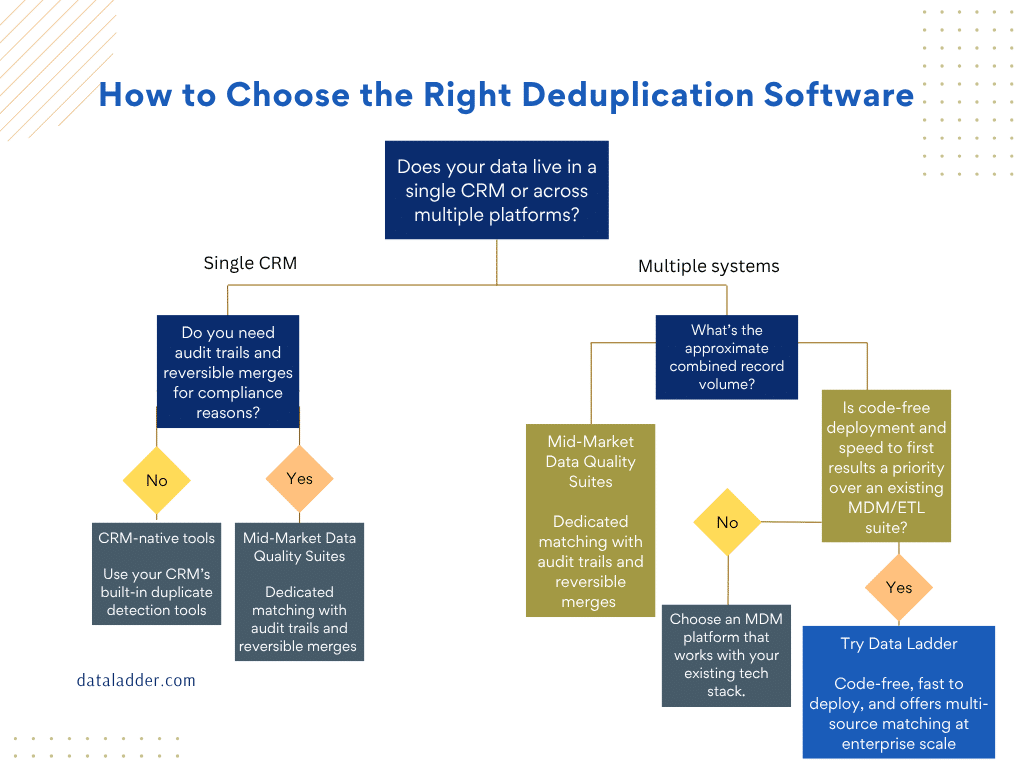
Decision Tree: Which Tier of Tool Fits Your Environment
Four questions narrow the field quickly. Each branch points to one of three tool tiers, covered in detail below.
Best Data Deduplication Software for Enterprise Data
The tools below range from CRM-focused duplicate management applications to multi-source data quality and enterprise data management platforms. They are compared based on matching capabilities, supported data sources, deployment, scalability, implementation requirements, and best-fit use cases.
| Tool | Matching Method | Multi-Source Support | Best-Fit Scale | Notable Limitation |
| Dedupely | Field/rule-based matching, no advertised fuzzy or probabilistic logic | CRM-native (HubSpot, Salesforce, Pipedrive), plus CSV import | Small-mid, single CRM | No fuzzy or probabilistic matching; not built for database-level or ERP matching |
| RingLead (ZoomInfo Operations) | Rule-based + fuzzy heuristic matching | Salesforce plus marketing automation platforms (Marketo, Pardot, HubSpot, Eloqua) | Mid-market, sales/marketing data | Scoped to CRM and MAP ecosystems; limited visibility into underlying algorithm |
| Plauti | Rule-based + fuzzy (25+ algorithms), AI Match Recommendations in Premium tier | Salesforce-native, including cross-object matching (Premium) | Small-mid Salesforce orgs | Salesforce-only; fuzzy matching and cross-object features require Premium or PDM edition |
| WinPure | Fuzzy + phonetic + rule-based | Databases, spreadsheets, CRMs, mailing lists, cross-file matching, plus API | Mid-market to enterprise | Primarily on-premise Windows deployment; no independently published large-scale accuracy benchmark |
| DemandTools (Validity) | Rule-based, configurable scenario matching | Primarily Salesforce; new Dynamics 365 product launched separately | Mid-market, Salesforce-centric | No native merge reversal without a pre-merge backup; Salesforce-centric despite Dynamics expansion |
| Data Ladder | Deterministic + probabilistic + fuzzy, algorithm-tunable | Databases, CRMs, spreadsheets, flat files, API | Enterprise, high-volume, multi-source | Broader capability set means more setup decisions upfront than a single-purpose CRM tool |
| Informatica Data Quality | Rule-based + ML-powered matching via the CLAIRE AI engine | Enterprise, full Intelligent Data Management Cloud | Large enterprise on Informatica stack | DQ licensing alone reportedly $50K to $200K+/year; typically needs dedicated ETL developers |
| IBM InfoSphere QualityStage | Probabilistic matching with configurable survivorship rules | Enterprise, cloud-native via IBM Cloud Pak for Data as a Service and watsonx | Large enterprise on IBM infrastructure | Steep learning curve per reviewers; pricing unpublished, quote-only, no free trial |
| Talend Data Quality (Qlik) | Rule-based + machine-learning-based matching embedded in ETL jobs | Enterprise, broader integration suite (Qlik Talend Cloud) | Enterprise with existing ETL/integration needs | Free Open Studio tier discontinued Jan 2024; reviewers describe a steep ramp-up even for simple tasks |
| SAS Data Quality | Deterministic today, with probabilistic/AI-driven record linkage expanding on SAS Viya | Enterprise, statistical/analytics-heavy environments | Large enterprise, regulated industries | Steep learning curve, requires SAS expertise; premium pricing |
Best CRM Deduplication Solutions
The best CRM deduplication solution depends on whether duplicate records exist primarily within one CRM or across several business systems.
CRM-native products provide focused duplicate cleanup for sales and marketing teams. Multi-source data-quality platforms are more appropriate when customer identities must be reconciled across CRMs, ERPs, databases, warehouses, spreadsheets, and legacy systems.
CRM-Native Deduplication Tools
CRM-native tools are best suited to organizations whose duplicate records are primarily contained within one CRM or its connected sales and marketing systems.
Dedupely focuses on duplicate cleanup in HubSpot, Salesforce, and Pipedrive using configurable field and rule-based matching.
Plauti provides Salesforce-native duplicate management, including fuzzy matching, cross-object matching, audit controls, and merge reversal on applicable editions.
DemandTools supports configurable deduplication scenarios for Salesforce and offers a separate product for Microsoft Dynamics 365.
RingLead, now part of ZoomInfo Operations, extends CRM deduplication into connected marketing automation platforms such as Marketo, Pardot, HubSpot, and Eloqua.
These tools can be faster to implement for revenue teams working within a defined CRM ecosystem. They are generally less suitable when identities must also be reconciled against standalone databases, ERP records, warehouses, and other enterprise sources.
Multi-Source CRM Deduplication Tools
Multi-source platforms are more appropriate when customer records must be matched across different types of business systems.
DataMatch Enterprise supports deterministic, fuzzy, phonetic, and probabilistic matching across CRMs, ERPs, databases, spreadsheets, flat files, and other supported sources. Teams can standardize inconsistent records, group likely duplicates, review match results, and apply configurable merge and survivorship rules.
WinPure also supports matching across CRM exports, databases, spreadsheets, mailing lists, and other files, with a primarily Windows-oriented deployment model.
Broader suites such as Informatica Data Quality, IBM InfoSphere QualityStage, Talend Data Quality, and SAS Data Quality are generally more appropriate when CRM deduplication is one component of a larger MDM, governance, data-integration, or analytics program.
How to Choose a CRM Deduplication Solution
Choose a CRM deduplication tool based on where duplicates exist, how many systems must be reconciled, and whether the project requires simple cleanup or ongoing entity resolution.
| Requirement | Best-fit solution type | Tools to consider |
|---|---|---|
| Basic duplicate cleanup within one CRM | CRM-native application | Dedupely, Plauti, DemandTools |
| CRM plus marketing automation data | Revenue operations platform | RingLead |
| CRM matched with ERP, database, warehouse, or file data | Multi-source data-quality platform | DataMatch Enterprise, WinPure |
| Deduplication within wider governance or MDM | Enterprise data-management suite | Informatica, IBM, Talend, SAS |
When DataMatch Enterprise Is the Better Fit
DataMatch Enterprise is a strong fit when duplicate customer records exist across a CRM and other systems, including ERPs, databases, warehouses, spreadsheets, and legacy applications.
It helps organizations standardize inconsistent records, identify exact and near-duplicates, review match groups, and apply configurable merge and survivorship rules across multiple data sources.
It is particularly relevant for:
- CRM migrations
- Customer 360 initiatives
- CRM-to-ERP reconciliation
- Post-merger data consolidation
- Golden-record creation
- Organizations that have outgrown exact-match rules or lightweight single-CRM tools
A CRM-native application may be more appropriate for a small team that only needs basic cleanup inside one Salesforce, HubSpot, or similar environment. A broader MDM or governance suite may be preferable when deduplication is only one component of a larger enterprise data-management program.
Deduplication Mistakes That Undermine Even Good Software
Treating deduplication as a one-time project. Running a single cleanup pass and considering the problem solved ignores how data actually accumulates. New duplicates enter the system every day through manual entry, imports, and integrations, so accuracy degrades again within weeks unless matching runs on an ongoing schedule or in real time at the point of entry.
Auto-merging without defined survivorship rules. Merging duplicate records without deciding in advance which field values should survive, most recent, most complete, or from a specific trusted source, produces a golden record that’s arbitrary rather than accurate. Finding the duplicate is only half the job. Deciding what the correct combined record looks like is the other half, and it needs to be defined before merges run, not figured out reactively.
Relying only on exact-match rules. Deterministic-only matching feels safer because it produces fewer false positives, but it also misses the majority of real-world duplicates, which rarely appear as perfect field-for-field matches. Skipping fuzzy and phonetic matching to avoid tuning work usually means duplicates just go undetected instead.
Never validating accuracy against an independent benchmark. Every vendor claims high accuracy. Few provide evidence beyond internal marketing. Before trusting a tool’s stated accuracy rate, ask for benchmark methodology and, where possible, test the tool against a labeled sample of real duplicate and non-duplicate pairs from your own data. That’s the only way to know whether the accuracy claim holds up in practice.
FAQ
What are the best CRM deduplication solutions?
CRM-native tools such as Dedupely, Plauti, DemandTools, and RingLead are suitable when duplicates primarily exist within CRM and marketing systems. DataMatch Enterprise is better suited to organizations that must resolve duplicate customers across CRMs, ERPs, databases, warehouses, and files. Enterprise suites such as Informatica and IBM are more appropriate when deduplication is part of a broader MDM or governance program.
What is the difference between deterministic and probabilistic data deduplication?
Deterministic deduplication matches records only when specified fields are identical, such as an exact Social Security number match. Probabilistic deduplication scores similarity across multiple fields and calls a match once the combined score clears a threshold, catching variations deterministic rules miss but requiring more careful tuning to avoid false positives.
How accurate is fuzzy matching for deduplication?
Fuzzy matching accuracy varies by vendor and configuration, but enterprise-grade tools using tuned fuzzy and probabilistic logic commonly report matching accuracy in the mid-90s percent range on structured data, compared to rule-based-only approaches that miss a meaningfully higher share of true duplicates.
Can deduplication software handle multiple data sources at once, like a CRM, a database, and spreadsheets together?
Enterprise-grade platforms are built to match across multiple sources simultaneously, while CRM-native tools are generally scoped to a single platform. Confirming multi-source support before purchase matters most for organizations managing data across more than one system.
What’s the difference between deduplication and data cleansing?
Deduplication identifies and resolves duplicate records representing the same entity. Data cleansing corrects, standardizes, and completes individual field values, such as fixing formatting or filling missing data. The two are complementary, since clean, standardized data makes duplicates easier to detect accurately.
How do you deduplicate data without losing information?
Define survivorship rules before merging, specifying which field values should be retained when duplicate records are combined, based on recency, completeness, or source reliability. Tools with proper governance features log merges and allow them to be reversed if a survivorship decision turns out to be wrong.
Is code-free deduplication software as accurate as custom-built scripts?
Accuracy depends on the matching logic available, not on whether it’s accessed through code or a no-code interface. Code-free enterprise tools with deterministic, probabilistic, and fuzzy matching options, and algorithm-level tuning, can match or exceed custom scripts, while removing the ongoing engineering maintenance a custom script requires.
Duplicate records aren’t a one-time cleanup problem. They accumulate continuously, and the right software depends less on brand recognition than on matching methodology, source coverage, and how honestly a vendor can explain its own accuracy claims. CRM-native tools solve a real problem for teams working inside a single platform. Enterprise multi-source platforms exist for teams that have outgrown that scope, whether that’s a post-merger consolidation, a multi-system golden record project, or ongoing high-volume matching that a single CRM tool was never built to handle.
For teams evaluating that second category, Data Ladder’s DataMatch Enterprise is worth testing directly against a real sample of your own data. Start a free trial or book a demo to see matching accuracy on your actual database, not a vendor’s demo dataset.
Get rid of duplicates with 99% accuracy
Data Ladder lets you deduplicate data and create golden records without typing a single line of code.
Start a Free Trial