




































Last Updated on November 9, 2026
KYC remediation is the structured process of reviewing and correcting existing customer records so they are sufficiently complete, consistent, current and connected for customer due diligence. It can include profiling data, standardizing identity attributes, finding missing information, resolving duplicate or fragmented customers and routing records that require further evidence or human review.
A remediation project may involve thousands or millions of records spread across onboarding platforms, account systems, CRMs and legacy databases. Without preparation, reviewers can receive duplicate cases, incomplete customer profiles and conflicting information that already exists elsewhere in the institution.
Data quality and entity resolution make the data more usable. This does not mean that they automatically determine which customers require remediation, what evidence must be collected or whether a customer satisfies the institution’s KYC requirements.
Key Takeaways
- KYC remediation improves existing customer records before or during formal review.
- Data profiling identifies missing, invalid, inconsistent and duplicated information across source systems.
- Standardization makes names, addresses, dates and identifiers easier to compare.
- Entity resolution connects fragmented records belonging to the same customer, organization or related party.
- Risk and data-quality indicators can help prioritize the remediation population.
- Uncertain matches, conflicting values and missing evidence require controlled human review.
- Data-quality software supports remediation but does not replace verification, screening, risk assessment or compliance decisions.
What Is KYC Remediation?
KYC remediation is a controlled project for identifying and correcting discrepancies in existing customer records. It may address incomplete customer files, outdated information, inconsistent formats, duplicate records, fragmented identities and undocumented relationships that affect customer due diligence.
The institution performing remediation defines which customers and data deficiencies fall within the remediation scope. Data teams then prepare and organize the records, while authorized KYC or compliance teams determine what additional evidence, outreach, review or decision is required.
KYC remediation is related to but different from several other activities:
| Activity | Primary purpose |
| KYC remediation | Corrects identified deficiencies across an existing customer population |
| Periodic KYC review | Reassesses a customer at a defined or risk-based interval |
| Event-driven review | Reassesses a customer after a relevant change or trigger |
| Data cleansing | Corrects formats, values and structural data-quality problems |
| Customer deduplication | Identifies and resolves duplicate customer records |
| Entity resolution | Connects records and relationships that refer to the same real-world entity |
| Identity verification | Evaluates whether identity evidence supports the customer’s claimed identity |
A remediation project may use all these capabilities, but that does not make these terms interchangeable. For example, standardizing an address improves the record but does not verify that the customer currently resides there. Similarly, linking duplicate records provides a more complete customer view but does not determine whether the KYC file is complete.
The condition of the underlying records affects every stage of the project. Improving customer data quality for KYC can reduce duplicated review work, reveal missing information earlier and provide reviewers with a more consistent customer profile.
When Is KYC Remediation Needed?
KYC remediation may be needed when an institution identifies deficiencies affecting an existing customer population or determines that previously collected information no longer supports its current review requirements. The trigger, scope and required actions should be defined by the institution under its policies and applicable obligations.
FATF Recommendation 10 states that due diligence should also be applied to existing customers at appropriate times, based on materiality and risk. Institutions should interpret and implement this through their applicable requirements and internal policies.
Common operational triggers include:
Data-Quality Assessment Findings
Profiling may reveal high levels of missing information, invalid formats, placeholder values, duplicate customers or inconsistent data across source systems. These findings can help define the affected records and the preparation required before review.
Internal Audit or Control Findings
An internal review may identify customer files that do not contain the expected evidence, approvals, classifications or relationship information. Data analysis can then help locate other records with the same deficiency.
Policy or Process Changes
Changes to internal KYC standards, customer-risk models or required data fields may leave older records below the institution’s current standard. Remediation can identify and prepare the affected population for reassessment.
Legacy-System Migration
Customer records may need to be profiled, standardized and deduplicated before moving into a new onboarding, KYC, CRM or core system. Migrating unresolved records can reproduce existing problems in the target environment.
Merger or Acquisition
Combining customer populations can introduce overlapping records, conflicting identifiers and duplicate customer profiles. Entity resolution helps determine which records may represent the same customer or organization across the acquired systems.
Incomplete Legal-Entity or Related-Party Data
Customer files may be missing current organization details, ownership information, directors, signatories or other documented relationships required by the institution’s review process.
Review Backlogs
Large populations awaiting review may contain duplicate cases and records that can be grouped or prioritized before analysts begin. Preparing the population can reduce avoidable review effort without bypassing required decisions.
Customer or Relationship Changes
A name, address, ownership structure, business activity or other relevant change may expose conflicting information across connected systems and require affected records to be reviewed.
Not every data-quality issue requires the same remediation response. Institutions should distinguish between records that can be corrected from trusted internal sources, records requiring customer outreach and records requiring review by an authorized team.
Common Customer-Data Problems Found During KYC Remediation
KYC remediation often reveals several connected data-quality problems rather than one isolated deficiency. Missing fields may coexist with duplicate records, conflicting values and fragmented identities. Teams should identify both the affected records and the source processes that produced the problem.
| Data problem | Example | Possible remediation action |
| Missing information | Date of birth, registration number or ownership field is blank | Determine whether the value exists in another approved source or requires collection |
| Inconsistent formats | Dates, telephone numbers or legal identifiers use different structures | Standardize values into an approved comparable format |
| Placeholder values | Required fields contain “N/A,” repeated digits or default text | Classify the value as invalid and route the record appropriately |
| Outdated information | An old address remains active after a verified update | Apply controlled survivorship or initiate the required review |
| Duplicate customer records | The same person has multiple customer profiles | Compare and merge approved duplicates while preserving source history |
| Fragmented identities | Related records remain separated across business units or systems | Use entity resolution to connect records into a unified customer view |
| Conflicting values | Two systems contain different dates, names or identifiers | Determine source authority and route unresolved conflicts for review |
| Unstructured identity data | Names, addresses or notes are stored in combined free-text fields | Parse relevant components before standardization and comparison |
| Missing relationships | A director, signatory or beneficial owner is not connected to the legal entity | Link documented parties and relationships to the appropriate entity |
| Untraceable corrections | A value was overwritten without recording its origin | Restore source lineage and document future changes |
| Orphaned records | An account or relationship lacks a dependable customer link | Identify candidate entities and review the supporting evidence |
| Incorrect entity type | An organization is treated as an individual or a branch as a separate customer | Correct classification before applying entity-specific rules |
Separate Correctable Data from Missing Evidence
Some problems can be corrected using trusted internal information—for example, normalizing a date format or applying a verified address already held in an authoritative system.
Other deficiencies require new evidence, customer outreach or an authorized decision. Data-cleansing software should not infer or manufacture a missing identity attribute simply to make the record appear complete.
Preserve the Original Record
Standardized and corrected values should remain traceable to the original source. Reviewers need to distinguish between information supplied by the customer, values obtained from an approved source and transformations applied during remediation.
A Practical KYC Remediation Process
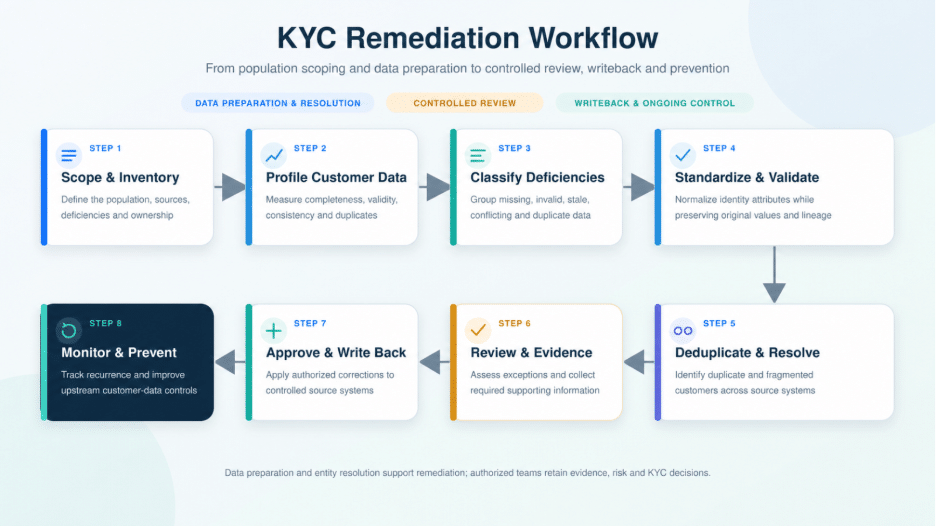
A KYC remediation process moves from defining the affected population to preparing customer data, resolving identities, completing required reviews and writing approved corrections back to controlled systems. The exact workflow depends on the institution’s policies, customer types, risk framework and identified deficiencies.
1. Define the Scope and Completion Criteria
Specify which customers, legal entities, business units, products or deficiencies are included. Define what constitutes a completed record, which decisions require approval and which systems will receive the corrected information.
2. Inventory the Source Systems
Identify where customer, account, relationship and review data is stored. Document source-system owners, record identifiers, available attributes and the system considered authoritative for each important value.
3. Profile the Customer Population
Use data profiling to measure missing values, invalid formats, duplicates, placeholder values and inconsistencies by source and customer segment. This establishes the baseline and quantifies the remediation population.
4. Classify the Deficiencies
Group records according to the issue requiring action, such as:
- Missing or invalid identity information
- Outdated customer details
- Duplicate or fragmented customer profiles
- Conflicting values across systems
- Missing organization or related-party relationships
- Records that require additional evidence or review
A record may belong to more than one deficiency group.
5. Standardize Comparable Attributes
Normalize names, addresses, dates, contact details, organization suffixes and identifiers into approved formats. Keep the original values and transformation history available for review.
6. Deduplicate and Resolve Customer Identities
Compare records within and across sources to identify duplicates and fragmented identities. Entity resolution for KYC and customer due diligence can connect approved records into a unified customer or organization profile while retaining source lineage.
Replace the placeholder link after the entity-resolution article is published.
7. Prioritize the Review Population
Apply institution-approved prioritization criteria using customer risk, data severity, affected products, review deadlines and operational dependencies. Data-quality indicators can support prioritization, but they should not independently determine customer risk.
8. Correct Data or Obtain Missing Evidence
Some deficiencies can be corrected using trusted information already held by the institution. Others may require customer outreach, documentary evidence, specialist review or another authorized process.
Automated cleansing should not invent values or treat inferred information as verified customer evidence.
9. Review and Approve the Remediated Record
Authorized reviewers should see the original values, proposed corrections, source evidence, resolved relationships and outstanding exceptions. The decision, reviewer, timestamp and rationale should be recorded.
10. Write Approved Changes Back to Source Systems
Apply approved corrections through a controlled process. Define which system receives the master value, how connected systems are updated and how rejected or unresolved changes are handled.
11. Validate the Results
Re-profile the remediated population and confirm that:
- Required deficiencies have been addressed
- Duplicate and fragmented records have been reduced
- Source lineage remains available
- Unresolved cases are clearly identified
- Downstream systems received the intended changes
12. Monitor for Recurrence
Establish validation rules, ownership and scheduled data-quality checks so the same problems are detected earlier. A remediation project should improve the ongoing customer-data process, not only clear a temporary backlog.
The Role of Entity Resolution in KYC Remediation
Entity resolution helps determine which records across the remediation population refer to the same customer, organization or related party. It can reduce duplicate review cases, combine identity evidence held in separate systems and provide reviewers with a more complete, traceable customer profile.
Identify Duplicate Customer Records
The same customer may have several profiles created through different products, branches or onboarding channels. Matching these records before review can prevent separate teams from remediating the same customer independently.
Reconstruct Fragmented Customer Profiles
One source may contain a verified identifier, another an updated address and a third the customer’s account relationships. Entity resolution connects this information without removing the original source records.
Separate Different Customers with Similar Details
Remediation must also prevent incorrect consolidation. Common names, shared addresses and similar organization names can create plausible but false relationships. Multi-attribute matching and human review help keep distinct entities separate.
Connect Legal Entities and Related Parties
Organizations may be associated with directors, signatories, owners or other documented parties stored in different systems. Entity resolution can connect those records and relationships to the appropriate legal entity for review.
Consolidate Approved Records
After relationships have been reviewed, survivorship rules can determine which approved value should appear in the consolidated customer profile. The retained value should remain traceable to its source and review history.
Reduce Duplicated Outreach and Review
A resolved customer view helps teams identify which deficiencies belong to the same entity. This can reduce repeated requests for the same information and allow related corrections to be considered together.
Entity resolution does not determine whether the customer record is complete or whether the customer has passed KYC review. It organizes the identity evidence and relationships used by the authorized remediation process.
For the complete technical workflow, see Entity Resolution for KYC and Customer Due Diligence.
Human Review and Exception Management
KYC remediation requires human review when data is missing, conflicting, insufficiently supported or too ambiguous for an approved automated action. Reviewers should receive the underlying evidence and a clearly defined decision path rather than only a data-quality flag or match score.
What Reviewers Should See
Each remediation case should provide:
- The original source records and identifiers
- Standardized and proposed corrected values
- The deficiency or rule that created the case
- Available source evidence and its origin
- Duplicate or entity-match results
- Supporting and conflicting attributes
- Connected accounts, organizations and related parties
- Previous outreach, review and decision history
- Outstanding information or dependencies
Define Permitted Review Outcomes
Possible outcomes may include:
- Approve a supported data correction
- Confirm or reject a duplicate-record relationship
- Accept or reject a proposed consolidated value
- Request additional information or evidence
- Refer the case to another authorized team
- Mark the case as blocked by a defined dependency
- Return the record for additional data preparation
- Complete the data-remediation step while leaving the KYC decision pending
The available outcomes should reflect the reviewer’s role and authority.
Preserve the Decision Record
For each decision, retain the reviewer, date, affected fields or relationships, source evidence, outcome and rationale. If a proposed correction is rejected, preserve both the original proposal and the reason it was not applied.
Keep Exceptions Visible
A record should not appear complete merely because it has passed through the workflow. Missing evidence, unresolved conflicts, rejected matches and unavailable customer responses should remain visible with an assigned status and owner.
Separate Data Approval from KYC Approval
Approving a standardized value, duplicate merge or resolved entity relationship does not mean the customer has completed KYC review. The data-remediation decision and the customer-level KYC decision should remain separate, traceable events.
Apply Quality Assurance
A sample of completed and rejected cases should be reviewed to identify inconsistent decisions, unclear rules and recurring source-data problems. Findings can be used to improve reviewer guidance, matching thresholds and upstream data controls.
How to Measure KYC Remediation Progress
KYC remediation should be measured across population coverage, data-quality improvement, identity-resolution quality and operational progress. A single completion percentage can hide records that were processed but remain unresolved, blocked or incomplete.
| Metric | What it indicates |
| Population coverage | Percentage of the defined customer population successfully inventoried and assessed |
| Deficiency rate | Percentage of records containing each identified data problem |
| Required-field completeness | Change in the availability of attributes required for the remediation scope |
| Validity and standardization rate | Percentage of values meeting the approved format and validation rules |
| Duplicate-record rate | Change in the number of confirmed duplicate customer records |
| Fragmented-identity rate | Change in customers represented by unresolved records across systems |
| Match precision and recall | Quality of entity-resolution decisions against a labelled evaluation set |
| Human-review rate | Percentage of records or candidate relationships requiring manual assessment |
| Case completion rate | Percentage of cases meeting the institution’s documented completion criteria |
| Blocked-case rate | Percentage of cases awaiting evidence, outreach, system changes or another dependency |
| Rework rate | Percentage of completed cases returned because of errors or missing steps |
| Case age | Time records remain in each stage or exception queue |
| Source-system recurrence | Rate at which remediated deficiencies reappear in new or updated records |
Establish a Baseline Before Corrections
Profile and record the original population before transformations, merges or writebacks begin. Without a baseline, the institution cannot reliably show what changed or determine whether improvements resulted from remediation.
Measure Data and Workflow Separately
A customer record may be standardized and deduplicated while still awaiting evidence or KYC review. Conversely, a case may be marked complete even though the corrected values were not propagated to every relevant system.
Data-quality status, data-remediation status and customer-level KYC status should therefore be reported separately.
Validate Entity-Resolution Quality
Do not measure resolution only by the number of records merged. Evaluate confirmed relationships against representative labelled examples and track false matches and missed matches separately.
An aggressive configuration may reduce the apparent duplicate count by incorrectly combining different customers. A conservative configuration may leave genuine customer records fragmented.
Report Outstanding Exceptions
Management reporting should show completed, in-progress, blocked, rejected and unresolved cases. It should also identify recurring deficiencies by source system, customer segment and responsible owner.
A remediation project is successful when it improves both the existing customer population and the process that creates or updates customer data—not simply when the initial queue reaches zero.
How to Prevent KYC Data Problems from Returning
KYC remediation should address both the affected records and the processes that created the deficiencies. Without ongoing controls, duplicate profiles, incomplete fields and inconsistent values can re-enter the customer population soon after the project closes.
Validate Data at Entry
Apply field, format and dependency rules during onboarding and customer updates. Invalid dates, incomplete identifiers, placeholder values and missing required relationships should be identified before the record enters downstream systems.
Check for Existing Customers Before Creating Records
Compare new applicants with existing customer profiles using names and supporting identity attributes. Possible matches should be resolved or reviewed before another customer identifier is created.
Standardize Data Consistently
Use shared rules for names, addresses, telephone numbers, dates, organization suffixes and identifiers across source systems. Inconsistent transformations can recreate the same matching problems that remediation corrected.
Define Authoritative Sources and Survivorship Rules
Document which system or approved source should provide each retained customer attribute. When values conflict, controlled survivorship rules and review procedures should determine which value is used.
Propagate Approved Corrections
A correction made in one system should not leave connected records unchanged indefinitely. Define how approved updates move to downstream platforms and how failed writebacks or synchronization problems are detected.
Monitor Data-Quality Rules
Run scheduled profiling and validation checks for recurring deficiencies, including:
- Missing or invalid identity attributes
- New duplicate customer records
- Fragmented identities across systems
- Conflicting values between authoritative sources
- Orphaned accounts or related parties
- Changes that have not reached downstream systems
Assign Data Ownership
Every important customer-data domain should have an owner responsible for definitions, quality rules, exceptions and corrective action. Remediation findings should be assigned to the teams that can address the upstream source of the problem.
Version Matching and Validation Logic
Record changes to standardization rules, matching thresholds and data-quality checks. Test updated configurations against representative records before applying them to production data.
Track Recurrence by Source
Measure which systems, channels or processes continue to generate deficiencies after remediation. A falling backlog with a high recurrence rate indicates that records are being corrected without fixing the underlying process.
The goal is to move from periodic large-scale cleanup to controlled customer-data maintenance. Continuous profiling, validation and entity resolution can identify emerging problems before they become another remediation backlog.
How DataMatch Enterprise Supports KYC Remediation
DataMatch Enterprise helps data and operations teams profile, standardize, match, deduplicate and consolidate customer records used within a KYC remediation project. It prepares and resolves the institution’s customer data but does not perform document verification, customer outreach, risk assessment or compliance case management.
Profile the Remediation Population
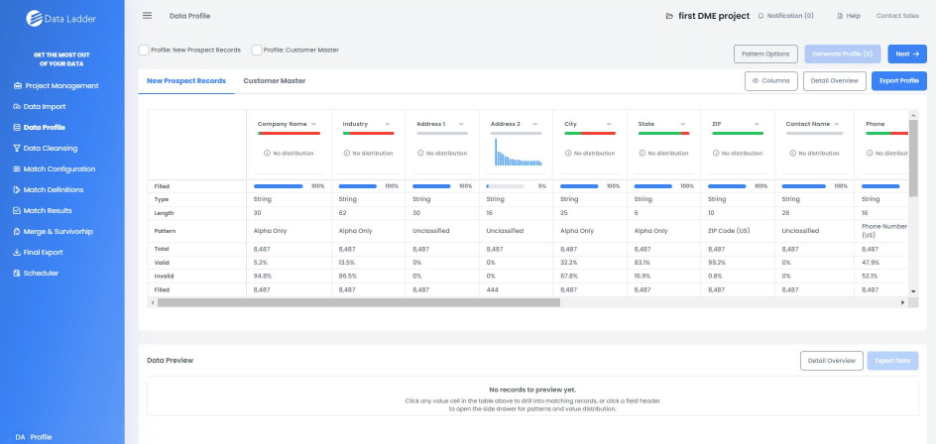
Teams can assess source datasets for missing values, invalid formats, uniqueness, duplicates and unusual patterns. Profiling results establish a baseline and help identify which records require correction, resolution or further review.
Standardize Identity Attributes
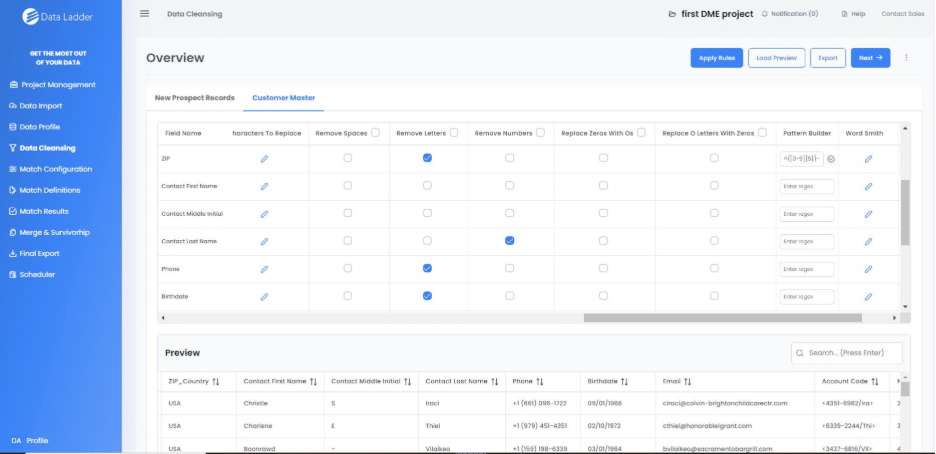
DataMatch Enterprise can parse, cleanse and normalize names, addresses, dates, telephone numbers, organization details and identifiers into comparable formats. Original values can remain available for lineage and review.
Match Records Across Systems
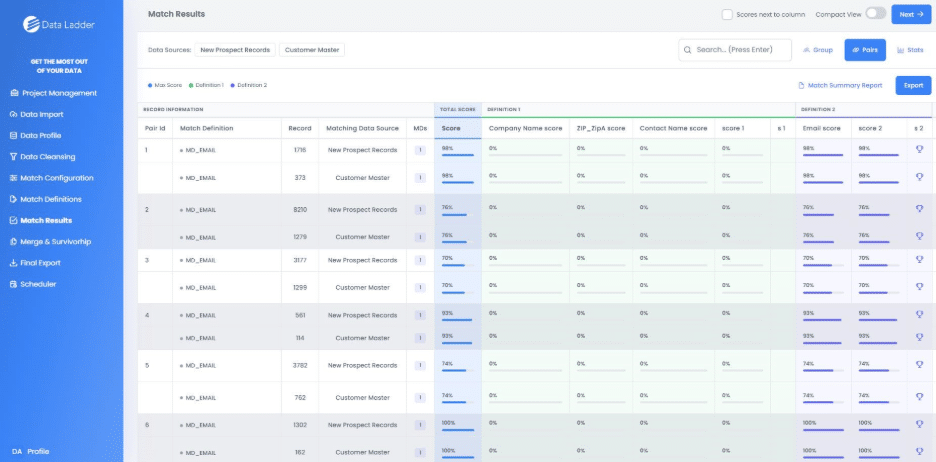
Users can combine exact, fuzzy, phonetic, numeric and other configurable methods across multiple fields. This helps identify customers or organizations represented differently in onboarding, CRM, account and legacy systems.
Detect Duplicates and Fragmented Identities
Records can be compared within one dataset or across several sources to identify possible duplicates and customer fragments. Match rules and thresholds can separate strong candidates from uncertain relationships requiring review.
Consolidate Approved Customer Records
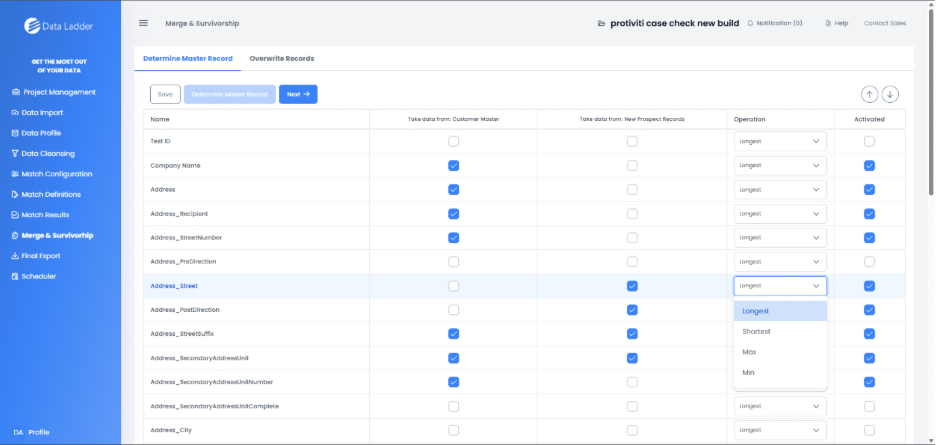
After relationships are approved, survivorship rules can determine which values should be retained in a consolidated customer profile. Source records and identifiers should remain traceable rather than being silently overwritten.
Examine Relationships with Entity Graphs
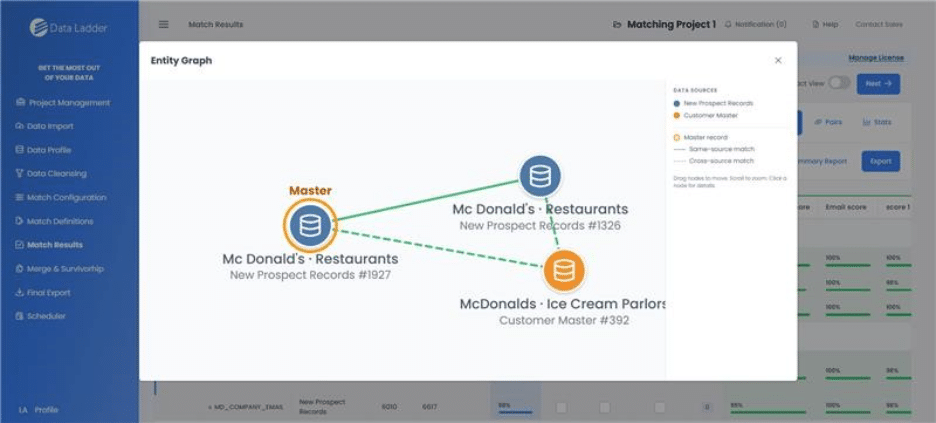
Entity Graphs can display customer, organization and related-party records as connected nodes. This helps users inspect documented relationships without merging separate parties into one entity.
Export and Integrate Remediation Results
The browser-based platform provides a visual interface for data preparation and matching. Its REST API supports repeatable workflows and integration with authorized downstream systems. Established Windows desktop and server deployments also remain available.
Deploy Within Enterprise Infrastructure
The web platform supports Docker-based Linux deployment across on-premises and cloud environments. Organizations can choose an architecture aligned with their infrastructure, security and governance requirements.
Data Ladder publishes the configuration and test conditions behind its 10-million-record benchmark so technical evaluators can review the reported processing results in context.
DataMatch Enterprise supports the data-preparation and entity-resolution stages of remediation. The institution remains responsible for defining the remediation population, collecting required evidence, conducting customer reviews and making KYC decisions.
KYC Remediation Implementation Checklist
Before beginning a KYC remediation project, confirm that the scope, customer population, data controls, review responsibilities and completion criteria have been documented.
Scope and Governance
- Define the customers, entities, business units and deficiencies included.
- Document why each population has been selected.
- Assign owners for data preparation, matching, review, approval and writeback.
- Separate data-remediation decisions from customer-level KYC decisions.
- Establish escalation and exception-handling procedures.
Data Inventory and Baseline
- Identify every relevant onboarding, account, CRM and legacy source.
- Preserve source-system identifiers and original values.
- Define authoritative sources for important customer attributes.
- Profile completeness, validity, consistency and uniqueness.
- Record the baseline before corrections or merges begin.
Data Preparation
- Classify deficiencies by type and severity.
- Standardize names, addresses, dates, contact details and identifiers.
- Identify placeholder, invalid and unstructured values.
- Keep transformation history and original data available.
- Distinguish correctable values from information requiring new evidence.
Deduplication and Entity Resolution
- Compare records within and across source systems.
- Use multiple identity attributes rather than relying on names alone.
- Establish separate match, review and non-match thresholds.
- Test matching rules against representative labelled records.
- Preserve source lineage and support reversal of incorrect links.
Prioritization and Review
- Apply the institution’s approved customer-risk and urgency criteria.
- Track data-quality severity separately from customer risk.
- Route records into actionable review and exception queues.
- Provide reviewers with source evidence and proposed corrections.
- Record every approval, rejection, escalation and unresolved dependency.
Writeback and Validation
- Define how approved corrections reach authoritative and downstream systems.
- Monitor failed or incomplete updates.
- Re-profile the remediated population.
- Confirm that unresolved cases remain visible.
- Validate a sample of completed and rejected cases.
Ongoing Controls
- Apply validation rules when customer data enters or changes.
- Check for existing customers before creating new profiles.
- Monitor duplicate creation and identity fragmentation.
- Track recurring deficiencies by source system and owner.
- Version matching, standardization and validation configurations.
- Define how often customer-data quality will be reassessed.
A project should not be considered complete solely because every record has passed through the workflow. Completion should mean the documented deficiency was resolved, appropriately escalated or retained as a visible exception under the institution’s procedures.
Prepare and Resolve Customer Data Before KYC Review
A KYC remediation project is easier to control when the customer population has been profiled, standardized, deduplicated and resolved before reviewers begin working through individual cases. This preparation reveals missing information, reduces duplicated effort and gives reviewers a more complete view of the records and relationships already held by the institution.
DataMatch Enterprise supports the data stage of remediation through profiling, cleansing, configurable matching, deduplication, entity resolution, survivorship and integration through a REST API. It helps prepare and organize customer records while preserving the evidence and source lineage needed for review.
The institution’s authorized teams remain responsible for defining the remediation scope, collecting required evidence, contacting customers, assessing risk and approving KYC outcomes.
Request a DataMatch Enterprise demo to evaluate the platform using a representative sample of your customer records, data deficiencies and entity-resolution requirements.
Frequently Asked Questions About KYC Remediation
What is the difference between KYC remediation and periodic review?
KYC remediation addresses identified deficiencies across an existing customer population. Periodic review reassesses individual customers at defined or risk-based intervals. A remediation project may include overdue reviews, but the two activities are not interchangeable.
What customer data should be assessed before KYC remediation?
The assessment may include names, addresses, dates of birth, contact details, identity or registration numbers, customer identifiers, entity classifications and documented related parties. The exact attributes depend on the institution’s remediation scope and customer types.
Should customer records be deduplicated before remediation?
Duplicate and fragmented records should be identified early so teams understand the actual customer population. Approved duplicates can be grouped or consolidated, while uncertain relationships should be reviewed before records are merged or cases are closed.
Can KYC remediation be fully automated?
Data profiling, standardization, validation, matching and case preparation can be automated to an extent. Missing evidence, conflicting information, uncertain entity relationships and customer-level decisions generally require controlled review under the institution’s procedures.
How should KYC remediation success be measured?
Measure population coverage, deficiency reduction, data completeness, duplicate and fragmentation rates, entity-resolution quality, review volume, blocked cases, rework and recurrence. Report data-remediation status separately from customer-level KYC status.
Is DataMatch Enterprise a KYC remediation platform?
DataMatch Enterprise supports the data-preparation and entity-resolution stages of remediation. It profiles, cleanses, standardizes, matches, deduplicates and consolidates customer records. It does not perform identity verification, customer outreach, risk assessment or compliance case management.