




































Last Updated on October 22, 2026
Every KYC check runs on customer records the institution already holds, so screening engines, risk models, and monitoring rules can only be as accurate as the data they receive. When one customer exists as three records with different spellings and a missing date of birth, each check can work exactly as designed and the program still reaches the wrong conclusion about who that customer is.
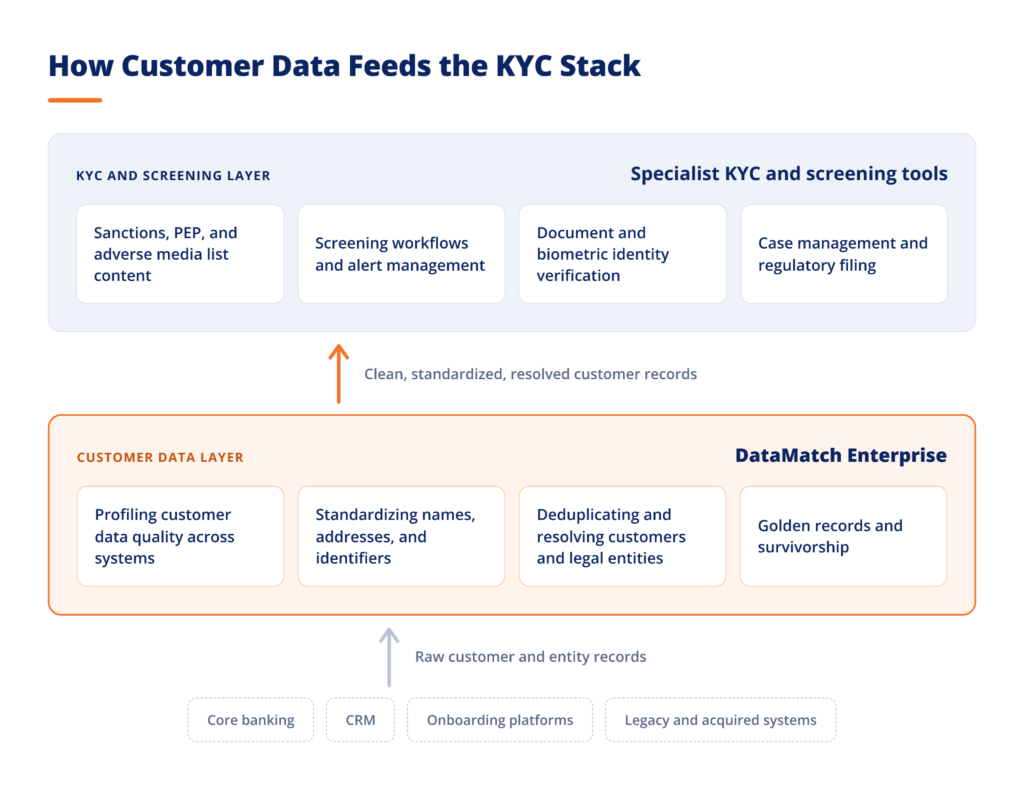
KYC budgets and attention tend to go into the checks themselves, such as identity verification, screening platforms, alert tuning, and case management. Far less goes into the customer data underneath them, which sits across core banking systems, CRMs, onboarding platforms, and databases inherited through acquisitions. That data belongs to data and IT teams as much as to compliance, and it is where customer data quality and KYC is won or lost.
This guide covers what KYC needs from customer records, where poor data quality breaks each stage of the process, and what fixing it involves in practice. It also covers where a data quality platform fits in a KYC program and where specialist screening and verification tools take over.
What KYC Data Quality Means in Practice
KYC data quality is the degree to which an institution’s customer records are complete, standardized, current, and resolved to one identity per real customer, so that identity verification, due diligence, screening, and monitoring all work from an accurate picture of each customer. It applies to individuals, legal entities, and the owners, signatories, and related parties attached to them.
Regulators rarely define these requirements field by field. FinCEN’s Customer Due Diligence Rule does not mandate a fixed set of customer information beyond what is needed to build a risk profile, conduct monitoring, and collect beneficial ownership details. Each institution decides what it collects, which means each institution also owns the condition of what it collects.
In practice, the same handful of attributes carries almost every KYC process, and each has to be held in a form that matching logic can compare, which is a higher bar than a form a person can read. A full name stored in one free-text field gives the logic no way to weight surname and given name differently, and dates of birth in mixed formats or addresses held as unstructured text weaken every comparison they feed in the same way.
The last row is the requirement that unfortunately gets checked least. Each real customer should resolve to one identity across every system holding their data, with accounts, products, and related parties linked to it. Without that, an institution can verify, screen, and rate every individual record correctly and still never see the customer as a whole.
What Fixing KYC Data Quality Involves
The work follows a consistent sequence whether the trigger is a remediation program, a screening optimization project, or a core system migration. Each step depends on the one before it, and skipping ahead to matching before the data is profiled and standardized is the most common reason entity resolution projects underdeliver.
- Profile the data across source systems. Measure completeness, format consistency, value distributions, and placeholder values field by field and system by system. This sets a baseline and shows where effort will have the most effect.
- Standardize and parse. Split names into components, move titles and legal suffixes into their own fields, normalize date formats, structure addresses, and apply consistent legal entity designators. Matching accuracy depends heavily on this step.
- Match and resolve entities. Compare records within and across sources using a combination of fuzzy, phonetic, and numeric matching on several attributes at once, then route borderline pairs to human review. The output is a set of clusters, each representing one real customer or entity.
- Apply survivorship rules and build golden records. Decide which source wins for each attribute, such as the most recent verified address or the identifier from the system of record, and keep links back to every contributing source record for audit.
- Measure match accuracy. Test results against a labeled sample, tracking false merges and missed matches separately, and document the thresholds chosen and the reasoning behind them.
The last step is the one most often skipped, and in KYC it carries the most weight because both kinds of error are costly. A false merge folds two different people’s histories into one risk profile and can be harder to detect and unwind than a duplicate, while a missed match leaves a customer fragmented across the risk rating, screening, and reporting processes covered above.
KYC checks inherit the quality of the customer data they run on. Profiling, standardizing, and resolving customer records before they reach risk rating, screening, or remediation improves every stage at once, and it is work the institution controls entirely.
Where Poor Data Quality Breaks Each Stage of KYC
KYC is usually described as a sequence of onboarding, due diligence, screening, monitoring, and periodic refresh. Data quality problems tend to enter at one stage and surface at another, so a duplicate created at onboarding can reappear as a fragmented risk profile, a noisy screening alert, and an extra remediation file before anyone traces it back to its source.
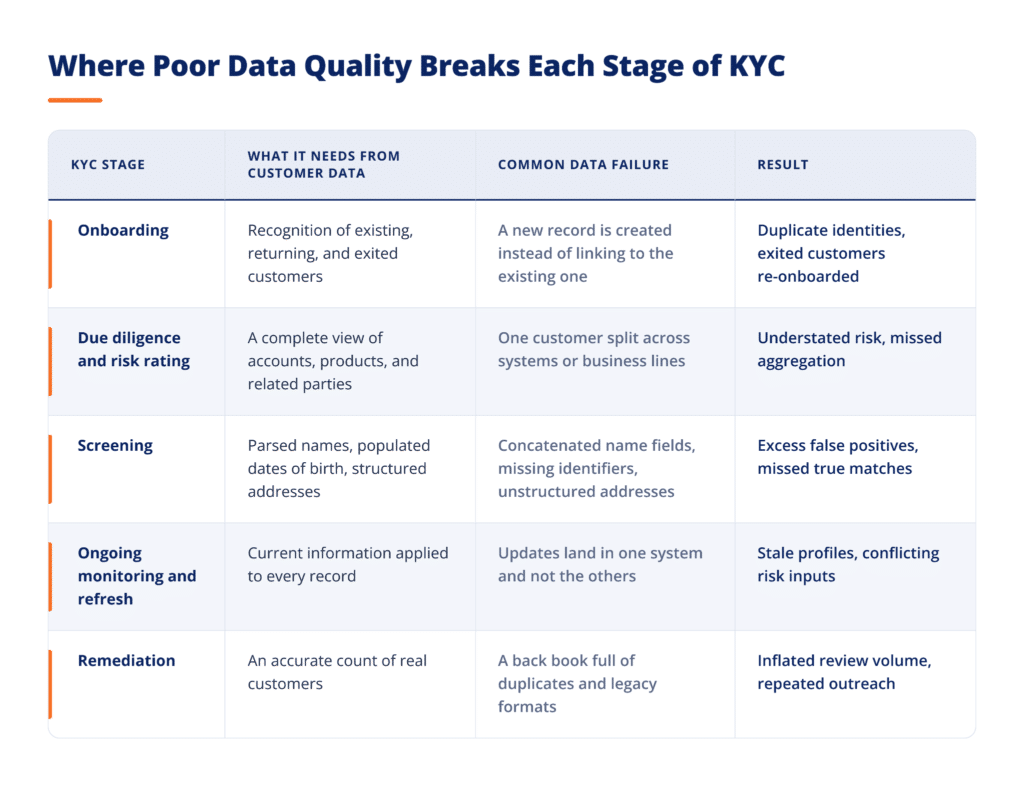
The sections below take each stage in turn, starting where most of these problems originate.
Onboarding and Identity Verification
Onboarding is a common source of duplicate customer records, often because the onboarding system has no reliable way to recognize an existing customer arriving through a different channel. A mortgage customer who applies for a credit card online with a shortened name and a newer address will often end up with a second identity that nothing in the onboarding flow flags.
Identity verification tools answer a different question, confirming through documents, biometrics, or third-party data that an applicant is who they claim to be. They are generally not designed to check whether that person already exists in the institution’s own systems under a previous address, a maiden name, or as a signatory on a business account.
If the onboarding check relies on exact matches against internal records, a former customer offboarded for risk reasons can return through a new channel with small variations in their details and pass unrecognized. A duplicate check that applies fuzzy, phonetic, and identifier matching against the existing customer base before the account opens closes most of that gap.
Customer Due Diligence and Risk Rating
FinCEN’s CDD Rule requires institutions to understand the nature and purpose of customer relationships in order to develop a customer risk profile, and to conduct ongoing monitoring against it. A risk profile can only be as complete as the set of records it draws from.
Fragmentation across business lines is where risk profiles most often fall short. When a customer’s retail account, sole proprietor business account, and investment relationship sit in three separate systems, each may be scored as low risk while the combined activity and exposure would justify enhanced due diligence, and no single system holds the view that would prompt anyone to look.
Transaction reporting depends on the same capability. Under 31 CFR 1010.313, financial institutions must treat multiple currency transactions as one when they know the transactions are by or on behalf of the same person and total more than $10,000 in a business day. Knowing that two transactions belong to one person is an entity resolution question before it becomes a reporting one. Over-linking carries its own risk, since FinCEN’s guidance on common ownership presumes separately incorporated businesses are independent persons even when one person owns them.
Sanctions and PEP Screening
Screening is the stage where data quality problems are easiest to see, because they show up as alert volume. A 2024 study in Frontiers in Artificial Intelligence notes that false positives make up over 90% of screening alerts, and each one takes analyst time to clear.
The screening engine and the sanctions, PEP, and adverse media lists it checks against come from specialist providers. The institution supplies the other half of every comparison, which is its customer and counterparty data.
The Wolfsberg Group’s Guidance on Sanctions Screening states that screening depends on the type, availability, completeness, and quality of that data. For institutions regulated by the New York State Department of Financial Services, NYDFS Part 504 goes further and requires validation of the integrity, accuracy, and quality of data flowing through filtering programs, along with extraction and loading processes that move it completely and accurately from source systems.
Names held in a single field stop the engine from weighting surname and given name separately, and a missing date of birth removes the attribute an analyst would normally use to discount a common name, so both leave more alerts to be worked manually. Names truncated by legacy field limits or stored in transposed order cause the opposite problem by pushing genuine matches below threshold, while titles and legal suffixes left inside name fields add noise to every comparison. Researchers at the Federal Reserve note that even fuzzy logic remains vulnerable to noisy string representations.
Cleaner inputs don’t replace threshold tuning or a better matching engine. They make every tuning decision more reliable, because the team is calibrating against accurate data instead of setting thresholds to compensate for bad data.
Ongoing Monitoring and KYC Refresh
FinCEN’s 2020 CDD guidance clarifies that institutions are not required to update customer information on a fixed schedule. They must update it when normal monitoring reveals a change relevant to the customer’s risk, and may need to reassess the risk profile as a result.
That obligation assumes the update reaches every record the customer has, which rarely happens in a fragmented environment. A new address captured at a branch can update the core banking record while the CRM, card platform, and screening database keep the old one, leaving the institution with conflicting risk inputs and no clear way to tell which version is correct.
Event-driven and perpetual KYC models make this more pressing. A trigger on one account has to reach every account and relationship the customer holds, which depends on reliable links between those records. Without a resolved identity, perpetual KYC refreshes individual records on schedule while the customer they belong to stays fragmented.
Remediation of Existing Customer Records
Remediation programs usually follow a regulatory finding, a policy change, an acquisition, or a core system migration, and they require reviewing the existing customer base against current standards. They are among the most expensive projects a KYC function runs, and much of the cost scales directly with the number of files under review.
The first question is how many customers there actually are, since back books built over decades carry duplicates from channel silos, merged institutions, and earlier migrations, along with legacy formats and placeholder values. Every duplicate that reaches the review queue becomes a file an analyst opens, assesses, and may request documents for, sometimes more than once for the same person.
Deduplicating and standardizing before outreach begins reduces the review population, groups related records so reviewers see each relationship once, and identifies which records lack the data the review will require. Profiling at this stage also gives program leads an evidence base for planning, including completeness rates by field, the scale of duplication, and which source systems contribute most of the problems.
Where DataMatch Enterprise Fits in a KYC Program
DataMatch Enterprise works on the institution’s own data. It profiles, cleanses, standardizes, matches, and deduplicates customer and entity records drawn from core banking, CRM, onboarding, and legacy systems, then builds golden records using configurable survivorship rules. It does not supply sanctions, PEP, or adverse media data, and it does not replace a screening platform, an identity verification provider, or case management.
Within that scope, remediation teams can deduplicate and standardize the back book before reviews begin, and data teams can prepare and validate customer files before they are loaded into a screening engine or resolve customers across business lines so risk rating and aggregation work from one identity.
The REST API and live search, at around 200 records per second, extend the same matching logic to onboarding checks against the existing customer base, while entity graphs show how resolved customers, accounts, and related parties connect.
Across 15 comparative studies, DME found 5 to 12% more matches than other enterprise data quality platforms, with 99% matching accuracy. In a KYC context, each additional correct match is a customer whose records are reviewed, rated, screened, and monitored as one, and each avoided false merge is a risk profile that stays accurate.
Getting Customer Data Ready Before the Next Review
KYC programs tend to judge themselves by their checks, through alert volumes, review backlogs, and refresh completion rates. Those numbers reflect KYC data quality as much as the tools that produce them, and improving the data often moves them further than replacing a tool would.
The starting point is the records the institution already holds. Profile them, standardize them, resolve each customer to a single identity, and measure how accurate that resolution is. Every stage covered above benefits, and the evidence produced along the way answers the question examiners increasingly ask, which is how the institution knows its data is complete and accurate.
If you are planning a remediation, a screening optimization, or a migration that touches customer data, you can try DataMatch Enterprise free on your own records, with no credit card required, and see what profiling and matching reveal before the review begins. To see how other teams have approached similar projects, browse Data Ladder’s customer stories.
Frequently Asked Questions
These answers cover the questions data and compliance teams raise most often when customer data quality comes up in a KYC context.
How does customer data quality affect sanctions screening false positives?
Screening engines compare customer data against list entries, so the structure of that data shapes the result. Names stored in a single field, missing dates of birth, and unstructured addresses remove the attributes needed to rule out a common name, which produces more alerts for analysts to clear. Poor data can also push genuine matches below threshold.
What is the difference between KYC data quality and identity verification?
Identity verification confirms that an applicant is who they claim to be, usually through documents, biometrics, or third-party data. KYC data quality concerns whether the institution’s own records are complete, standardized, and resolved to one identity per customer after that point, so every later check works from an accurate customer view.
Why is entity resolution important for KYC?
Entity resolution links every record belonging to the same customer or legal entity across systems and business lines. KYC relies on that link to build accurate risk profiles, aggregate transactions for reporting, apply updates consistently, and recognize existing or exited customers at onboarding. Without it, each record is assessed in isolation from the rest of the relationship.
What should be done to customer data before a KYC remediation project?
Profile the customer base to measure completeness and duplication, standardize names, addresses, and identifiers, and deduplicate records so each customer appears once in the review population. This reduces review volume, groups related records for reviewers, and flags files missing the information the review will need before outreach starts.
Can a data quality platform replace a KYC or screening platform?
No. A data quality platform prepares and resolves the institution’s own customer records, while KYC and screening platforms supply watchlist and PEP data, run screening workflows, verify identities, and manage cases. The two work together, with data quality improving the inputs that screening, risk rating, and monitoring depend on.