































Enterprise Entity Resolution That Scales with You

Unify fragmented records into trusted entities across unlimited sources. 96% resolution accuracy, 15-minute setup, and results in seconds, not months.

Certified for security, quality, compliance and code integrity.

Process

How does entity resolution work?

Ingestion

Bring data together at one place, since it is scattered across disparate sources, and resolve any conflicting changes in database schemas to allow further processing.

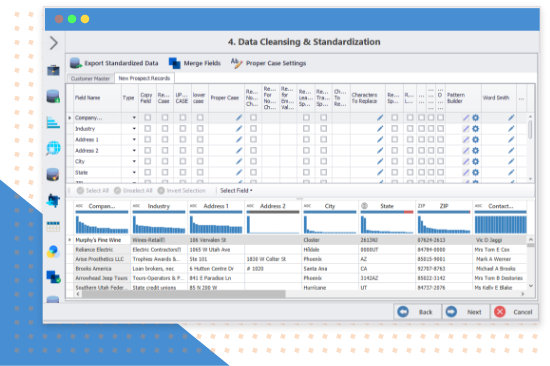
Data standardization

Fix data standardization issues highlighted in the previous step, including filling in empty data, replacing inaccurate or invalid information, standardizing values against defined patterns and formats, etc.


Survivorship & Publishing

Merge information from duplicate records with the help of canonical rules, so that maximum information is combined into one golden record which represents the completeness of that entity.

Data discovery

Discover and highlight any statistical anomalies that may be present in the form of missing, incomplete or invalid data values.

Entity record linking

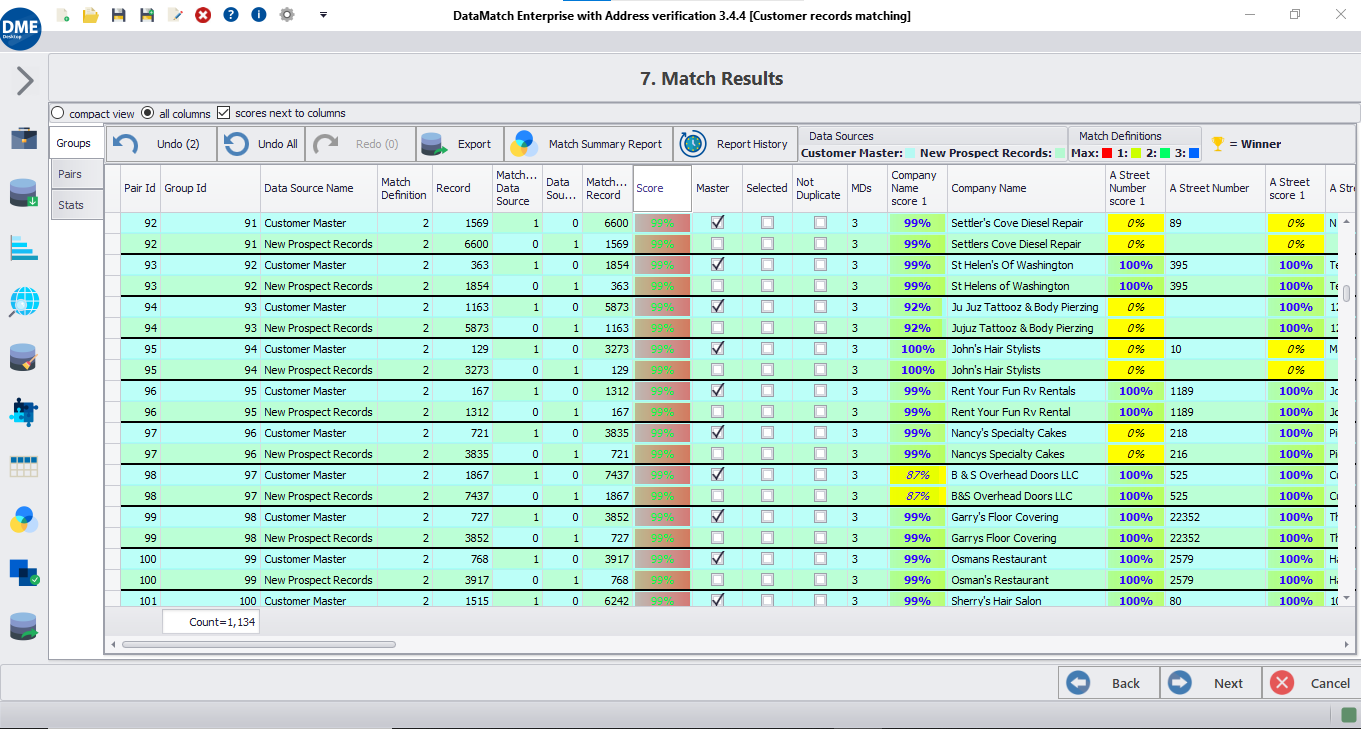
Match records within and across databases and identify potential records that relate to the same entity. Datasets usually lack standardized uniquely identifying attributes, and so a combination of intelligent fuzzy matching algorithms may be needed to increase accuracy.

Canonicalization

Merge information from duplicate records with the help of canonical rules, so that maximum information is combined into one golden record which represents the completeness of that entity.

Solution

Let Data Ladder handle your entity resolution process

See DataMatch Enterprise at work

DataMatch Enterprise is a highly visual and intuitive data scrubbing software that has the suite of features to inspect, reconcile, and remove data errors at scale in an intuitive and affordable manner.

DataMatch leverages a plethora of industry-standard and proprietary algorithms to detect phonetic, fuzzy, mis-keyed, and abbreviated variations. The suite allows you to build scalable configurations for data standardization, deduplication, record linkage, enhancement, and enrichment across datasets from multiple and disparate sources, such as Excel, text files, SQL and Hadoop-based repositories, and APIs.

Business benefits

How can entity resolution benefit you?

Customer identity resolution

Reconcile conflicting identities by creating unified customer profiles to confidently track customers across omni-channel interactions.

Enhanced Patient matching

Ensure efficient and timely healthcare diagnosis and treatment by matching patient IDs correctly with EHR records.

Fraud prevention

Detect fraudulent activities such as overdue payments or multiple claims within or across several datasets with unique identifiers.

Lower customer acquisition costs

Remove duplicates from contact lists, CRMs, and databases to avoid marketing expenditure on erroneous and redundant leads.

Regulatory compliance

Accurately match datasets against watchlists to comply with federal including OFAC, KYC, AML, and much more.

Lower time-to-insight

Improve time-to-insight from weeks to hours by saving hundreds of man-hours and complete projects weeks ahead of deadlines.

User roles

A tool made for everyone

Data analysts

Business users

IT Professionals

Novice users

Let’s compare

How accurate is our solution?

10% chance of losing key personnel; over 5 years, half of the implementations lose the core member who ran and understood the matching program.

Detailed tests were completed on 15 different product comparisons with university, government, and private companies (80K to 8M records), and these results were found: (Note: this includes the effect of false positives)

Features of the solutionData LadderIBM Quality StageSAS DatafluxIn-House SolutionsComments
Match Accuracy (Between 40K to 8M record samples)96%91%84%65-85%Multi-threaded, in-memory, no-SQL processing to optimize for speed and accuracy. Speed is important, because the more match iterations you can run, the more accurate your results will be.
Software SpeedVery FastFastFastSlowA metric for ease of use. Here speed indicates time to first result, not necessary full cleansing.
Time to First Result15 Minutes2 Months+2 Months+3 Months+
Purchasing/Licensing Costing80 to 95% Below Competition$370K+$220K+$250K+Includes base license costs.

Customer Stories

See what our customers say...

Frequently asked questions

Got more questions? Check this out

Simply put, an entity is a single unique object that exists in the real word. Usually, in the realm of data management, the word entity is normally used to describe an individual, customer, employee, product, organization, etc.

Entity resolution is a core data quality process used to identify records that refer to the same entity within or across data sources. This could be done for deduplication and cleansing purposes, or to enrich and create golden records that absorb entity fragments across your business and create a unified entity profile.

As data grows exponentially, a large-scale entity resolution process is required that can: span across multiple sources, work with millions of entities at a time, incorporate differences of data formats and standards, as well as cluster and merge information to prevent data loss.

Data matching is the process of comparing records to determine whether they refer to the same thing (a person, company, product, or location). Entity resolution is the broader workflow that uses data matching plus standardization, scoring, review, and consolidation to create a trusted, unified view of that entity across datasets. Identity resolution is a specific type of entity resolution focused on people or customers—connecting identities across systems, channels, and identifiers to build a single customer view.

Data Ladder reduces false positives by combining data standardization with configurable match rules and match scoring, so records aren’t merged based on a single weak signal. Teams can weight stronger identifiers more heavily (like emails or phone numbers when available), use multi-field logic (name + address + phone), and define thresholds to separate clear matches from “possible matches” that require review. This approach helps maximize true matches while minimizing incorrect merges.

DataMatch Enterprise supports multiple matching approaches depending on data quality and use case. Deterministic matching uses exact rules (for example, a consistent ID or email match). Fuzzy matching compares similarity for fields like names and addresses to handle typos and variations. Probabilistic-style scoring combines multiple attributes into an overall confidence score so records can be matched even when no single identifier is perfectly reliable. These methods can be used together to improve accuracy across real-world datasets.

When multiple records represent the same entity, survivorship rules determine which values become the “best version” in the golden record. For example, you can prioritize a trusted source system, prefer the most recent value, keep the most complete field, or select a standardized format. Survivorship ensures the golden record is not just a merge—it’s a controlled, consistent representation of the entity that supports downstream systems, analytics, and operations.

Accordion ContentYes. Data Ladder can resolve entities across multiple systems by ingesting records from different sources, standardizing key fields, and applying matching logic to identify which records represent the same real-world entity. This supports common enterprise scenarios such as unifying customer data across CRM and billing systems, consolidating vendor records across ERP instances, or deduplicating and resolving entities before data is published to a warehouse for analytics.

ready? let's go

Try now or get a demo with an expert!

"*" indicates required fields

Choice*
Hidden
Hidden
Hidden
Hidden
Hidden
Hidden
This field is for validation purposes and should be left unchanged.