



































If you’re searching for a Precisely alternative or evaluating data matching software, the right choice depends on whether you need a broad data integrity ecosystem or a focused platform for fast, configurable data matching and entity resolution.
Data quality issues – including duplicate CRM records, conflicting ERP data, and inconsistent customer information—can disrupt operations, weaken analytics, and increase costs. Both Precisely and Data Ladder address these problems, but with different product scopes.
Precisely offers a broad enterprise portfolio spanning data quality, governance, integration, observability, enrichment, and location intelligence. DataMatch Enterprise (DME), by comparison, is purpose-built for profiling, cleansing, standardization, matching, deduplication, entity resolution, survivorship, and golden-record creation.
DME stands out when speed, control, and explainability are central requirements. Through its no-code interface, users can create and adjust matching logic, assign field weights, fine-tune thresholds, preview results in real time, and review potential matches without writing code or waiting for development changes.
Organizations can use DME’s established Windows desktop and server products or its browser-based, API-first platform with REST APIs, Entity Graphs, Live Search, and Docker-based Linux deployment across on-premises and cloud environments.
If you’re weighing your options—or looking for a Precisely replacement that delivers more controllable data matching and explainable results—this comparison will help determine which platform better fits your technical environment, users, and data quality goals.
When Precisely brands itself as a data-quality powerhouse, it isn’t exaggerating. With tools like Precisely Spectrum Quality and Precisely Trillium Quality, it serves global enterprises with powerful matching logic, scalable infrastructure, and governance frameworks.
But here’s the nuance: power doesn’t always mean full clarity.
Precisely’s logic often operates deeper within configuration files and dispersed workflows – visible to technical users, but sometimes less transparent for business users.
That’s where Data Ladder stands apart.
Rather than burying match logic behind service layers or toolchains, Data Ladder puts explainable matching front and center. With DataMatch Enterprise (DME), you can see why a record matched, adjust logic on the fly, preview results in real time, and fine-tune thresholds – all without code and without delay.
Precisely offers deep governance. Data Ladder delivers explainable, real-time matching that works with your existing stack and puts control in the hands of users (both technical and business users).
This post breaks down how Precisely and Data Ladder compare in real-world execution, not just features, so you can make the right call for your data quality goals.
If you’re weighing your options (or looking for a Precisely replacement for faster data matching with more accurate, explainable results), you’ll leave with a clear understanding of why Data Ladder is often a strong choice when clarity, precision, and time matter most.
Data Ladder vs. Precisely: Feature Comparison
Data Ladder vs. Precisely: What Both Tools Offer – Feature Comparison at a Glance
| Category | Precisely | Data Ladder |
| Primary Purpose/Typical Use Cases | Data governance, validation and standardization; customer 360; address verification with geocoding; and data quality support in SAP/ERP environments. | Fast, accurate, explainable data matching, profiling, deduplication; creating golden records. Supports address verification as an optional add-on (U.S. & Canada). |
| Deployment Fit | Cloud, on-prem; batch or real-time workflows; high governance; wide ecosystem connectors. | Standalone deployment; cloud, on-prem, hybrid; integrates with any stack. |
| Customization | Rule-based standardization, ML match key generation. | Visual rule builder, weight tuning, immediate previews. |
| Match Transparency | AI/ML recommendations with variable explainability. | 100% visual, previewable, explainable. |
| Intended Users | IT/data teams, data stewards, regulated environments. | Business users, analysts, technical teams. |
| Best Fit For | Global ERP/CRM transformations, governed workflows, metadata policies. | Teams needing explainable, precise business-ready matching fast. |
| Cost | Modular subscription with a required Foundation license and optional services; quote-based. | Quote-based license by edition (core, API, or Address Verification) and deployment |
Precisely vs. Data Ladder – Where the Real Differences Start to Show
1. Matching Control and Result Visibility
Precisely provides configurable matching through its Data Integrity Suite, Spectrum Quality, and Trillium Quality products. Depending on the selected product, capabilities include AI-powered recommendations, configurable match rules, and fuzzy matching. However, the configuration experience can vary across Precisely’s broader product portfolio.
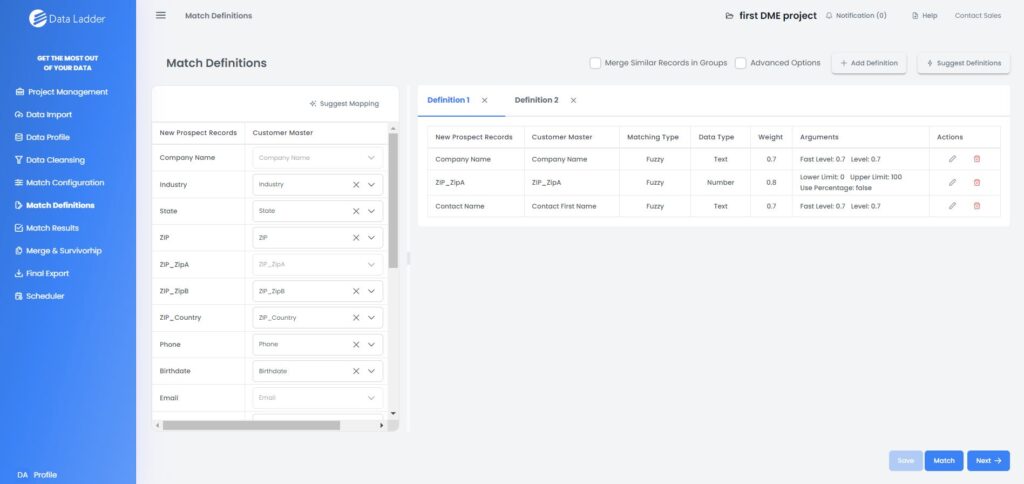
DataMatch Enterprise centralizes matching configuration and review within one no-code workflow. Users can:
- Select exact, fuzzy, phonetic, probabilistic, numeric, and domain-specific algorithms.
- Build multi-field match rules and assign field-level weights.
- Fine-tune acceptance and rejection thresholds.
- Preview results immediately and review potential matches.
- Trace results back to the rules, algorithms, scores, and thresholds used.
This direct control allows analysts and data stewards to test and refine matching logic without writing code or waiting for development changes.
1. Integration and Deployment Flexibility
Precisely supports cloud, on-premises, and hybrid data-quality workflows. Its Data Integrity Suite allows teams to design rules in the cloud and execute them where the data resides, while Spectrum and Trillium products provide additional APIs and enterprise connectors. Deployment requirements vary according to the selected products and services.
DataMatch Enterprise can operate as a standalone solution or integrate with existing applications and pipelines. Its deployment options include Windows desktop and server products; Docker-based Linux deployment across on-premises and cloud environments. DataMatch Enterprise Server is available in both Docker and non-Docker builds.
The browser-based, API-first platform provides REST APIs and 150+ integrations for automated workflows. Entity Graphs support visual match investigation, while Live Search enables point-in-time record searches without requiring a full batch job.
2. Usability and Control
Precisely’s configuration experience differs across Data Integrity Suite, Spectrum Quality, and Trillium Quality, which provide different interfaces and workflows across Precisely’s broader portfolio.
DataMatch Enterprise provides a focused, no-code workflow for importing, profiling, cleansing, matching, reviewing, and exporting data. Analysts and data stewards can build match rules, adjust weights and thresholds, test configurations, and preview results without writing code. Developers can use the same capabilities through REST APIs.
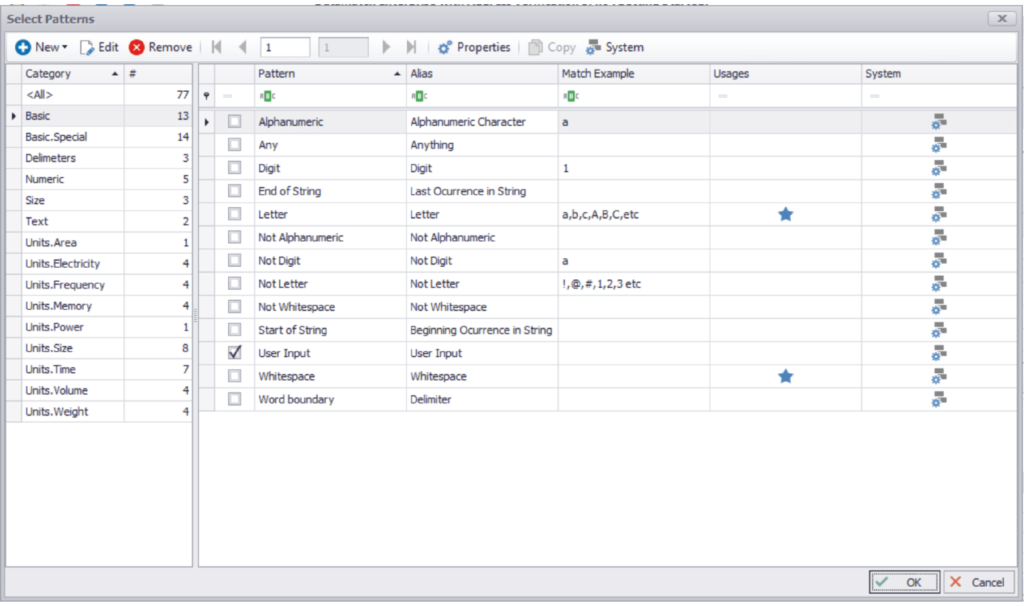
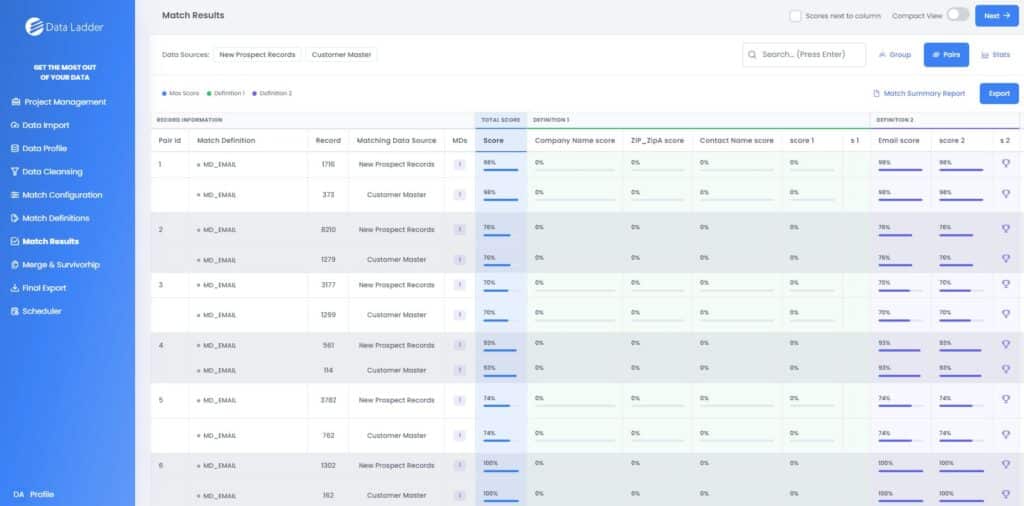
This combination reduces dependence on development teams while allowing technical and business users to collaborate on the same matching process. It is especially useful for organizations seeking to decentralize data stewardship without giving up control over match logic.
3. Pricing and Total Cost
Precisely does not publish prices for its enterprise products. The Data Integrity Suite is sold as modular subscriptions: a Foundation license is required for every Suite service, and customers add the services they need, such as data quality, governance, or enrichment. Some components scale with usage, and Data Observability is priced as a percentage of the customer’s other Suite spend. Through AWS Marketplace, Foundation is offered with a minimum annual commitment. Final pricing depends on the services selected, data volumes, deployment model, support, and implementation requirements.
Data Ladder licenses DataMatch Enterprise by edition and deployment, with pricing provided by quote. API access and U.S./Canadian address verification are available as separate editions. When matching and deduplication are the primary requirements, its focused product scope may reduce the need to purchase and implement broader governance, enrichment, or location-intelligence services.
Buyers should compare vendor quotes using the same workload and include software licensing, implementation, integrations, infrastructure, training, administration, and ongoing support in the total-cost calculation.
Data Ladder vs. Precisely: Which Platform Should You Choose?
Precisely may be a stronger fit when you need:
- An enterprise-wide data integrity, governance, and observability ecosystem.
- Global address validation, geocoding, and location intelligence.
- Data enrichment and governance capabilities extending beyond matching.
- A platform supporting broad, multi-team data-management programs.
Choose DataMatch Enterprise when you need:
- Fast, configurable data matching, deduplication, and entity resolution.
- A no-code interface for adjusting rules, weights, and thresholds.
- Profiling, cleansing, matching, clerical review, survivorship, and golden records in one workflow.
- Windows desktop and server products or Docker-based Linux deployment across on-premises and cloud environments.
- REST APIs for integrating matching into existing applications and pipelines.
Consider using both when:
- Precisely supports enterprise governance, enrichment, or location intelligence.
- DME handles focused matching, deduplication, migration cleanup, or data-remediation projects.
The best choice should be determined using representative data and measurable criteria such as match quality, false positives, false negatives, configuration effort, processing time, and total cost.
Use Case Snapshot
| Use case | Likely fit | Why |
|---|---|---|
| Enterprise-wide data governance and observability | Precisely | Broader data integrity and governance ecosystem |
| Global address validation and geospatial enrichment | Precisely | Extensive international location-intelligence capabilities |
| Focused data matching and deduplication | DataMatch Enterprise | Configurable matching within a focused no-code platform |
| Business-user match-rule configuration | DataMatch Enterprise | Visual rules, weights, thresholds, and result previews |
| Profiling, cleansing, matching, and merge-purge | DataMatch Enterprise | Connected workflow with survivorship and golden records |
| CRM, ERP, or migration cleanup | DataMatch Enterprise | Focused profiling, standardization, and duplicate resolution |
| Embedded or automated matching workflows | DataMatch Enterprise | REST APIs, server automation, and flexible deployment |
| Enterprise governance plus specialized matching | Both | Precisely can support governance while DME handles focused matching projects |
These are likely fits rather than absolute recommendations. Organizations should validate both platforms against their own data, integration requirements, and operating model.
Compare Matching Results Using Your Own Data
Whether you’re evaluating Precisely alternatives or need a focused way to match and deduplicate your data, the most reliable comparison uses a representative dataset from your environment.
Test DataMatch Enterprise and evaluate match quality, false positives, false negatives, configuration effort, processing time, clerical-review requirements, and golden-record output.
Data Ladder has served more than 4,000 customers, including over 500 enterprise customers, across government, healthcare, financial services, education, retail, and other sectors.
Start a free DataMatch Enterprise trial or book a technical demonstration using your own matching requirements.
Frequently Asked Questions
What is the main difference between DataMatch Enterprise and Precisely?
Precisely provides a broad data integrity portfolio covering data quality, governance, observability, enrichment, integration, and location intelligence. DataMatch Enterprise is a focused platform for profiling, cleansing, matching, deduplication, entity resolution, survivorship, and golden-record creation.
Is DataMatch Enterprise a complete Precisely replacement?
DME can replace Precisely when the primary requirement is data quality, matching, deduplication, or entity resolution. It is not a like-for-like replacement when an organization depends on Precisely for enterprise governance, observability, global geospatial enrichment, or other broader services.
Which platform provides more control over matching logic?
Both platforms support configurable matching. DME gives users direct no-code control over algorithms, multi-field rules, weights, and thresholds, with immediate result previews. Precisely’s configuration experience varies across its Data Integrity Suite, Spectrum Quality, and Trillium Quality products.
Does DataMatch Enterprise require developers?
No. Analysts and data stewards can configure and review matching through its graphical interface. Developers can automate the same workflows through REST APIs and server-based integrations.
What deployment options does DataMatch Enterprise provide?
DME supports Windows desktop and server products; Docker-based Linux deployment across on-premises and cloud environments. DataMatch Enterprise Server is available in Docker and non-Docker builds.
How does Precisely pricing compare with Data Ladder pricing?
Precisely sells the Data Integrity Suite as modular subscriptions: a required Foundation license, the services selected, and some usage-based components, all priced by quote. Data Ladder licenses DataMatch Enterprise by edition and deployment, also priced by quote. Actual total cost depends on implementation scope, integrations, infrastructure, support, and contract terms, so buyers should compare vendor quotes against the same requirements.
If you’re also looking for a Precisely alternative for deduplication or matching, try DataMatch Enterprise today.
Comparison Methodology and Disclosure
This comparison is published by Data Ladder. Precisely product information is based on publicly available Precisely product pages and documentation reviewed on September 24, 2026. DataMatch Enterprise information is based on Data Ladder product documentation and verified internal product information.
The platforms were not tested head-to-head using the same dataset, infrastructure, or configuration. Product capabilities, packaging, and pricing may change, so buyers should confirm current technical and commercial requirements directly.