





























RingLead and DataMatch Enterprise overlap in data cleansing and deduplication, but they are designed for different data environments and business requirements.
RingLead, acquired by ZoomInfo in 2021 and now associated with ZoomInfo Operations, is a cloud-based data management and routing solution for sales and marketing teams. It supports CRM data cleansing, duplicate prevention, enrichment, segmentation, and lead and account routing. Current ZoomInfo documentation and login services continue to use the RingLead name.
DataMatch Enterprise (DME) is Data Ladder’s no-code data matching software for profiling, cleansing, standardizing, matching, deduplicating, and resolving records across files, databases, CRMs, ERPs, and APIs. Users can configure matching logic, algorithms, weights, and thresholds, preview results, review potential matches, and create survivorship rules and golden records without relying on lengthy development cycles.
Organizations can use DataMatch Enterprise’s established Windows desktop and server products or its browser-based, API-first platform with REST APIs, Entity Graphs, Live Search, and Docker-based Linux deployment across on-premises and cloud environments.
In short, RingLead is generally better suited to CRM-focused revenue operations, enrichment, and record routing. DataMatch Enterprise is the more specialized choice for cross-source data deduplication, entity resolution, and reusable cleansed data across enterprise systems. The products are not exact replacements and may also operate alongside one another.
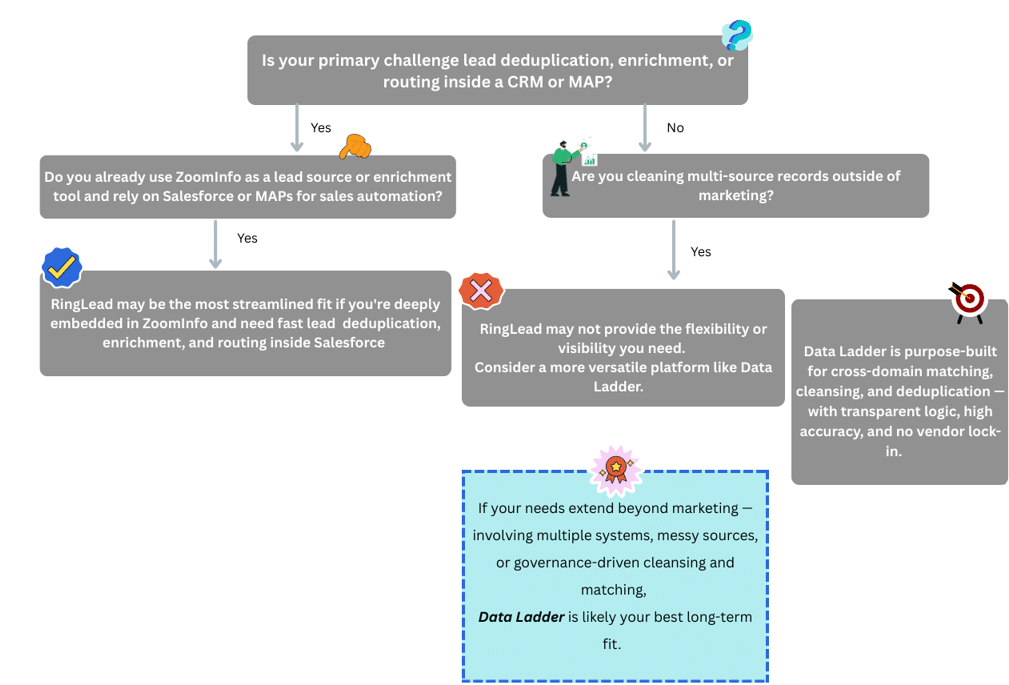
Diagnostic Flowchart: What Are You Actually Trying to Solve?
Feature Breakdown: What Each Tool Offers
| Feature | RingLead (ZoomInfo) | Data Ladder |
| Primary Use Case | Lead deduplication, enrichment, routing, within CRM/MAP | No-code profiling, cleansing, standardization, matching, deduplication, and entity resolution |
| Matching Techniques | Match keys and rule-based deduplication, with heavy reliance on contact/account IDs from ZoomInfo | Configurable exact, fuzzy, phonetic, numeric, and composite matching |
| Integration Depth | Deep native integration with Salesforce and MAPs; optimized for ZoomInfo enrichment and workflows | Files, databases, CRMs, ERPs, REST APIs, and 150+ connectors |
| User Experience | Designed for sales/marketing ops; GUI geared toward lead ops teams | No-code visual workflows with real-time previews and threshold tuning |
| Data Enrichment | Real-time enrichment from ZoomInfo (paid add-on); strong for firmographic/contact detail | Address verification and standardization rather than B2B contact enrichment |
| Deployment Options | Fast for CRM environments (especially with ZoomInfo); limited outside that stack | Windows desktop and server products; Docker-based Linux deployment across on-premises and cloud environments |
| Auditability & Transparency | Limited – match logic is configurable but abstracted; less visibility into scoring and match rationale | Reviewable rules, scores, weights, thresholds, and match results |
| Best Fit For | Sales/marketing teams needing real-time lead routing and enrichment tied to ZoomInfo | Cross-source data quality, matching, deduplication, and entity resolution |
Data Ladder vs. RingLead: Key Differences
1. Matching Configuration and Transparency
RingLead: Offers deduplication via matching rules defined within its platform, primarily for Salesforce objects like leads, contacts, and accounts. RingLead data matching feature allows users to choose from preset or custom match rules, but the logic is largely geared toward field-level comparison inside a CRM context. There is limited visibility into the underlying matching algorithm and little room for advanced configuration beyond CRM workflows.
Data Ladder: DME gives users no-code control over how records are compared and scored. Teams can combine exact, fuzzy, phonetic, numeric, and domain-specific algorithms; assign weights; adjust acceptance and rejection thresholds; and preview results in real time. Match scores, configured rules, and review workflows help users validate, refine, and explain matching decisions.
2. Scope: CRM Deduplication vs. Enterprise Data Matching
RingLead: Strong within Salesforce, but limited beyond it. Its core modules – Cleanse, Dedupe, Enrich, Route – are tightly tied to CRM workflows and marketing operations. While RingLead ZoomInfo supports API connections and integrations, its native capabilities are optimized for contact and lead data within CRM systems.
Data Ladder: DME is Data Ladder’s no-code entity resolution software for linking, deduplicating, and consolidating records across CRMs, ERPs, data warehouses, databases, files, and APIs. Teams can resolve customer, supplier, patient, citizen, and other business entities without routing all their data through a CRM. This makes DME a broader RingLead alternative when requirements extend beyond CRM deduplication to cross-source matching, survivorship, and golden-record creation.
3. Batch and Real-Time Matching
RingLead: Real-time deduplication and lead routing are RingLead’s strengths. It also supports batch deduplication within CRM datasets, but is not optimized for large-scale, multi-source, offline matching jobs that span non-CRM databases.
Data Ladder: Supports batch processing, Live Search, and API-driven matching workflows. Teams can run recurring jobs through the established desktop and server products or integrate matching into applications and data pipelines through REST APIs. In controlled internal testing, the new web-based platform completed configured matching for 10 million records in approximately 41 minutes. This was an internal DME benchmark—not a head-to-head RingLead test—and results vary by dataset, hardware, configuration, and deployment.
4. Deployment and Integration
RingLead: Cloud-native, with integrations centered around Salesforce and marketing platforms. It’s ideal for RevOps teams needing quick wins in CRM hygiene. However, deployment flexibility is limited, which means you’re bound to RingLead’s Salesforce-centric, cloud model.
Data Ladder: Deployment options include Windows desktop and server products; Docker-based Linux deployment across on-premises and cloud environments. The browser-based, API-first platform provides REST APIs, while 150+ connectors support integration with files, databases, CRMs, ERPs, data warehouses, and other enterprise systems.
5. Usability: Built for RevOps vs. Data Teams
RingLead: Designed for RevOps teams with an intuitive UI for CRM users. It works well for non-technical users managing leads and contacts (working within CRM environments). But this simplicity comes at the cost of depth and becomes a limitation for technical users who need granular control or deeper configuration.
Data Ladder: DME provides no-code visual workflows for analysts, data stewards, and business users. They can profile data, build match rules, adjust weights and thresholds, test configurations, and preview results without writing code. Technical teams can integrate matching into applications and data pipelines through REST APIs.
6. Price-to-Capability Ratio
RingLead: Pricing is subscription-based and aligned with Salesforce data volumes and module usage. For Salesforce-centric teams or CRM-centric workflows, it can be fair investment. But organizations needing cross-system data quality may require stitching together multiple tools or workflows—adding complexity and cost.
Data Ladder: Pricing depends on the selected product, deployment model, and organizational requirements. Buyers should compare software, implementation, integration, infrastructure, and ongoing administration costs when evaluating total cost of ownership.
Common Use Cases for Data Ladder vs. RingLead
| Use Case | RingLead (ZoomInfo) | Data Ladder |
| Prevent duplicate leads from entering Salesforce | Native dedupe rules, real-time prevention | Clean and match records before CRM import |
| Clean existing Salesforce records before a campaign | Built for this | Profile, standardize, match, and deduplicate CRM data |
| Clean & merge leads from a ZoomInfo campaign before Salesforce import | Native use case: dedupe + enrich + route based on campaign logic | Clean and deduplicate before import; no native enrichment or lead routing |
| Clean customer, vendor, or citizen records outside your CRM | Limited scope – focused on lead/contact data | Cross-source cleansing, standardization, and matching |
| Deduplicate a vendor list from Excel before AP onboarding | Not built for this use case; would require awkward CRM routing | Import, profile, match, deduplicate, and export without a CRM |
| Match and merge records across Excel, databases, and APIs | Not built for multi-source matching | Configurable exact, fuzzy, phonetic, numeric, and composite matching |
| Deduplicate patient records across systems by name, DOB, and SSN | Not optimized for complex fuzzy matching across multiple identifiers | Configurable multi-field matching across demographic and identifier data |
| Merge siloed customer data across apps | Possible if routed through CRM, but not seamless | Cross-source matching, survivorship, and golden-record creation |
| Need match explainability for compliance or auditing | Match logic is opaque; rules often embedded in workflows | Reviewable rules, scores, weights, thresholds, and results |
| Create golden records (for vendors, customers, etc.) | Not a fit | Configurable survivorship, merging, review, and export |
RingLead (ZoomInfo) is:
- Purpose-built for Salesforce and CRM-centric workflows
- Tightly couple with ZoomInfo data for B2B sales/marketing
- Focused on lead enrichment, routing, scoring, and deduplication
- Designed for revenue operation teams, not technical data quality work
Data Ladder (DataMatch Enterprise) is:
- Data Ladder’s no-code data matching and entity resolution platform
- Built for profiling, cleansing, standardization, matching, deduplication, survivorship, and golden-record creation
- Designed to work across files, databases, CRMs, ERPs, APIs, and other systems through 150+ connectors
- Configurable through visual rules, algorithms, weights, thresholds, previews, and review workflows
- Available through Windows desktop and server products or a browser-based, API-first platform with REST APIs, Entity Graphs, Live Search, and Docker-based Linux deployment
- Used by more than 4,000 customers, including over 500 enterprise customers, across 40 countries
Which Tool Fits Your Data Footprint Best?
- Choose RingLead when your primary requirement is Salesforce-focused duplicate prevention, ZoomInfo enrichment, segmentation, and lead or account routing.
- Choose DataMatch Enterprise when you need no-code data matching, cleansing, deduplication, and entity resolution across files, databases, CRMs, ERPs, and APIs—with configurable rules, weights, thresholds, previews, and review workflows.
- Consider using both when RingLead supports CRM revenue operations while DataMatch Enterprise handles upstream or cross-system data quality and consolidation.
- Consider a broader MDM platform when your requirements also include enterprise-wide governance, lineage, reference-data management, and continuously managed master data.
It’s not only one of the best RingLead alternatives for data matching, it also offers excellent profiling, cleansing, and standardization features to get your base data in order. With DME, all the data feeding your systems remains accurate and reliable.
Evaluate DataMatch Enterprise Using Your Data
Use a representative dataset to evaluate match quality, false positives and negatives, configuration effort, processing time, review requirements, and golden-record output.
Ready to improve data matching in your environment?
Try Data Ladder on your own data to see how it supports matching, deduplication, and entity resolution across complex systems.
Start a Free Trial[book a personalized demo] to see how you can match, dedupe, and standardize your data with confidence – across any system, source, or scale.