




































Last Updated on June 30, 2026
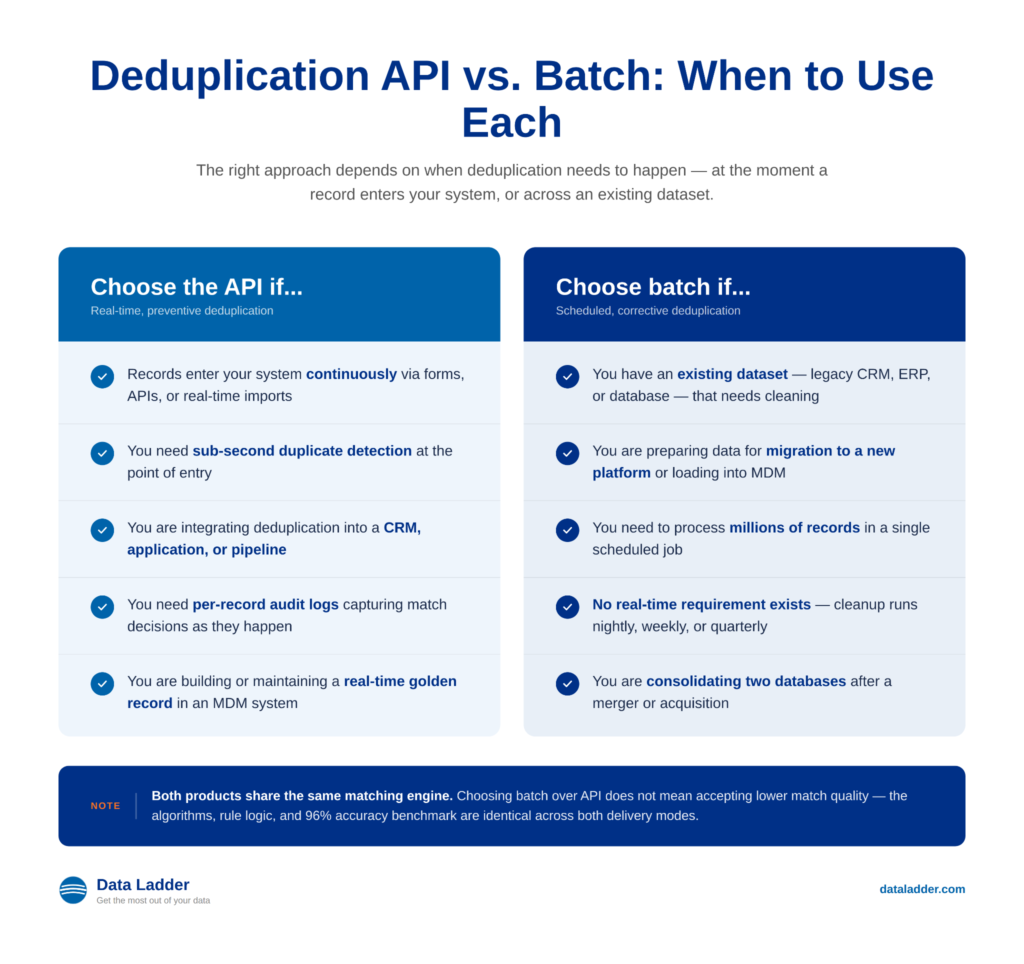
The right choice between a deduplication API and batch deduplication comes down to when deduplication needs to happen. If records need to be checked at the moment they enter a system, you need an API. If you have an existing dataset that needs cleaning, you need batch deduplication. Most mature data programs eventually need both, but they serve different stages of the data lifecycle, and conflating the two creates problems that neither approach was designed to solve.
In this guide, we will explain the difference between these two data deduplication strategies, explain what each one is used for, and how both data deduplication APIs and batch deduplication can fit into your existing workflows.
What Each Approach Actually Does
API deduplication allows you to match incoming records against existing data in real time. Depending on what data already exists in the system, the API then returns a match result or merged output within milliseconds. It sits inline with whatever system is producing new records, whether that is a web form, a CRM import, or a data pipeline ingesting from a third-party source. The match decision happens before the record lands in the destination system.
Batch deduplication is a scheduled or manually triggered job that processes an entire dataset at once. It scans a file or database for records that represent the same real-world entity, flags or merges them, and produces a cleaned output. The records already exist in a spreadsheet, database, CRM, or any other location. Batch deduplication is how you clean multiple records in one go regardless of where they may already be stored.
The Core Distinction: Prevention vs. Correction
When using an API for deduplication, whenever a new record arrives at an endpoint, it gets matched against what already exists in the system, and is either merged, flagged, or rejected before it touches your database. The duplicate never forms.
Batch deduplication is corrective. It addresses duplicates that have already accumulated, whether from years of manual entry, fragmented system integrations, or an acquisition that combined two overlapping customer databases. It does not prevent duplicates at the point of entry; it resolves them in bulk after they have already been created.
Neither approach is superior than the other. They operate at different points in a record’s lifecycle and address different root causes. The mistake most teams make is treating one as a substitute for the other, then finding that the problem persists because they addressed the wrong phase.
Here are some factors that can help decide whether API-based deduplication is better for your business or if you should choose batch deduplication instead:
| Dimension | API (Real-Time) | Batch (Scheduled) |
|---|---|---|
| Processing trigger | On-demand, per-record or per-event | Scheduled job or manual run |
| Latency | Milliseconds to seconds | Minutes to hours |
| Best data volume | Continuous streams, transactional ingest | Large historical datasets, one-time loads |
| Integration pattern | Embedded in application, pipeline, or CRM | Standalone tool or ETL step |
| Primary use case | Point-of-entry validation, CRM sync, real-time MDM | Data migration, periodic cleanup, pre-load dedup |
| Setup complexity | Higher (requires API integration) | Lower (UI-driven configuration) |
| DataLadder product | DataMatch Enterprise Server API | DataMatch Enterprise (desktop/batch mode) |
| Auditability | Per-call logs, rule traces per record | Job-level reports, match result exports |
Use Cases for API-Based Deduplication
The API approach belongs in workflows where deduplication needs to be part of the record ingestion process itself, not a downstream cleanup step.
CRM Record Entry
When a contact is submitted via web form or imported from a list, it needs to be checked against existing records before it reaches the CRM. Without this check, duplicate records accumulate with every import cycle. The API intercepts the record in transit, runs the match against existing data, and routes the result accordingly. The CRM receives only the resolved output.
Data Pipeline Ingestion
Records flowing through an ETL or ELT pipeline benefit from per-record validation before they land in a warehouse or MDM system. This matters most when data arrives continuously from multiple upstream sources with overlapping populations, which is a common architecture in multi-brand retail environments and financial services firms aggregating data across business units.
Real-Time MDM Golden Record Updates
When a new transaction or event should update an existing customer entity, the API handles the re-match in real time and keeps the golden record current. This is the core integration pattern for golden record creation via API. The match engine runs on each incoming event and surfaces the best-version record without requiring manual intervention.
Customer-Facing Onboarding and Registration Flows
Any application where users can create an account or submit personal information is a point-of-entry deduplication risk. Running a dedup check at registration prevents duplicate accounts from forming and avoids the downstream work of reconciling multiple profiles for the same individual. In regulated industries where identity accuracy carries compliance weight, this check is not optional.
Post-Migration Real-Time Monitoring
After a batch migration has cleaned a historical dataset and loaded it into a new system, the API takes over ongoing prevention. The batch job addressed the historical backlog; the API stops the same problem from re-forming. This two-stage pattern works because the two tools are doing fundamentally different jobs, and each is doing the one it was built for.
When to Use Batch Deduplication
Batch deduplication is purpose-built for high-volume, non-time-sensitive workloads. For the right use cases, it is faster to configure, easier to audit, and better suited to the scale of the job than any real-time approach.
Data Migration Prep
Deduplicating a legacy CRM or ERP before migrating to a new platform is one of the highest-ROI uses of batch deduplication. Migrating dirty data imports the problem into the new system. Running batch deduplication on the source dataset before the cutover means the new platform starts with accurate record counts and no duplicate-driven distortions in reporting or pipeline from day one.
Periodic Data Quality Sweeps
Even with real-time dedup in place at ingestion, scheduled batch jobs serve as an added quality check. Matching rules may change, which means that data that was treated as distinct a year ago may now be recognized as the same entity under updated logic. Monthly or quarterly batch runs let teams apply current matching logic to the full dataset and catch flyaways that point-in-time API checks would have missed.
Large Historical Dataset Cleanup
Processing millions of records that have accumulated over years is where batch deduplication excels. DataMatch Enterprise processes 2 million records in approximately 2 minutes at 99% accuracy, which is a meaningful benchmark when a dataset runs into the tens of millions. A real-time API is built for per-record responsiveness, not bulk throughput, and can even be the wrong tool for this job.
Post-Merger Data Consolidation
Merging two customer databases after an acquisition is a well-established batch deduplication use case. Both datasets typically carry different schemas, naming conventions, field populations, and data lineage. A batch job can be configured to apply fuzzy matching logic across all relevant fields, handle the schema mapping, and produce a single deduplicated master file before any records get written back to a production system.
Pre-Load MDM Deduplication
When data is being loaded into an MDM platform for the first time, batch deduplication on the source data is standard practice before the load. MDM systems carry meaningful per-record overhead at scale. Loading pre-cleaned data reduces the initial reconciliation burden and lets the platform focus on ongoing governance rather than bulk remediation from the start.
Can You Use Both?
Yes, and most organizations that have moved past reactive data cleaning use both in sequence. Batch handles the initial cleanup or migration, while the API handles ongoing prevention after the system is live.
Here’s what that would look like in practice: Run a DataMatch Enterprise batch job to deduplicate a legacy CRM before migrating it to a new platform. It provides a UI-driven workflow for configuring matching rules, running deduplication jobs across large datasets, and reviewing and exporting results. It is the right tool for migration prep, periodic cleanup, and any scenario where the goal is processing a full dataset rather than intercepting individual records.
Once the migration is complete and the system is live, enable the DataMatch Enterprise Server API to intercept new records at point of entry. It exposes a REST interface that your application, pipeline, or CRM integration calls with an incoming record. The API runs the match engine, returns a result, and logs the decision per call. It is designed to be embedded in existing infrastructure rather than operating as a standalone tool.
This workflow solves both problems that already exist pre-migration and even deals with issues that may arise when new data is being ingested into the system.
An important technical point to note is that both products run on the same underlying matching engine. The algorithms, rule logic, and accuracy benchmarks are consistent across both delivery modes. Choosing DataMatch Enterprise desktop edition for batch deduplication does not mean accepting lower match quality. It means choosing a different integration pattern for the same engine. There is no accuracy trade-off between them.
Frequently Asked Questions
What is the difference between real-time and batch deduplication?
Real-time deduplication checks and resolves duplicate records at the moment they enter a system, via an API endpoint that intercepts each incoming record before it lands in a database. Batch deduplication processes an existing dataset as a single job, identifying and resolving duplicates across all records at once. The core difference is timing: real-time dedup is preventive, batch dedup is corrective.
Can a deduplication API handle millions of records?
A deduplication API is designed for per-record calls, not bulk throughput. For one-time processing of large datasets in a single job, batch deduplication is the appropriate approach. APIs are built for continuous, record-by-record matching where per-call latency matters. Batch tools are built for high-volume workloads where total job time is what counts.
Is batch deduplication better for data migration?
Yes. Deduplicating the source dataset before migration prevents duplicate records from being carried into the new system. Running a batch job on the source file before cutover is significantly less expensive than cleaning duplicates after they have been imported, especially if the destination is an MDM platform or data warehouse with downstream dependencies built on that data.
Do DataMatch Enterprise API and the desktop product use the same matching engine?
Yes. Both DataMatch Enterprise Server API and DataMatch Enterprise (desktop/batch mode) run on the same underlying matching engine with the same algorithms, rule logic, and accuracy benchmarks. The difference is delivery mode and integration pattern, not match quality. Choosing batch does not mean accepting lower accuracy.
Can I run batch deduplication first and then switch to API-based deduplication?
This is the recommended hybrid pattern. Batch deduplication cleans the historical dataset; the API handles ongoing prevention once the system is live. The two approaches are complementary and address different phases of the data lifecycle. Starting with batch for initial cleanup and then enabling the API for real-time ingestion control is one of the most common implementation sequences among DataLadder customers.
What is the typical latency of a deduplication API call?
A well-implemented deduplication API call typically completes in milliseconds to low single-digit seconds per record, depending on dataset size, matching configuration, and network conditions. For transactional use cases like CRM entry or user registration flows, this is within acceptable response time thresholds. For pipeline use cases where throughput matters more than per-call speed, batch processing is the more efficient option.
Next Steps
The right starting point depends on where you are in your data lifecycle.
If you are building real-time deduplication into a pipeline, CRM, or application, explore DataMatch Enterprise Server API. It integrates directly with your existing infrastructure via REST and logs every match decision per call.
If you have an existing dataset to clean, a migration coming up, or periodic deduplication jobs to run, explore DataMatch Enterprise. It processes 2 million records in 2 minutes at 96% accuracy with no coding required.
Both run on the same matching engine and are available as a free trial with no credit card required. Start your free trial.