



































Data deduplication software
Find duplicate data records – even in the absence of unique identifiers and exact data values – by leveraging a combination of advanced probabilistic and deterministic algorithms, and identifying fuzzy, phonetic, mis-keyed, and abbreviated variants of data values.
Trusted By
Trusted By
DEFINiTION
What is data deduplication?
Data deduplication removes duplicate items from databases and lists either by matching records manually or using data matching algorithms to automatically detect duplicates. The purpose of deleting duplicate rows/records is to clean the underlying data set to achieve productivity improvements, save on duplicate mailings, and increase customer satisfaction.
Manually deleting duplicates can be a time consuming and error prone task, which is why dedupe software is an essential tool for enterprise-wide data quality initiatives.
Benefits
Why do you need a data deduplication tool?
Identify different types of duplicates
Find and resolve different types of duplicates, including exact, non-exact, or varying values, stored within or across data sources.
Avoid losing data while deduping
Prevent data loss and ensure retention of the most accurate and comprehensive view of an entity after deduplication.
Perform scalable deduping
Use more advanced and scalable features for CRM deduplication than the ones built in CRMs like HubSpot or Salesforce.
Implement custom merge behavior
Take the guesswork out of data deduplication by configuring custom merge and survivorship rules according to your needs.
Compare and integrate backups and archives
Reduce the number of versions residing in your archives by merging important information to the latest data record.
Improve customer journey
Leverage personalized customer experiences by deduping customer data captured at different touchpoints.
Features
What DME’s data deduplication can do for you?
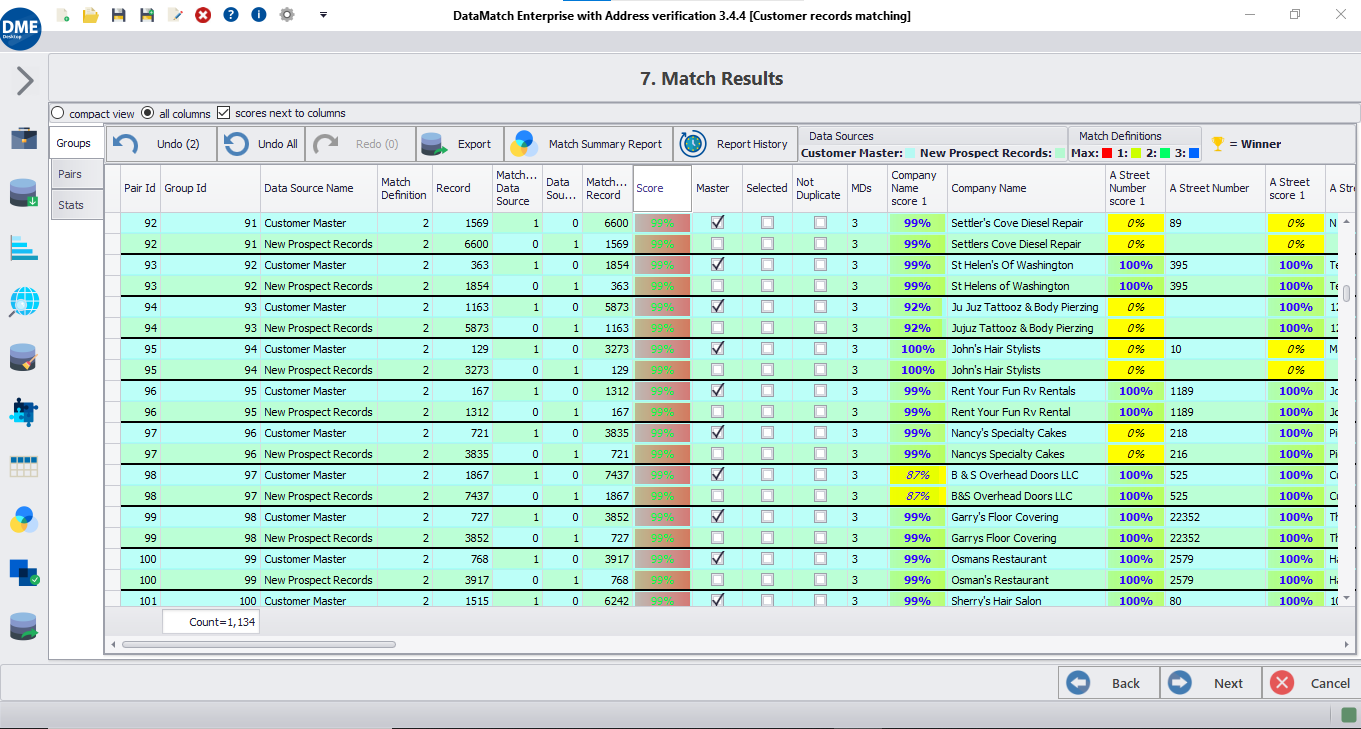
DME allows you to prepare your data before deduping it, which involves advanced data profiling , cleansing, and standardization. With DME, you can execute the necessary steps to ensure deduplication accuracy, such as pattern recognition, word replacement, letter case transformation, and address standardization.
DME leverages advanced field and record matching techniques that consider misspellings, human typographical errors, and conventional variations in data values. DME can assess similarity between records right down to the character level. Moreover, advanced fuzzy matching techniques are also used to compare words and long sentences.
There’s more
What else do you get out of the box?
- Live preview of deduplicated data
- Unique and duplicate record selection
- Character and token-based similarity checks
- Phonetic and numeric similarity detection
- Scheduler for automatic data deduplication
- Fine tuning deduplication algorithm
- Merging and overwriting records
- Multi-format support for exporting results
User roles
A tool made for everyone

Data analysts

Business users

IT Professionals

Novice users

Features
We take care of your complete DQM lifecycle
Import
Connect and integrate data from multiple disparate sources
Profiling
Automate data quality checks and get instant data profile reports
Cleansing
Standardize & transform datasets through various operations
Matching
Execute industry-grade data match algorithms on datasets
Deduplication
Eliminate duplicate values and records to preserve uniqueness
Merge & purge
Configure merge and survivorship rules to get the most out of data
Want to know more?
Check out DME resources

Merging Data from Multiple Sources – Challenges and Solutions

Oops! We could not locate your form.

EMPI vs Entity Resolution: What Healthcare IT Teams Need to Know
Last Updated on March 3, 2026 The average healthcare organization carries 8% to 12% duplicate patient records, and in large health systems, that number often rises to 15% to

Dedupe Software Tools for Multi-Source Data Integration
Last Updated on February 27, 2026 Dedupe software identifies and removes duplicate records from databases, CRMs, and other data systems so organizations maintain a single,

EMPI vs Entity Resolution: What Healthcare IT Teams Need to Know
Last Updated on March 3, 2026 The average healthcare organization carries 8% to 12% duplicate patient records, and in large health systems, that number often rises to 15% to

Dedupe Software Tools for Multi-Source Data Integration
Last Updated on February 27, 2026 Dedupe software identifies and removes duplicate records from databases, CRMs, and other data systems so organizations maintain a single,

What Is Data Matching and Why Does It Matter?
Last Updated on February 27, 2026 Written by Data Ladder’s data quality team, drawing on 15+ years of experience helping enterprises match and deduplicate datasets
Frequently asked questions
Got more questions? Check this out
Data Ladder’s data deduplication software is an enterprise-grade solution that identifies, flags, and removes duplicate records from databases, CRMs, spreadsheets, and other data sources. Powered by its flagship product, DataMatch Enterprise, it uses proprietary fuzzy matching, phonetic algorithms, and domain-specific techniques to find and merge duplicate records including near-duplicates that simple exact-match tools miss achieving up to 96% matching accuracy
Data Ladder’s deduplication software detects multiple types of duplicate records, including:
- Exact duplicates — identical records
- Near-duplicates — records with minor spelling variations, typos, or formatting differences
- Phonetic duplicates — records that sound the same but are spelled differently (e.g., “Smith” vs. “Smyth”)
- Abbreviated or truncated records — where one entry is a shortened version of another
- Cross-source duplicates — duplicate entities across two or more separate data systems
Data Ladder’s DataMatch Enterprise achieves up to 96% matching accuracy using a combination of proprietary and industry-standard algorithms. Independent third-party tests across datasets ranging from 80,000 to 8 million records have confirmed its performance. In head-to-head comparisons, DataMatch Enterprise found 53% more matches than competitors like WinPure on similar datasets.
Yes. DataMatch Enterprise supports multi-source deduplication, allowing users to connect data from CRMs, SQL databases, Hadoop repositories, Excel spreadsheets, flat files, cloud applications, and APIs. Records from different systems are standardized, matched, and merged into a single golden record.
A golden record is a single, authoritative, and comprehensive record created by merging duplicate entries. Data Ladder uses configurable survivorship rules to determine which values from duplicate records are retained in the final merged record — for example, always keeping the longest value, the most recent value, or applying custom merge logic. This ensures no data is lost during deduplication.
Yes. Data Ladder offers purpose-built CRM deduplication capabilities for quick and accurate identification and resolution of duplicate customer and contact records. It integrates with CRM platforms and supports merge/purge operations to maintain a clean, single view of each customer or entity.
Data Ladder’s DataMatch Enterprise is positioned as a best-in-class alternative for organizations that need enterprise-grade deduplication without the cost and complexity of full MDM platforms. Key differentiators include:
- 53% more matches found than WinPure in independent tests
- Faster deployment — operational in minutes vs. months for Informatica MDM or IBM InfoSphere
- Higher accuracy — advanced true-matching algorithms handle out-of-order text, fused words, and multiple errors
- US-specific optimization — custom detection patterns for SSNs, ZIP+4 codes, and other US data formats
- Unified platform — combines profiling, cleansing, matching, deduplication, and enrichment in one tool
Yes. Data Ladder offers a free trial of DataMatch Enterprise — no credit card required. The trial is fully functional, allowing users to test deduplication on their own data before purchasing.