































Record Linkage Software

Link, compare, and deduplicate records across disparate data sources—even when identifiers are missing or inconsistent. DataMatch Enterprise combines exact, fuzzy, phonetic, numeric, and domain-specific matching to help teams identify related records, review match results, and build a more complete view of each entity. Comparative testing has reported matching accuracy of up to 99%.

Trusted By

Trusted By

Definition

What is record linkage?

Record linkage is the process of identifying records across two or more datasets that refer to the same real-world person, organization, household, product, or other entity. It compares identifying attributes—such as names, addresses, emails, phone numbers, dates, or account numbers—to classify records as matches, non-matches, or potential matches.

Exact identifiers can support deterministic record linkage. When identifiers are missing, incomplete, or inconsistent, probabilistic, fuzzy, phonetic, numeric, and domain-specific comparisons can calculate similarity and confidence scores. Teams can then review uncertain results and apply deduplication, merge, purge, or survivorship rules where appropriate.

Process

How does record linkage work?

Pre-processing

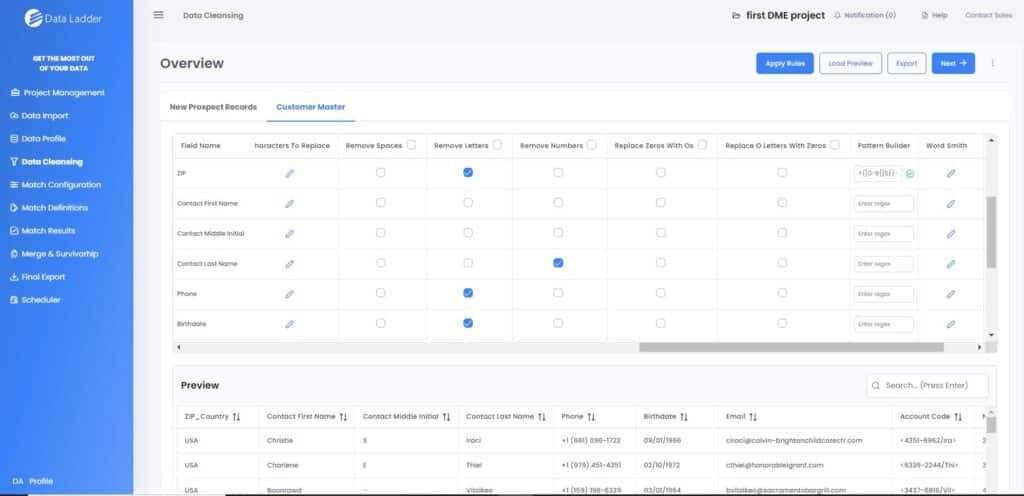
Profile, cleanse, and standardize source data before comparison. Normalize names, addresses, phone numbers, dates, and other identifiers so formatting differences, missing values, and invalid data do not distort linkage results.

Field comparisons​

Select identifying fields and compare their values using exact, fuzzy, phonetic, numeric, or domain-specific matching algorithms. Each field can be weighted according to how strongly it identifies an entity.


Record deduplication

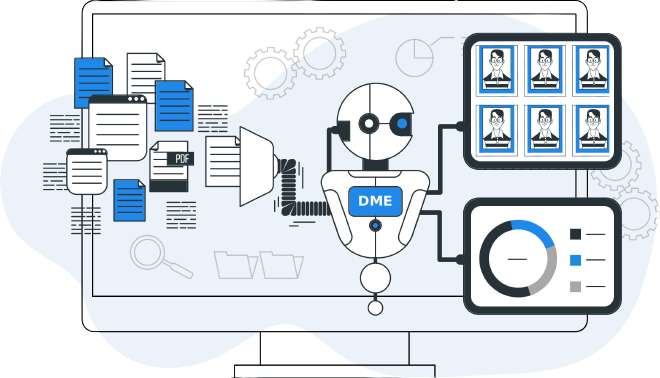
Apply deduplication, merge, purge, and survivorship rules to resolve linked records. Retain the most trustworthy values and create a consolidated record without discarding useful source information.

Indexing/Blocking

Use blocking or indexing rules to create likely candidate pairs instead of comparing every record with every other record. This reduces unnecessary comparisons and improves performance on large datasets.

Classification and evaluation

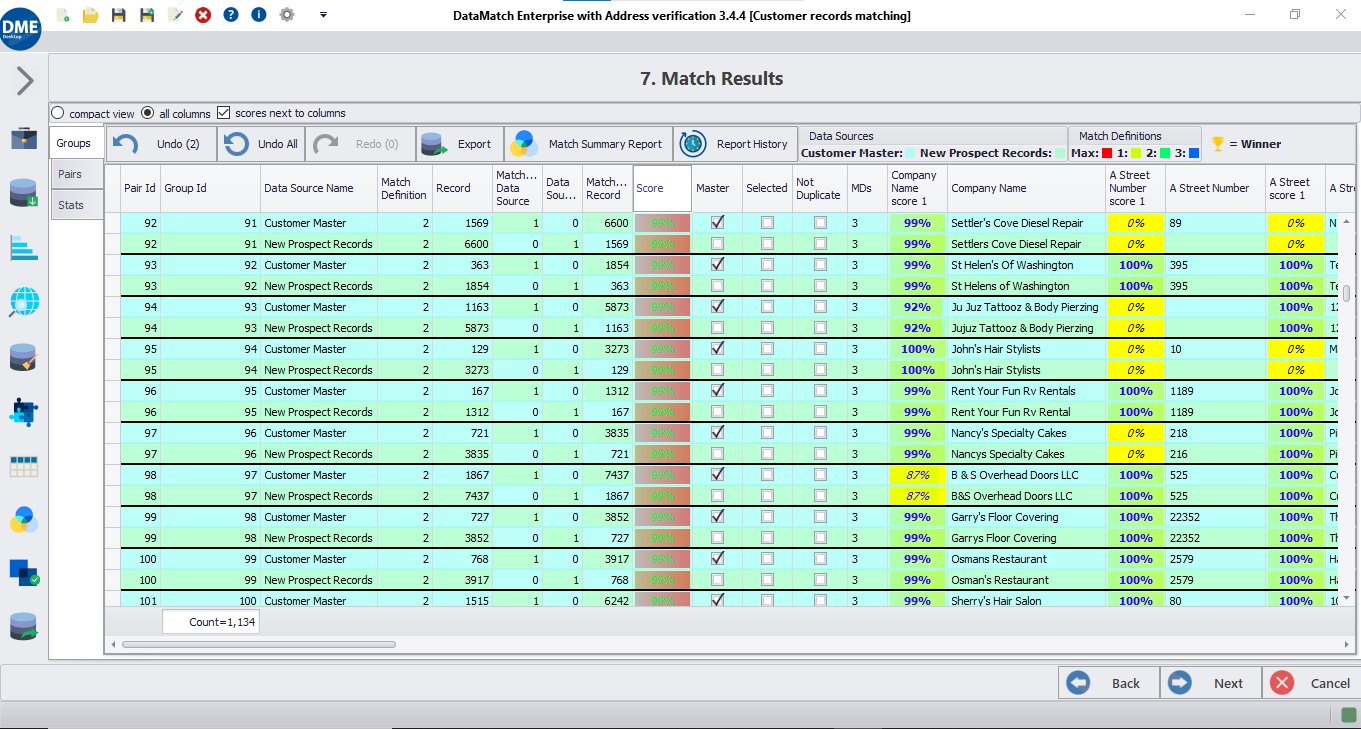
Combine field-level similarity scores into an overall confidence score, then classify pairs as matches, non-matches, or possible matches. Tune thresholds and send uncertain pairs for human review.

Record deduplication

Configure merge purge rules to overwrite data, remove duplicates, and attain a single, comprehensive view of the entity.

Solution

Enterprise record linkage with DataMatch Enterprise

See DataMatch Enterprise at work

DataMatch Enterprise is visual record linkage software for connecting customer, patient, supplier, and organizational records across multiple sources. Teams can profile and standardize source data, configure matching rules, adjust field weights and thresholds, and review results without building matching logic from scratch.

Exact, fuzzy, phonetic, numeric, and cross-column comparisons help identify related records despite incomplete or inconsistent identifiers. Teams can inspect matched groups through per-run Entity Graphs and apply deduplication, merge, purge, and survivorship rules. REST API access and Docker-based deployment support integration with existing data workflows.

Business benefits

How can record linkage benefit your organization?

Improve customer experience

Give sales, service, healthcare, and operations teams a more complete view of each person or organization, reducing repeated questions and inconsistent interactions.

Unify records across data sources

Connect related records from CRMs, databases, spreadsheets, and other systems even when names, addresses, phone numbers, or identifiers differ.

Increase operational efficiency

Reduce manual comparisons by using blocking, scoring, thresholds, and review workflows to focus staff attention on uncertain matches.

Eliminate duplicate efforts

Prevent duplicate outreach, case handling, account creation, billing, or reporting caused by multiple records representing the same entity.

Improve reporting and analytics

Avoid double-counting customers, patients, suppliers, or organizations so dashboards, segmentation, forecasting, and business decisions use more reliable data.

Build a single source of truth

Apply merge, purge, and survivorship rules to retain the most trustworthy values and create a consolidated record for downstream systems.

Let’s compare

How has DataMatch Enterprise been tested?

Accuracy and scalability answer different questions and should be evaluated separately. Data Ladder reports matching accuracy of up to 99% across 15 comparative studies.

A separate controlled internal benchmark measured elapsed time and completion using a 10-million-record dataset. It compared the DataMatch Enterprise web and legacy applications under the same configuration; it did not measure accuracy or compare DataMatch Enterprise with other vendors.

Features of the solutionData LadderIBM Quality StageSAS DatafluxIn-House SolutionsComments
Match Accuracy (Between 40K to 8M record samples)99%91%84%65-85%Multi-threaded, in-memory, no-SQL processing to optimize for speed and accuracy. Speed is important, because the more match iterations you can run, the more accurate your results will be.
Software SpeedVery FastFastFastSlowA metric for ease of use. Here speed indicates time to first result, not necessary full cleansing.
Time to First Result15 Minutes2 Months+2 Months+3 Months+
Purchasing/Licensing Costing80 to 95% Below Competition$370K+$220K+$250K+Includes base license costs.

Frequently asked questions

Got more questions? Check this out

Deterministic record linkage uses exact agreement on reliable identifiers or predefined rules, such as matching the same customer ID or a specific combination of email and date of birth. Probabilistic record linkage combines evidence from multiple fields and calculates how likely two records are to represent the same entity. It is better suited to incomplete, inconsistent, or error-prone data.

Record linkage accuracy should be tested against a labeled dataset containing known matches and non-matches. Important measures include precision, recall, F1 score, false positives, false negatives, and the percentage of pairs requiring manual review. Accuracy alone can be misleading when a dataset contains far more non-matches than genuine matches.

Start with a labeled sample to validate match rules and thresholds, then repeat the test with representative medium- and production-scale datasets. Keep the rules and infrastructure consistent while measuring completion time, memory usage, precision, recall, false matches, missed matches, and manual-review volume. Include incomplete records and difficult duplicates rather than testing only clean data.

Yes. Teams can define an upper threshold for automatic matches, a lower threshold for non-matches, and a review range for uncertain pairs. Reviewers can examine field-level similarities, confidence scores, source values, and connected records before accepting or rejecting a match. Reviewed decisions can then be used to refine rules and thresholds.

Data matching is the broader process of comparing records or values. Record linkage connects records across datasets that may refer to the same entity. Deduplication identifies and resolves repeated records, often within one dataset. Entity resolution combines matching, linkage, grouping, review, and consolidation to build a more complete representation of a real-world entity.

Record linkage is used for customer 360 initiatives, patient matching, government and statistical research, fraud investigations, supplier consolidation, CRM migration, merger and acquisition data integration, and master-data programs. It is especially valuable when multiple systems describe the same people or organizations without sharing a reliable unique identifier.

ready? let's go

Try now or get a demo with an expert!

"*" indicates required fields

Hidden
Hidden
Hidden
Hidden
Hidden
Hidden
This field is for validation purposes and should be left unchanged.