



































Data quality is no longer a luxury. As organizations grapple with fragmented systems, duplicate records, and poor data trust, the debate isn’t just about who does data quality, but who does it best.
Experian Data Quality (EDQ) is a comprehensive suite of solutions developed by Experian to help businesses manage, validate, and improve their data assets. It includes tools for data quality improvement, enrichment, governance, and validation – backed by Experian’s global reference datasets. Among its core offerings is Experian Aperture Data Studio that enables users to design, automate, and govern data quality workflows.
Data Ladder’s DataMatch Enterprise (DME) also provides a full-featured data quality suite – with profiling, cleansing, deduplication, matching, standardization, and survivorship logic. But it is especially geared toward high-accuracy record matching, explainability, and fast, low-lift, no-code deployment. DME emphasizes transparency and control to empower business users to handle data quality tasks without heavy IT involvement.
Data Ladder vs. Experian Data Quality – Executive Summary:
EDQ offers a comprehensive suite that fits well in enterprise ecosystems, especially for global contact data validation and governance initiatives. But for organizations where record matching is the central challenge – and control, speed, and transparency are top priorities – DataMatch Enterprise is often a better EDQ alternative. It provides a faster, more focused, no-code, hands-on solution that empowers business users directly.
Let’s break down how.
Breadth vs. Depth: Comprehensive Platform vs. Tuned Matching Specialization
Experian Data Quality positions itself as an end-to-end data quality platform, and it absolutely delivers across many fronts, including contact data validation, profiling, cleansing, deduplication, enrichment, monitoring, and enterprise-scale integration across MDM, CRM, and ERP environments.
DME, in contrast, is laser-focused on solving one of the most challenging aspects of the data quality lifecycle – record matching – with high accuracy and explainability.
It offers data profiling, cleansing, deduplication and standardization as part of its suite, all of which are essential for preparing and structuring data effectively. However, its standout strength lies in entity resolution, i.e., helping you find, understand, and act on true matches across disparate, messy datasets with full transparency and user control.
✅ If your use case is identity resolution, deduplication, or householding across complex systems—DataMatch Enterprise offers more control and transparency.
Matching Accuracy with Explainability
EDQ offers data matching through its Aperture Data Studio platform. Its matching capabilities are strong, and support fuzzy, phonetic, deterministic, and multicultural logic. Users can build custom match rules, apply match scoring, and view lineage tracking.
Experian’s April 2025 update added Gen AI-powered rule creation to Aperture Data Studio, allowing business users to prompt AI to generate data quality rules without writing logic manually. This meaningfully narrows the self-serve gap for standard use cases. That said, auditing, validating, and iterating on AI-generated rules in complex enterprise environments may still involve governance oversight — whereas DataMatch Enterprise exposes every rule, weight, and threshold as directly adjustable configuration that users own and modify without a model intermediary.
DME offers business-user friendly tools and full transparency out of the box. Matching decisions are not only scored and auditable, but also fully explainable, with clear logic behind every linked record. It supports:
- Phonetic, fuzzy, exact, numeric, domain-specific, and pattern-based matching
- Custom rule-building without code
- Match scoring with confidence levels
- Detailed audit trails of what matched, why, and how
🔍 Data Match Enterprise doesn’t just match records – it shows you how and why they matched and gives you the tools to improve results.
Deployment and Technical Lift
Aperture Data Studio now offers a drag-and-drop interface and is marketed by Experian as intuitive and easy to deploy for standard workflows. For straightforward profiling, cleansing, and matching use cases, business users can get started without significant IT involvement. Where complexity increases — multi-source governance programs, stewardship role configuration, enterprise MDM integration — IT and governance teams typically re-enter the picture. DataMatch Enterprise is no-code across all deployment types, with no governance prerequisites for any tier of matching or deduplication work.
DME, by comparison, is designed for fast time to value and ease of use. It is a faster, no-code Experian alternative for data matching.
- No heavy implementation
- Drag-and-drop interface
- Business users can independently run profiling, cleansing, matching, and deduplication workflows without needing IT intervention
- Compatible with all major databases, CRMs, flat files, APIs, and more
⚡ What takes days or weeks elsewhere can often be configured in a day with DataMatch Enterprise. If time-to-results is critical, choose DME; it’s a much faster alternative to Experian Data Quality.
Flexibility Without Complexity
While both platforms offer configurable logic and visual workflows, Data Ladder strikes the ideal balance between flexibility and usability. DME lets users customize rules and outputs with precision and clarity. It offers flexibility without technical overhead – giving business users fine-tuned control without sacrificing power and depth.
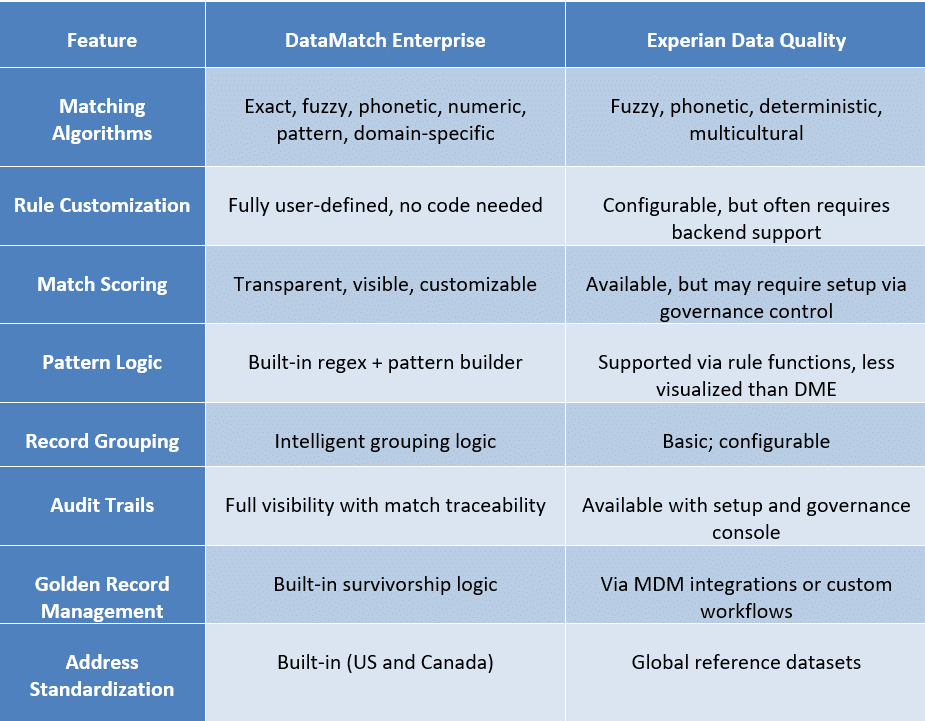
⚙️ With DME, you can fine-tune logic at the column level. With EDQ, tuning is powerful but often requires IT involvement or pre-built governance models.
Cost and Licensing
EDQ uses a modular licensing model. Experian Aperture Data Studio, Address Validation, Governance Platform, and other tools can be licensed individually or bundled. While this flexibility is valuable, costs may rise quickly for mid-sized to large teams or those with variable data projects.
Data Ladder offers transparent, all-in-one pricing:
- No usage-based surprises (no limits on number of users, data volumes, or records processed)
- No mandatory add-ons for advanced matching features
Use Cases: Where Data Ladder Outperforms
Experian Data Quality remains a strong fit for global contact data validation and large-scale enterprise governance. But Data Ladder shines as a better Experian alternative in scenarios where record matching, accuracy, speed, and explainability are the core requirements.
Some common DME use cases include:
- Healthcare: Patient deduplication, compliance with HIPAA traceability, record survivorship.
- Finance: Consolidation of customer data across silos for KYC, fraud prevention
- Retail & E-Commerce: Householding, single view of customer, marketing optimization
- Public Sector & Education: Deduplication of citizen, student, or alumni records
- B2B Data Providers: Matching across incomplete or inconsistent firmographic datasets
🎯 If the bottleneck in your matching process is understanding and improving your record matching outcomes, DataMatch Enterprise solves it faster – and with greater clarity.
When Matching Accuracy is the Mission, Data Ladder is the Winner
Both Experian Data Quality and Data Ladder offer broad data quality capabilities – but they differ in their strengths.
EDQ provides a globally integrated, scalable platform ideal for enterprise ecosystems, backed by rich datasets and governance tools. It’s a strong choice for organizations needing global data validation, complex integration, and formal data stewardship.
Experian’s April 2025 update also added a Data Catalogue for governance and data asset management, and a Business Impact Analysis feature that quantifies the financial cost of data quality issues in monetary terms. For enterprise buyers who need to build internal ROI cases for data initiatives, that last capability is worth noting — it’s not something DataMatch Enterprise provides. DME’s value proposition sits upstream of that: faster, more accurate matching with full rule-level transparency, rather than platform-wide governance and financial impact reporting.
Data Ladder, however, is the more specialized choice for teams who want unmatched transparency, rapid deployment, and fine-tuned control over their matching logics – without waiting on IT or sacrificing accuracy. This makes it a great replacement for Experian Aperture Data Studio.
Ready to see how Data Ladder can solve your toughest data matching challenges?
Download a free trial or book a personalized demo to experience the best Experian Data Quality alternative for record matching.
Frequently Asked Questions
1. Is DME a faster alternative to Experian Aperture Data Studio for data matching?
Yes. DataMatch Enterprise (DME) is not just faster, it is also a no-code alternative to Experian Aperture Data Studio. It deploys in minutes to hours, and delivers high-accuracy data matching with full control and visibility into match logic. There’s also no platform overhead, making it a great choice for those looking for a faster and leaner solution.
2. Do I need to rebuild my systems to replace Experian Aperture Data Studio with Data Ladder?
No. Data Ladder’s data quality software – DataMatch Enterprise (DME) – integrates with your existing tech stack and doesn’t require any re-architecture. It’s a plug-and-play alternative to Experian Data Quality for matching and cleansing use cases.
3. How does Data Ladder handle survivorship logic compared to Experian?
DME includes built-in survivorship rules that let you define which fields to retain based on completeness, recency, or custom priorities – without any coding. In contrast, Experian typically requires custom workflows or governance-based configurations for merging and survivorship, which can be more complex to set up and audit.
4. Can I audit match decisions in DataMatch Enterprise like I can in Experian?
Yes. DME offers full match traceability – and in many cases, greater transparency than Experian.
DataMatch Enterprise offers visual previews of matched records, confidence scoring, and a clear view of the logic behind each match. It doesn’t require governance consoles or backend setup to review and explain match outcomes, making it one of the best Experian alternatives for teams seeking transparency, traceability, and control.
5. Can I use Data Ladder for matching patient or citizen records?
Yes. DME is widely used in regulated sectors like healthcare, finance, public services, and education. It includes traceability and audit features that help organizations meet HIPAA compliance requirements, along with survivorship logic and high-accuracy deduplication across messy, siloed datasets.