


































Last Updated on October 13, 2026
At some point, most data teams discover the uncomfortable truth that their data isn’t describing reality anymore.
A customer exists under four different names across three systems.
A supplier shows up 14 times in the vendor master.
A patient’s records are split across two hospital systems with slightly different spellings of the same address.
The data hasn’t been wrong in any one place. It’s just that nobody taught the systems to recognize the same real-world entity across all of them. This is why companies often struggle to unify customer data from various sources, which impacts data accuracy and business outcomes.
That’s the problem entity resolution software exists to solve.
Entity resolution (ER) is the process of identifying, linking, and consolidating records that refer to the same real-world entity across disparate data sources, even when those records are inconsistent, incomplete, or formatted differently.
What Is the Best Entity Resolution Software?
The best entity resolution software depends on the use case. DataMatch Enterprise is a strong fit for code-free data profiling, cleansing, matching, deduplication, and golden-record creation. Senzing fits developer-led, real-time implementations; Quantexa suits fraud and AML investigations; Informatica and Reltio support broader MDM programs; Tamr provides ML-assisted mastering; AWS Entity Resolution serves AWS-native workflows; and Zingg supports customizable open-source deployments.
Best Entity Resolution Tools by Use Case
Entity resolution products vary significantly in scope. Some focus on data quality and deduplication, while others provide embedded resolution engines, graph analytics, cloud services or complete master data management. The following shortlist maps common buyer requirements to the platforms most relevant for evaluation.
| Buyer requirement | Tools to shortlist | Why they fit |
| Customer-data unification and deduplication | DataMatch Enterprise | Combines profiling, cleansing, matching, deduplication and golden-record creation in a code-free workflow |
| Real-time ER embedded in applications | Senzing | Provides an SDK-oriented resolution engine for developer-led implementations |
| Fraud, AML and relationship analysis | Quantexa | Combines entity resolution with graph-based contextual analysis |
| Customer 360 with enterprise governance | Informatica MDM or Reltio | Supports entity resolution within broader MDM, stewardship and governance programs |
| ML-assisted data mastering | Tamr | Combines machine learning with human feedback for complex mastering projects |
| AWS-native matching workflows | AWS Entity Resolution | Provides a managed service integrated with the AWS data ecosystem |
| Open-source, customizable ER | Zingg | Offers a Spark-based framework for engineering-led implementations |
| Government or regulated data | DataMatch Enterprise or Senzing | Supports deployment models that can keep sensitive data within controlled infrastructure; buyers should verify audit and review requirements |
| Minimal manual rule configuration | Senzing or an ML-assisted platform | Reduces initial rule authoring, but buyers should still test explainability, customization and false-match controls |
How We Researched and Evaluated These Tools
We selected platforms that offer entity resolution as a documented capability and represent distinct implementation categories, including data quality software, embedded ER engines, graph-based investigation platforms, master data management systems, managed cloud services and open-source frameworks.
Each product was evaluated using the following criteria:
- Best-fit use case: The business problem and type of team the platform is designed to support
- Matching approach: Exact, fuzzy, rule-based, probabilistic, machine-learning, graph-based or hybrid methods
- Entity coverage: Support for people, organizations, products, locations and other entity types
- Deployment and integration: SaaS, cloud, on-premises, Docker, API, SDK and batch options
- Technical requirements: The level of coding, configuration and specialist expertise required
- Review and explainability: Human-review workflows, confidence scores, match reasoning and auditability
- Operational capabilities: Blocking, clustering, survivorship, golden-record creation and downstream delivery
- Public evidence: Official documentation, published benchmarks, customer case studies and third-party reviews
- Limitations: Implementation demands, ecosystem dependencies and use cases for which the product may not be appropriate
The 8 Best Entity Resolution Software Tools Compared for 2026
The following evaluations compare eight entity resolution, data quality and MDM platforms by intended use case, matching approach, deployment model, technical requirements, public evidence and limitations. The tools are not ranked as universally best because suitability depends on the organization’s data, infrastructure and intended outcome.
1. DataMatch Enterprise by Data Ladder
Best for: Data quality, IT and operations teams that need to profile, cleanse, match, deduplicate and consolidate structured records without building a custom entity resolution system.
Platform category: Data quality and entity resolution software
Matching approach: DataMatch Enterprise combines exact, fuzzy, phonetic and cross-field matching with configurable match rules, field-level weights and thresholds. Data profiling, data standardization and data cleansing can be applied before matching to reduce errors caused by inconsistent source data. Address information can also be prepared using address standardization when location data contributes to matching.
Supported entity types: Customers, patients, organizations, suppliers, products, contacts and other structured business records.
Deployment and integration: Available through a web-based interface, REST API and Server Edition deployment options, including Docker and non-Docker environments. It supports batch workflows and integration with databases, business applications and downstream systems.
Coding requirement: The interface supports code-free configuration for analysts and data stewards. Development resources may be required for API integration, automation or embedding matching into operational applications.
Human review and explainability: Users can inspect matched groups, confidence information and the attributes contributing to a match. Entity Graphs provide a visual view of records within a resolved group, while configurable rules and thresholds allow teams to control automated and manual review decisions.
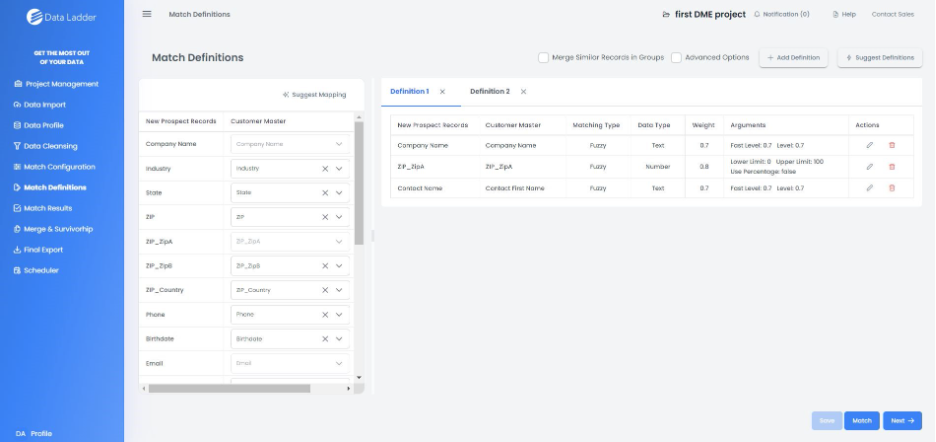
Why it stands out: DataMatch Enterprise combines data preparation, entity resolution, data deduplication, merge-purge and survivorship in one workflow. This helps teams standardize inconsistent source data before matching records and applying survivorship rules to create golden records or a 360-degree customer view.
Key limitation: It is primarily designed for structured-data matching and consolidation. Organizations requiring fraud-network investigation, persistent knowledge graphs or a complete multi-domain MDM governance platform may need complementary technology.
Public evidence: In Data Ladder’s published 10-million-record benchmark methodology, the DataMatch Enterprise web application completed two matching runs in approximately 41 and 43 minutes using the same 12-column dataset, match definition and hardware environment. This controlled internal benchmark measured elapsed time and completion not matching accuracy or performance against competing products.
Start a free trial of DataMatch Enterprise
2. Senzing
Best for: Engineering teams that need to embed real-time entity resolution and relationship detection into applications, operational systems or investigative workflows.
Platform category: Developer-focused entity resolution SDK
Matching approach: Senzing uses its Entity Centric Learning approach to evaluate records in the context of an evolving entity rather than relying only on isolated record-pair comparisons. It can update resolved entities as new records and identifying attributes are added.
Supported entity types: Primarily people and organizations, including customers, employees, vendors, counterparties and watchlist subjects.
Deployment and integration: Senzing v4 can be deployed on Linux, Windows, macOS, Docker, AWS, Azure and air-gapped infrastructure. SDK documentation is available for languages including Python, Java and C#, while container components can support custom loaders and REST services.
Coding requirement: Development resources are normally required to map source data, integrate the SDK, design ingestion and output pipelines, and operate the supporting infrastructure.
Human review and explainability: Senzing provides exploratory and audit tools for examining resolved entities, relationships and the reasons records were linked. However, organizations requiring a complete business-user stewardship queue should assess whether they need to build or integrate an additional review interface.
Why it stands out: It is designed as an embeddable resolution engine rather than a broad data-quality or MDM suite. This makes it relevant when entity resolution must run inside an existing application or operational workflow.
Public evidence: Senzing publishes SDK references, deployment guides, data-mapping specifications, technical briefs and sample truth sets that buyers can use to examine its architecture and test the engine.
Key limitation: Senzing is primarily an SDK, so implementation, data preparation, workflow design and downstream integration remain the customer’s responsibility. Teams seeking a self-service data-quality interface may require additional tools or development work.
3. Quantexa
Best for: Large financial institutions, government agencies and investigative teams that need to resolve entities and analyze networks for fraud, AML, KYC and other risk-related use cases.
Platform category: Decision intelligence and graph analytics platform with entity resolution
Matching approach: Quantexa combines data preparation, machine-learning-based entity resolution and graph generation. Its models link records across internal and external sources before representing resolved entities, transactions and relationships within a connected graph.
Supported entity types: Customers, organizations, counterparties, suppliers, accounts, transactions and other entities involved in financial, commercial or government networks.
Deployment and integration: Quantexa supports cloud and on-premises deployment, including native and containerized environments. APIs and libraries connect the platform with data lakes, warehouses, analytics environments and operational systems.
Coding requirement: Although parts of the platform support low-code configuration, implementation normally requires data engineering, data science and domain expertise to onboard sources, configure resolution models, generate graphs and develop risk analytics.
Human review and explainability: Entity Explorer, entity-quality scoring and investigation interfaces help teams examine resolved entities, identify possible over-linking or under-linking, explore relationships and understand the data behind risk decisions. Human review can be incorporated into investigation and decision workflows.
Why it stands out: Quantexa extends entity resolution into graph generation, contextual analytics and investigative decision-making. It is particularly relevant when the objective is to uncover relationships and risk networks rather than simply deduplicate records or produce a golden record.
Public evidence: Quantexa publishes platform documentation, solution descriptions, customer case studies and guidance for monitoring and tuning entity-resolution quality. Performance and outcome figures presented by the company should still be treated as vendor-reported unless supported by an independently documented evaluation.
Key limitation: Quantexa is a broad enterprise platform that typically requires substantial implementation and specialist resources. It may be unnecessarily complex for bounded projects such as CRM deduplication, list matching or routine data cleansing.
Ready to resolve entities and unify your records?
Try Data Ladder on your own data to see how it supports matching, deduplication, and entity resolution across complex systems.
Start a Free Trial4. Informatica MDM
Best for: Large enterprises that need entity resolution as part of a broader, governed master data management program covering multiple business domains and source systems.
Platform category: Enterprise multi-domain master data management platform
Matching approach: Informatica supports exact and fuzzy matching through configurable match models, rules, filters, thresholds and candidate-selection criteria. Match-and-merge processes can automatically consolidate strong matches, route uncertain matches for manual review or leave records classified as unique.
Supported entity types: Customers, organizations, suppliers, products, locations, assets and other configurable master-data domains.
Deployment and integration: Deployment depends on the selected Informatica product and edition. MDM SaaS provides cloud-based mastering, while Multidomain MDM supports self-managed enterprise implementations. Informatica’s wider platform supplies data integration, quality, governance and application connectivity capabilities.
Coding requirement: Match rules and survivorship policies can be configured, but implementation normally requires specialist MDM, integration and data-governance expertise. Complex environments may also require custom data models and workflows.
Human review and explainability: Data stewards can inspect potential duplicates, compare source records, preview proposed merges and approve or reject consolidation decisions. Match rules, source cross-references, trust settings and merge history provide evidence behind the resulting master record.
Why it stands out: Informatica combines matching and consolidation with stewardship, hierarchies, governance and synchronization across multiple master-data domains. It is most relevant when entity resolution forms part of an enterprise-wide MDM operating model.
Public evidence: Informatica publishes detailed documentation covering match models, fuzzy matching, automatic and manual consolidation, trust rules, survivorship, merge history and stewardship workflows.
Key limitation: Informatica MDM can require significant implementation, governance and specialist resources. It may be excessive for teams that only need a focused matching or deduplication solution.
5. Tamr
Best for: Enterprises that want to master large, diverse datasets using machine-learning models supplemented by human feedback and curation.
Platform category: AI-native, cloud-based master data management platform
Matching approach: Tamr Cloud uses trained machine-learning models and configurable rules to identify and cluster records representing the same entity. Its documented approach includes pre-trained models, similarity-based clustering, human feedback and record-consolidation rules for creating golden records.
Supported entity types: Companies, customers, suppliers, contacts, employees, students, healthcare organizations, providers and other person or organization records supported by its data products.
Deployment and integration: Tamr Cloud is delivered as a fully managed SaaS platform and can connect with data held across cloud and on-premises environments. Its APIs support access to mastered entities and real-time search, creation and update workflows.
Coding requirement: Pre-built models reduce the need to create extensive matching rules from scratch. However, data engineering and domain expertise may still be required for source onboarding, schema alignment, validation and downstream integration.
Human review and explainability: Data curators can review and adjust clusters, merge or separate entities, move source records between clusters and override golden-record attributes. Tamr preserves these curation decisions in subsequent mastering runs.
Why it stands out: Tamr combines machine-learning-based entity resolution, data enrichment, golden-record creation and ongoing human curation. It is especially relevant when matching logic must adapt across large or changing datasets.
Public evidence: Tamr publishes product documentation describing its machine-learning models, clustering process, curation controls, persistent entity identifiers, APIs and golden-record workflows. Buyers should separately validate vendor-reported performance and accuracy claims using representative data.
Key limitation: Tamr’s SaaS delivery model, data-product approach and ongoing curation process may not suit organizations requiring a lightweight matching utility, fully self-managed deployment or minimal stewardship involvement.
6. Reltio
Best for: Enterprises that need real-time, cloud-native master data management and entity resolution across multiple business domains.
Platform category: Cloud-native, multi-domain master data management platform
Matching approach: Reltio supports configurable match rules, match-level cleansing, fuzzy comparison methods and AI-powered entity resolution. Records identified as representing the same entity can be consolidated into profiles with persistent identifiers, source crosswalks and dynamically calculated survivorship values.
Supported entity types: Customers, organizations, products, suppliers, locations, employees and other configurable enterprise entities.
Deployment and integration: Reltio is delivered as a cloud-native SaaS platform. Its API-first architecture provides REST APIs for configuration, data access, external matching, match-and-merge operations and integration with operational applications and data platforms.
Coding requirement: Business rules and data models can be configured within the platform, but enterprise implementations generally require technical resources for modeling, source integration, API workflows, governance and downstream activation.
Human review and explainability: Teams can inspect potential matches, analyze matching strategies, review relevance information and manually merge, unmerge or classify records as not matching. Crosswalks, match rules and source values help users understand how a consolidated profile was formed.
Why it stands out: Reltio combines real-time entity resolution with dynamic survivorship, persistent identifiers, relationships, lineage and multi-domain MDM. It is particularly relevant when mastered profiles must remain continuously available to operational systems through APIs.
Public evidence: Reltio publishes detailed documentation for match rules, merge behavior, survivorship, crosswalks, APIs and external matching. SAP completed its acquisition of Reltio in May 2026, so buyers should also review how Reltio fits into SAP’s evolving data-management portfolio.
Key limitation: Reltio is a broader cloud MDM platform rather than a lightweight matching utility. Organizations should account for implementation complexity, governance requirements, SaaS deployment preferences and possible product-roadmap changes following the SAP acquisition.
7. AWS Entity Resolution
Best for: Data teams already operating in AWS that need a managed service for matching records stored within an AWS-centered data environment.
Platform category: Managed cloud entity-matching service
Matching approach: AWS Entity Resolution supports configurable rule-based, machine-learning-based and third-party provider-based matching workflows. Depending on the selected rule type, matching can use exact or fuzzy comparisons. Matched records are assigned a common Match ID.
Supported entity types: Customer information, product codes, business identifiers and other structured records that can be mapped to a supported input schema.
Deployment and integration: The service runs within AWS and uses services such as Amazon S3, AWS Glue, AWS KMS and IAM for data input, storage, encryption and access control. Results can be written to S3 or, for supported workflows, Amazon Connect Customer Profiles.
Coding requirement: Matching workflows can be configured through the AWS console, but teams need AWS expertise to prepare Glue tables, map schemas, configure permissions, manage storage and integrate outputs. APIs are available for automated workflows.
Human review and explainability: Rule-based results identify the rule that generated a match, while ML workflows return group-level—and in some cases record-level—confidence information. AWS Entity Resolution does not provide a complete data-steward review and survivorship workflow, so uncertain matches may need to be reviewed in another application.
Why it stands out: It provides managed entity matching without requiring teams to deploy and maintain a separate resolution engine. It is especially relevant when source data and downstream workflows already reside in AWS.
Public evidence: AWS publishes detailed user guides and API references covering workflow configuration, supported matching techniques, schema mapping, Match IDs, confidence information, provider integrations and output options.
Key limitation: The service is closely tied to the AWS ecosystem and focuses primarily on matching and ID assignment. Teams needing extensive data cleansing, business-user review, golden-record survivorship or multi-cloud portability may require additional components.
8. Zingg
Best for: Data engineering teams that want an open-source, machine-learning-based entity resolution framework they can configure and run within their own data infrastructure.
Platform category: Open-source entity resolution framework with commercial enterprise editions
Matching approach: Zingg trains blocking and similarity models using record pairs labeled by subject-matter experts. The resulting model can deduplicate records within one dataset or link records across multiple sources. Configuration determines which fields are compared and the type of matching applied.
Supported entity types: Customers, organizations, suppliers, patients, citizens, products and other structured entity types defined through the project’s schema.
Deployment and integration: The community edition runs on Apache Spark and can be installed from a release, built from source or deployed through Docker. It supports Spark-compatible data sources and formats, including Databricks, Snowflake, S3, relational databases, CSV, JSON and Parquet. Commercial editions provide additional deployment and product capabilities.
Coding requirement: Zingg requires data engineering skills to configure schemas, prepare labeled examples, operate Spark jobs, integrate sources and manage outputs. Python APIs are available, but Python workflows still execute through Spark and the Zingg runtime.
Human review and explainability: Subject-matter experts participate by labeling candidate record pairs used to train the model. Buyers should compare editions carefully because review, explainability, real-time processing and other operational features differ between the community and enterprise versions.
Why it stands out: Zingg gives engineering teams control over the training data, matching configuration, execution environment and resulting entity data. It is relevant when an organization prefers an open-source starting point or needs to customize entity resolution for an unusual schema.
Public evidence: Zingg provides public documentation, a GitHub-hosted open-source release, installation guidance, Python APIs, connector documentation and sample workflows that technical evaluators can inspect and test.
Key limitation: Teams are responsible for infrastructure, configuration, training data, labeling, model validation and ongoing operations. The community edition is therefore less suitable for business users seeking a ready-to-use interface or complete data-steward workflow.
How These Entity Resolution Tools Compare at a Glance
Compare the best-fit use case, deployment model, and technical requirements of eight entity resolution and MDM platforms.
| Tool | Best For | Deployment | Code Required |
|---|---|---|---|
| DataMatch Enterprise | Multi-source deduplication and data quality | Desktop / API | No |
| Senzing | Real-time resolution embedded in applications | SDK / Docker / Cloud | Yes — integration |
| Quantexa | Financial crime, fraud, and AML with graph analytics | Enterprise platform | Yes — implementation |
| Informatica MDM | Multi-domain MDM in large enterprises | Cloud / On-premises | Yes — configuration |
| Tamr | AI mastering with human feedback loops | Cloud / Warehouse | Some |
| Reltio | Cloud-native MDM with real-time entity resolution | SaaS / Cloud | Some |
| AWS Entity Resolution | AWS-native managed deduplication | Managed cloud | Some |
| Zingg | Custom open-source entity resolution on Apache Spark | On-premises / Cloud | Yes |
Deployment, Review and Evidence
| Tool | Deployment and API | Human-review workflow | Explainability | Public evidence | Key limitation |
| DataMatch Enterprise | Web interface, REST API, Docker and non-Docker Server Edition | Matched-group review and Entity Graphs | Rules, thresholds, field-level matching information and confidence results | Public 10M-record performance methodology, comparative studies and customer reviews | Not designed as a fraud-network or complete MDM platform |
| Senzing | SDK, Docker, cloud, on-premises and air-gapped deployment | Technical exploration and audit tools; custom stewardship UI may be needed | Reasons for entity resolution and relationships can be inspected | Public SDK documentation, technical briefs and sample truth sets | Requires engineering and application integration |
| Quantexa | Cloud or on-premises; native or containerized; APIs and libraries | Entity-quality and investigation interfaces | Entity, graph and risk context can be examined | Product documentation, tuning guidance and customer case studies | Significant platform and implementation scope |
| Informatica MDM | Cloud SaaS or self-managed edition; enterprise integrations | Mature data-steward and merge-approval workflows | Match rules, source records, trust settings and merge history | Extensive product and stewardship documentation | High implementation and governance requirements |
| Tamr | Fully managed SaaS with APIs | Curators can adjust clusters and golden-record attributes | Model outputs and clusters can be reviewed and overridden | Public cloud-product, clustering and curation documentation | SaaS model and ongoing curation may not fit every team |
| Reltio | Cloud-native SaaS with REST APIs | Potential-match review, merge, unmerge and not-a-match controls | Match rules, relevance information and crosswalks | Detailed developer and match-and-merge documentation | Broader MDM scope and cloud dependency |
| AWS Entity Resolution | Managed AWS service with console and APIs | No complete built-in stewardship workflow | Matched rule or ML confidence information, depending on workflow | Detailed AWS user guides and API references | AWS dependency; limited survivorship and stewardship |
| Zingg | Spark, Docker and supported data platforms; Python APIs | Expert labeling during model training; other controls vary by edition | Advanced explainability is edition-dependent | Public documentation and open-source code | Requires infrastructure, labeling and model operations |
How to Evaluate Entity Resolution Software
The best way to evaluate an entity resolution tool is to run a controlled proof of concept using representative records, known match outcomes and realistic operating conditions. Product demonstrations and vendor-reported accuracy figures cannot show how a platform will perform on your specific data.
1. Define the entity and business outcome
Specify whether you are resolving customers, patients, suppliers, organizations, products or another entity type. Then define the required outcome: deduplicated records, linked source records, a golden record, persistent entity IDs, relationship analysis or downstream activation.
2. Test representative customer data
Include clean records as well as misspellings, abbreviations, missing values, outdated contact details, shared addresses and conflicting identifiers. Preserve a labeled sample of confirmed matches and non-matches as a truth set for evaluation.
3. Measure precision, recall and error costs
Measure both precision—the proportion of predicted matches that are correct—and recall—the proportion of true matches the system finds. Determine whether false positives or false negatives create the greater business risk, then test thresholds accordingly.
4. Test blocking and performance at different volumes
Evaluate how the platform generates match candidates without comparing every record with every other record. Run the same workflow at increasing data volumes and record completion time, infrastructure usage, throughput and whether match quality changes at scale.
5. Inspect match-level explanations
Review whether users can see which attributes, rules, weights or model outputs contributed to a decision. Regulated and high-risk workflows may also require source lineage, match history, threshold documentation and an auditable record of manual decisions.
6. Evaluate clustering and survivorship
Pairwise matching alone is not enough. Test how the platform groups multiple related records, prevents unrelated entities from being over-linked and selects the surviving values used in a consolidated or golden record.
7. Review the human-review workflow
Measure how many records require manual review and how efficiently reviewers can approve, reject, merge, split or escalate uncertain matches. Confirm that human decisions are retained and can be audited or reversed.
8. Validate deployment and integration requirements
Confirm support for required batch jobs, APIs, SDKs, databases, cloud platforms and downstream applications. Review data residency, encryption, access control, logging, availability and on-premises or private-cloud requirements where applicable.
9. Estimate implementation and maintenance effort
Compare more than license cost. Account for data preparation, rule configuration, model training, infrastructure, specialist staffing, manual review, monitoring and the work required when source data or business requirements change.
Proof-of-Concept Scorecard
A useful proof of concept should report:
- Precision, recall and F1 score
- False-positive and false-negative rates
- Percentage of records requiring manual review
- Pair-level and cluster-level quality
- Processing time at representative volumes
- Infrastructure and implementation requirements
- Quality of explanations and source lineage
- Effort required to tune and maintain the system
- Success of API, batch and downstream integrations
Need Help Choosing an Entity Resolution Approach?
Review your data sources, record volumes, matching requirements, deployment preferences, review process, and survivorship rules with a Data Ladder specialist.
Start a Free TrialResearch and Editorial Disclosure
This comparison is based primarily on current vendor documentation, public product information, independent customer reviews, and published implementation evidence. It is a desk-research comparison rather than a standardized hands-on test of every platform.
DataMatch Enterprise was assessed using the same criteria as the other products. Because Data Ladder publishes this guide, readers should independently confirm current capabilities, pricing, integrations, and deployment requirements with each vendor.
Information reviewed: August 2026.
FAQ
What is the best entity resolution software?
The best entity resolution software depends on the use case. DataMatch Enterprise is a strong fit for code-free data quality and matching; Senzing for embedded real-time resolution; Quantexa for fraud and AML analysis; Informatica and Reltio for enterprise MDM; Tamr for ML-assisted mastering; AWS Entity Resolution for AWS workflows; and Zingg for open-source Spark implementations.
What is the difference between entity resolution and master data management?
Entity resolution identifies records that represent the same real-world entity. Master data management is broader: it adds governance, stewardship, hierarchies, survivorship, synchronization and lifecycle controls. An organization may use entity resolution independently or as the matching foundation within an MDM program.
What is the difference between entity resolution and identity resolution?
Entity resolution can apply to people, organizations, suppliers, products, locations and other real-world entities. Identity resolution usually focuses on people or customers, often connecting identifiers, accounts, devices or interactions across channels. Product terminology varies, so buyers should evaluate actual capabilities rather than relying only on the category label.
Can entity resolution work without a unique identifier?
Yes. Entity resolution can compare combinations of attributes such as name, address, phone number, email, date of birth or organization details. Exact, fuzzy, probabilistic, machine-learning or hybrid techniques can determine whether records likely represent the same entity even when no shared identifier exists.
How should entity resolution accuracy be measured?
Use a representative, labeled truth set containing known matches and non-matches. Measure precision, recall, F1 score, false positives, false negatives and the percentage of records requiring manual review. For clustered entities, evaluate the quality of complete groups as well as individual record pairs.
What should an entity resolution proof of concept test?
A proof of concept should test match quality, threshold behavior, blocking, clustering, survivorship, explanations, manual-review effort and processing performance. It should also validate required APIs, batch workflows, deployment controls and downstream outputs using representative data and realistic volumes.
Do entity resolution tools require machine learning?
No. Entity resolution can use deterministic rules, exact matching, fuzzy comparisons, probabilistic methods, machine learning or a combination of techniques. Machine learning can reduce manual rule creation in some cases, but it may introduce requirements for training data, feedback, monitoring and model explainability.
Data Ladder’s DataMatch Enterprise has been independently benchmarked against IBM, SAS, and WinPure across 15 comparative studies. Start a free trial to test it on your own data.