





























Quick Verdict
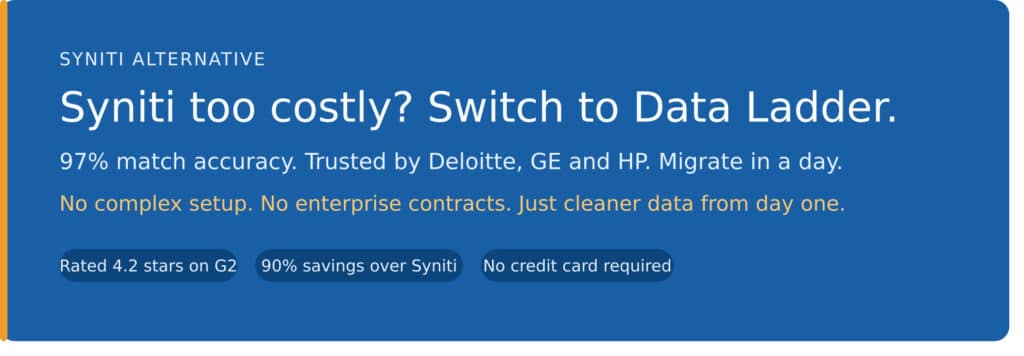
DataMatch Enterprise (Data Ladder) is Data Ladder’s platform for data profiling, cleansing, standardization, matching, deduplication, and entity resolution. Organizations can use its established Windows desktop and server products or the new browser-based, API-first platform with REST APIs and Docker deployment on Linux in on-premises or cloud environments. DME provides configurable algorithms, rules, fields, weights, and thresholds, making it a focused Syniti alternative when data quality and matching are the primary requirements.
Syniti (now part of Capgemini following its December 2024 acquisition) is an enterprise data management platform — Syniti Knowledge Platform (SKP) — purpose-built for SAP and ERP transformation programs, delivered through Capgemini’s consulting services and best suited for large enterprises executing multi-year data migration initiatives. Choose Data Ladder when matching speed, explainability, and standalone deployment matter; choose Syniti when SAP/ERP transformation with consulting-led delivery is the requirement.
Trusted by:
Deloitte · GE · HP · US Department of Transportation · US Department of Industrial Relations · 4,000+ customers, including over 500 enterprise customers, across government, financial services, healthcare, education, retail, and other sectors.
20 years building data matching technology. Headquartered in Suffield, Connecticut, USA.
Truth You Can Trace – Not Just Trust
“Trusted data” is a goal many data platforms claim (and aim) to deliver – and Syniti is no exception. With a strong legacy in ERP migration and master data governance, Syniti helps large enterprises align people, processes, and policies through its Syniti Knowledge Platform (SKP).
Note: Syniti was acquired by Capgemini in December 2024 and now operates as part of the Capgemini group. Buyers evaluating Syniti today are, in effect, evaluating a Capgemini-delivered solution — with the consulting-led pricing, delivery model, and ecosystem that implies.
In practice, trust without transparency is often not enough. It can leave business users in the dark – and even fail the very decisions it’s meant to support.
If you’re evaluating a Syniti alternative for business-friendly data matching, this is where the distinction becomes important.
Syniti’s data matching engine operates within SKP workflows and relies on technical users or services teams to manage matching logic. Business users often lack visibility into how scores are calculated or why records matched.
That’s where Data Ladder is different.
Data Ladder’s DataMatch Enterprise combines data profiling, cleansing, standardization, matching, deduplication, and entity resolution across CRMs, ERPs, spreadsheets, databases, and APIs. Users can configure algorithms, rules, fields, weights, and thresholds, then review and refine the results.
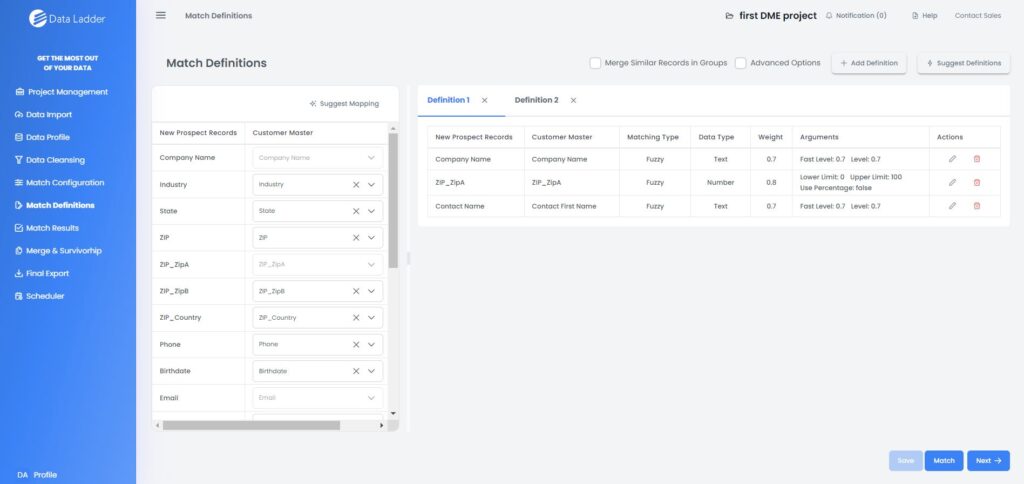
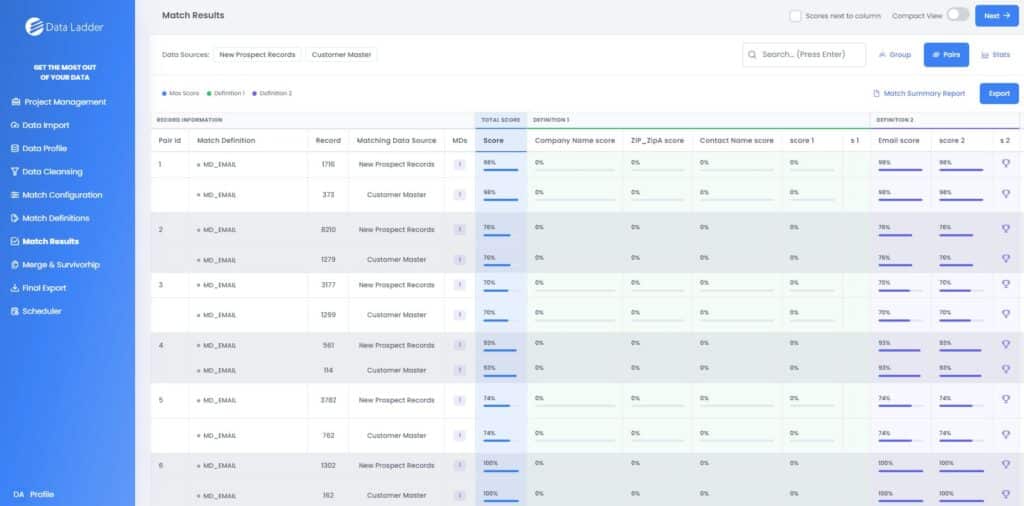
With DME, users can review match scores and adjust rule logic through visual workflows. Developers can integrate matching through REST APIs, while organizations can choose established Windows desktop/server products or the browser-based platform with Docker deployment on Linux in on-premises or cloud environments.
This Data Ladder vs. Syniti comparison explores where the two tools diverge – not in features, but in how they handle execution, transparency, and operational confidence.
What Is DataMatch Enterprise?
Organizations can use DataMatch Enterprise’s established Windows desktop and server products or its new browser-based, API-first platform. The new platform includes REST APIs, Docker deployment on Linux in on-premises or cloud environments, Entity Graphs, and Live Search. Licensing depends on the selected product, deployment model, and organizational requirements.
The platform combines five core capabilities in a single unified workflow:
Data profiling
DataMatch Enterprise begins every project with automated data profiling that identifies completeness gaps, format inconsistencies, statistical anomalies, and pattern violations across source data. Business users see exactly where the data quality issues live before matching begins — no separate profiling tool, no consulting engagement required to surface data patterns.
Data matching
The matching engine supports fuzzy, phonetic (Soundex, Metaphone), exact, probabilistic, composite-field, and domain-specific matching algorithms — all configurable with adjustable thresholds and weights through a no-code interface. Every match decision is traceable to a documented rule, weight, and threshold, making matching auditable at the rule level rather than opaque to the customer.
Entity resolution
Entity resolution unifies customer, vendor, patient, and product records across disparate sources into single verified entities — reconciling variations like “John A. Smith” with “J. Smith” or matching customer records spread across CRM, ERP, and billing systems. DataMatch Enterprise handles entity resolution as a native platform capability rather than a separately licensed module or consulting workstream.
Data deduplication
Deduplication runs against configurable match rules to identify and consolidate duplicate records within and across datasets — reducing customer databases from millions of duplicated records to single golden records with full lineage of how the consolidation happened. The platform handles deduplication at enterprise scale (100M+ records tested in production) with in-memory processing that completes in hours rather than the days typical of batch-oriented enterprise platforms.
Survivorship and golden records
Built-in survivorship rules determine which values win when duplicates merge — producing the single, authoritative golden record that downstream systems, analytics, compliance reporting, and AI pipelines can trust. Survivorship rules are user-configurable rather than platform-locked, so data stewards can adjust survivorship logic as business definitions evolve without a services engagement.
DataMatch Enterprise deploys as a desktop application, an on-premises server, or through the DataMatch Enterprise Server API for production integrations. All capabilities are included in the base license — no per-record metering, no per-module licensing, no feature gating. The platform is deployed across Fortune 500 enterprises, US federal and state agencies, and regulated industries spanning healthcare, financial services, insurance, and government.
What Is Syniti Knowledge Platform
Syniti Knowledge Platform (SKP) is an enterprise data management platform delivered as a unified suite covering data migration, data quality, data matching, replication, governance, and master data management. The platform is the core product Syniti has built its business on, with particular depth in SAP and ERP transformation programs — including SAP S/4HANA migrations, M&A data integration, and large-scale data archiving and decommissioning initiatives.
SKP combines six functional modules under one platform: Migrate, Quality, Match, Replicate, Catalog & Governance, and Master Data Management. Customers typically license SKP as part of a broader Syniti engagement that includes Capgemini consulting services for implementation, configuration, and ongoing operation — particularly for the SAP transformation use cases Syniti markets most heavily.
Note: As of December 2024, Syniti operates as part of Capgemini following Capgemini’s acquisition. SKP remains the named product, but the broader Syniti business is now integrated into Capgemini’s data-driven transformation practice. Buyers evaluating Syniti today are, in practical terms, evaluating a Capgemini-delivered solution — with the consulting-led pricing, delivery model, and ecosystem that implies. This comparison covers Syniti Knowledge Platform as the named product; it is not a comparison against Capgemini’s broader consulting services portfolio.
Syniti vs. Data Ladder: Strategic Decision Matrix – At a Glance
| Key Factor | Syniti (SKP) | Data Ladder (DME) |
| Primary Purpose | (Now part of Capgemini following December 2024 acquisition.) Data transformation, governance, ERP migration, and MDM for large enterprises. | Fast, accurate data profiling, record matching, cleansing, and deduplication across sources. |
| Deployment Time | Long; typically weeks to months; service-led with governance alignment. | Deploy in hours, usable same day; self-service or guided setup. |
| Best Fit For | Organizations executing large or complex SAP/ERP transformations, centralizing governance and MDM workflows. | Teams needing fast, auditable data matching and deduplication. Ideal for teams seeking a lightweight Syniti replacement for data cleansing and matching. |
| Governance Dependency | High – matching is embedded in SKP governance workflows. | None – runs independently or alongside existing infrastructure. |
| Data Matching Capabilities | Available within SKP workflows, not standalone. | Core strength: fuzzy, phonetic, numeric, exact, and domain-specific matching. |
| Usability | Requires platform knowledge or training; typically IT- or consultant-led. | Desktop and browser-based interfaces for users; REST APIs for developers and integrations |
| License Structure & TCO | Enterprise licensing; TCO for Syniti varies with scope and services. | Fixed license; subscription licensing based on the selected product, deployment model, and requirements |
Execution Risk: Who’s Really in Control?
| Dimension | Syniti (SKP) | Data Ladder (DME) |
| User Involvement | Consultant-led; workflows often managed by governance or IT teams. | Business users can run matching jobs independently with little to no IT support. |
| Logic Transparency | Matching logic often embedded in transformation rules or hidden behind platform workflows. | All logic is visual, adjustable, and transparent – with real-time previews and full traceability. |
| Iteration Speed | Slower; changes involve coordinated QA, approvals, and workflow rework. | Rapid – adjust rules, test, preview matches, and tune results in a single session. |
| Governance Dependencies | Designed to align with governance models, not bypass them; matching happens inside governed SKP processes. | None. Designed to work independently or complement existing governance programs – no dependency on metadata models or transformation orchestration. |
| Execution Risk | Higher – if configurations are off or transformations misfire, business impact is delayed. Errors can take time to surface. | Lower – full control over match behavior, real-time validation. Users see exactly what happens and can adjust rules immediately. |
Syniti’s approach assumes long-term governance maturity and centralized coordination. Data Ladder assumes you need to fix something now – and gives you the tools to do it with full visibility and control. It’s a great alternative to Syniti when speed, transparency, and precision all matter equally.
DataMatch Enterprise vs Syniti Knowledge Platform: Full Feature Comparison
The table below compares both platforms across the criteria enterprise buyers evaluate when choosing between standalone data matching software and a consulting-delivered enterprise data management platform.
| Evaluation Criterion | DataMatch Enterprise (Data Ladder) | Syniti Knowledge Platform (Capgemini) |
|---|---|---|
| Matching & Data Quality | ||
| Matching algorithms | Fuzzy, phonetic, exact, probabilistic, composite-field, and domain-specific — all configurable | Matching within SKP workflows; configuration via Syniti’s services team or platform-trained users |
| Explainable match decisions | Every match traceable to a documented rule, weight, and threshold — fully auditable by business users | Matching logic embedded in SKP transformation workflows; visibility varies by configuration |
| Survivorship & golden records | Built-in survivorship rules with versioning and audit trail | Native survivorship within SKP master data management module |
| Integrated data quality | Profiling, cleansing, parsing, standardization built into the matching workflow | Delivered through SKP Quality module as part of the platform suite |
| Architecture & Delivery | ||
| Platform architecture | Windows desktop/server products plus a browser-based, API-first platform | Integrated suite — Migrate, Quality, Match, Replicate, Catalog & Governance, Master Data Management modules |
| Deployment model | Windows desktop/server; browser-based platform; REST APIs; Docker on Linux for on-premises or cloud deployment | Consulting-led — typically delivered with Capgemini services for configuration and ongoing operation |
| Time to value | Varies according to project scope, configuration, integrations, and validation | Weeks to months depending on scope and services engagement |
| Required expertise | Business users, analysts, and stewards operate independently — no certification needed | Typically requires Syniti-certified consultants or Capgemini delivery teams |
| Use Case Fit | ||
| ERP migration (SAP, Oracle, Workday) | Strong matching and dedup for migration data preparation; ERP-agnostic | Syniti’s signature use case — particularly SAP S/4HANA migration with SAP Integrated Toolchain |
| Standalone data matching projects | Core platform purpose — operational matching at point of need | Available but typically embedded inside broader SKP transformation programs |
| AI-ready data foundation | Cleansed, deduplicated golden records suitable for RAG, knowledge graphs, and AI agents | Capgemini-led “AI-ready data foundation” positioning supports AI/ML initiatives at enterprise scale |
| Mid-market deployments | Built for mid-market through enterprise — no consulting requirement | Designed for large enterprise with Capgemini delivery scope |
| Commercial Model | ||
| Pricing model | Subscription licensing based on the selected product, deployment model, and requirements | Enterprise licensing typically bundled with Capgemini consulting services; total contract value includes services scope |
| Cost predictability | Known at contract signing — independent of data volume or services scope | Varies with project scope, services involvement, and engagement duration |
| Best fit | Matching-focused organizations, mid-market through enterprise, teams seeking self-service deployment without consulting dependency | Large enterprises executing SAP/ERP transformation programs with Capgemini-led delivery aligned to broader digital transformation initiatives |
Data Matching for SAP S/4HANA Migrations: DataMatch Enterprise vs Syniti
SAP S/4HANA migration is Syniti’s most heavily marketed use case — and one of the most demanding data quality scenarios in enterprise IT. Migrating from legacy SAP ECC (or non-SAP source systems) to S/4HANA requires deduplicating customer, vendor, material, and finance master data; standardizing records to S/4HANA’s modeling requirements; and resolving identity conflicts across systems that may have diverged over decades of independent operation. Both DataMatch Enterprise and Syniti Knowledge Platform address this scenario, but through very different operational models.
How Syniti approaches S/4HANA migrations
Syniti’s signature SAP offering is the SAP Integrated Toolchain — a delivery model combining SKP modules (Migrate, Quality, Match, Catalog & Governance) with Capgemini consulting services. Typical engagements involve dedicated Syniti or Capgemini consultants embedded in the customer’s project team for the duration of the migration — often 12-24+ months for large enterprise transformations. The Forrester Total Economic Impact study Syniti markets focuses on this delivery model, demonstrating risk and cost reduction at large-enterprise scale.
Syniti’s strength in this scenario is the depth of SAP-specific expertise embedded in both the platform and the services delivery — including selective data transition methodologies, rapid data governance configurations, and SAP-specific data modeling. For organizations executing major SAP transformations as multi-year programs, this end-to-end delivery model aligns with how SAP transformations are typically managed.
How DataMatch Enterprise approaches S/4HANA migrations
DataMatch Enterprise approaches SAP migration as a focused data matching and cleansing project rather than a full transformation program. The platform handles the data quality components of S/4HANA migration — deduplicating customer, vendor, and material master records; cleansing and standardizing source data to S/4HANA target schemas; resolving identity conflicts across source systems — operated by the customer’s own data team rather than a consulting partner.
For organizations whose SAP migration project includes a dedicated data matching workstream — independent of the broader transformation program management — DataMatch Enterprise typically completes the matching component in weeks rather than the months Syniti’s full-program model assumes. The output (clean, deduplicated, standardized master data) loads into S/4HANA through the standard SAP migration tooling.
When each approach fits the migration
The decision typically follows two factors:
- Program scope. When the SAP S/4HANA migration is a multi-year transformation program with hundreds of stakeholders, complex governance requirements, and dependency on consulting partners for execution, Syniti’s integrated platform + services model fits the operating context. When the migration is bounded — a specific phase, business unit, or data domain — DataMatch Enterprise’s focused matching capability completes the data quality workstream without the broader program overhead.
- Internal capability. When the customer has limited internal data engineering capacity and is relying on a consulting partner for migration execution, Syniti’s services-led delivery is operationally aligned. When the customer has internal data and analytics teams who can operate matching software directly, DataMatch Enterprise’s self-service model removes the consulting dependency.
For organizations executing SAP S/4HANA migration as part of a broader Capgemini-led transformation, Syniti is the natural fit. For organizations whose data matching needs are bounded — even within a larger SAP project — DataMatch Enterprise delivers the matching capability without committing to the full Capgemini engagement model.
Explainable Matching vs Consulting-Led Workflows
The explainability distinction that separates DataMatch Enterprise from many enterprise data platforms applies particularly sharply in the Syniti comparison. Where Syniti’s matching logic typically lives inside consulting-managed SKP workflows — configured by Capgemini delivery teams or Syniti-certified consultants and tuned through services engagements — DataMatch Enterprise exposes every match rule, weight, and threshold to business users and data stewards directly.
This is not a critique of consulting-led delivery in principle. For large SAP transformation programs, consulting partners deliver enormous value — managing complexity, navigating organizational change, ensuring methodology compliance. The constraint is structural: when matching logic lives inside services-managed workflows, the customer’s own data team cannot inspect, adjust, or audit match decisions without going back through the services engagement.
DataMatch Enterprise’s rule-level transparency means match decisions are documented, reproducible, and auditable directly by the customer’s data team — not gated through a services relationship. For organizations in healthcare, financial services, insurance, and government where audit-ready matching is a compliance requirement rather than a preference, this distinction is structural.
AI-Ready Data Foundation: DataMatch Enterprise vs Syniti’s AI Positioning
Syniti has repositioned around AI-readiness over the past 18 months, with Capgemini’s broader AI investment shaping the platform’s roadmap. Syniti’s current homepage leads with “Build an AI-Ready foundation that endures.” For organizations evaluating Syniti today, the AI-ready framing is central to the buying conversation — and the same conversation needs to happen with DataMatch Enterprise.
Configurable matching for reliable entity resolution
DataMatch Enterprise supports fuzzy, phonetic, exact, probabilistic, composite-field, and domain-specific matching. Users can configure fields, algorithms, rules, weights, and thresholds, then review and refine results through the interface..
Producing AI-ready data for downstream systems
Clean, deduplicated, well-resolved master data is a prerequisite for trustworthy AI. DataMatch Enterprise produces the deduplicated, standardized golden records that AI systems need as input — the single, verified version of each customer, product, or vendor entity. The output is ready to feed RAG pipelines, knowledge graphs, AI agents, and customer 360 personalization models, so downstream AI operates on one authoritative record per entity rather than fragmented copies.
For deeper detail on preparing data for AI systems, see our AI readiness overview
What changes for iteration speed
Match rules evolve as data changes. New source systems get added; business definitions shift; regulatory requirements update; matching thresholds need tuning as false-positive or false-negative patterns emerge. In a consulting-managed model, every iteration involves coordination with the services partner — scope clarification, change order processing, QA cycles, redeployment. In a self-service model, the customer’s data team adjusts rules, previews results, and validates changes within hours rather than weeks.
For organizations whose data quality program is mature enough to support continuous rule tuning, the iteration speed difference compounds significantly over time. Annual cost of rule changes in a consulting-managed model is materially higher than in a self-service model — not because the consultants are inefficient, but because every change requires services coordination.
Explainable matching as a structural choice
The DataMatch Enterprise approach is not “matching without consulting” as a marketing position — it’s matching designed so that consulting is optional rather than required. Customers who want services engagement can purchase it; customers who prefer to operate the software independently can do so without compromising the platform’s enterprise capability. Explainable matching is matching the customer controls — not matching the services partner controls.
What changes for compliance and audit
In regulated environments, the consulting-managed model has operational consequences. When a compliance officer asks why two customer records were merged, the answer needs to be reproducible by the customer — not by the consulting partner. “The Syniti configuration in our SKP environment matched these records” is not equivalent audit evidence to “the rule weighted Customer ID, Tax ID, and Address with documented thresholds, applied at this date, by this user.”
Truth in Matching: Clarity Over Confidence
It’s one thing to match records, it’s another to prove that the matches are correct – to auditors, regulators, stakeholders, or skeptical executives.
| Matching Element | Syniti (SKP) | Data Ladder (DME) |
| Match Methods | Primarily rule-based within services-defined workflows; no standalone matching module. | Phonetic, fuzzy, numeric, exact, and domain-specific rules – all configurable without coding. |
| Auditability | Match rationale can be hard to trace without deep platform knowledge; logic is dispersed across services, workflows, and metadata. | Every rule, weight, and result is logged, reviewable, and adjustable. |
| Explainability for Business Users | Typically requires technical interpretation. | Visual match builder with real-time feedback and human-readable scoring and rule logic. |
| False Positives/Negatives | May be hard to detect without structured QA cycles. | Easy to preview, validate, and tune matching thresholds in real time. |
| Transparency | Match logic embedded in complex workflows; rules may span multiple components. Visibility varies. | 100% transparent: users can see and validate each match scenario. |
Explainability might be a luxury or nice-to-have for some, but in industries like healthcare, insurance, and finance, it’s mandatory. Syniti focuses on governance-aligned data quality at the metadata level, but Data Ladder delivers it at the match-result level, where business decisions actually happen. DME focuses on in-the-moment clarity, helping users prove, trust, and act on match results with full confidence.
Operational Fit: Do You Need a Program – or a Product?
| Use Case | Syniti (SKP) | Data Ladder (DME) |
| ERP Migration | Deep planning and services layer; may require full data transformation. | Lightweight, visual match/merge that complements migration. Works alongside or instead of SKP tools to clean data pre-migration. |
| One-Off Data Cleanup | Too heavy for small projects or one-off needs. | Perfect Syniti alternative for one-off projects – offers quick, visual deduplication and export. No technical setup required. |
| 3rd-Party Data Matching | Data imports are possible but typically require governance context and workflow setup. | Plug-and-play setup; connects to diverse sources, including Excel, CSV, SQL, databases, and APIs. |
| Ongoing Match Jobs in Pipelines | Possible, but usually as part of broader Syniti Knowledge Platform – with workflow configuration. | Built-in automation, scheduling, and API support for pipelines. |
| Non-Technical User Involvement | Limited – mostly administrator- or consultant-driven. | Central – non-technical users can configure, preview, and validate. |
Syniti may be a strong choice when you’re launching a multi-year data governance program. Data Ladder is ideal when you need answers this quarter or this week. If you’re looking for a faster Syniti alternative for data matching and cleansing, Data Ladder is your best bet.
Data Ladder vs. Syniti: Real-World Scenarios – Who Wins Where?
| Scenario | Syniti (SKP) | Data Ladder (DME) |
| Cleaning customer records pre-campaign | Requires platform configuration, transformation rules, and stewardship approval. | Load/import, match, preview, export — all in a single session. |
| Merging two Salesforce orgs | Full project cycle: mapping, rules, stewardship, QA. | Plug in records, apply match rules, review edge cases visually. |
| Healthcare data deduplication | Can support but may require custom rule writing and workflows. | Built-in fuzzy logic for name, ID, DOB – highly tunable, no coding needed. |
| Vendor list cleanup | Not an ideal use case. | Simple and fast: dedupe across multiple attributes in minutes. Perfect Syniti alternative for fast list cleanups. |
Final Word: Do You Need Focused Matching or Full Governance?
Syniti offers a comprehensive data governance and MDM platform. Its strength lies in enabling large-scale SAP and ERP transformations and long-term stewardship. For teams managing large, complex enterprise programs, it delivers structure, metadata lineage, and governance at scale.
However, when you need clean, usable, verifiable data – now – then Data Ladder is the better Syniti alternative for business users and agile teams. It puts match logic in plain sight, lets business users stay in control, and helps you fix data issues fast without losing transparency or waiting a project plan.
Ready to replace Syniti for data matching and cleansing?
Download a free data matching software trial or book a live personalized demo with our expert to see how Data Ladder gets your data right – without the risk, drag, or delay.
Evaluating other enterprise data quality and MDM platforms? This page compares Data Ladder and Syniti directly. For organizations surveying the wider market — including Informatica, Reltio, IBM Match 360, and other consulting-led platforms — see our ranked guide to the best entity resolution software. For a closely related comparison covering a similar consulting-led, governance-platform model, see Data Ladder vs Informatica.
Frequently Asked Questions
1. What is the best Syniti alternative for data matching and deduplication?
For teams prioritizing transparency, speed, and ease of use, Data Ladder is one of the best Syniti alternatives available. If offers fast deployment, no-code matching, and clear scoring logic with real-time previews and full transparency for business users.
2. Is Data Ladder a good Syniti replacement for ERP data cleanup and migration prep?
Yes. While Syniti is a strong tool for full ERP transformation programs, Data Ladder’s matching software DataMatch Enterprise is a powerful Syniti replacement for upfront data preparation – such as cleaning, matching, and deduplicating records before migration. It integrates easily with ERP systems, accelerates timelines, and ensures cleaner cutover with less effort. For teams reevaluating broad data platforms, it also helps to review the current PowerCenter end-of-life migration strategy and decide which workloads should move to modern ETL versus specialized matching tools.
3. Does Data Ladder offer better transparency than Syniti?
Absolutely. All matching logic in Data Ladder is visual, explainable, and adjustable by business users, unlike Syniti where it may be embedded within workflows or services. Data Ladder also offers human-readable explanations for match rules and real-time previews. That means you don’t just trust the match; you can also prove it, adjust it, and explain it.
If your use case demands a more transparent data matching alternative to Syniti, Data Ladder is a top pick.
4. Can Data Ladder be used for real-time matching workflows?
Yes. DataMatch Enterprise includes full API support for real-time or scheduled matching in active data pipelines, making it a lightweight but powerful Syniti replacement for execution-heavy jobs.
5. Is Syniti or Data Ladder better for business users?
Data Ladder is generally the better fit when business users need to run profiling, matching, and deduplication with less dependence on large platform workflows. Syniti is stronger when organizations want a unified environment spanning data quality, migration, governance, and MDM across enterprise initiatives.
6. Can Data Ladder replace Syniti for data deduplication and entity resolution?
For matching-led use cases, often yes. DataMatch Enterprise is purpose-built for fuzzy, phonetic, numeric, and exact-style matching, plus cleansing, deduplication, and entity resolution. That makes it a practical Syniti replacement when the core need is record resolution rather than a full governance or migration platform.
7. What is the difference between DataMatch Enterprise and Syniti Knowledge Platform?
DataMatch Enterprise is a focused data matching and data quality platform available through established Windows desktop/server products and a browser-based, API-first platform with configurable matching workflows. Syniti Knowledge Platform (SKP) is an enterprise data management platform delivered through Capgemini consulting services, purpose-built for SAP and ERP transformation programs. DataMatch Enterprise is best for organizations needing matching as a focused capability operated independently; Syniti is best for large enterprises executing SAP transformation programs with consulting-led delivery.
8. How does Syniti pricing work post-Capgemini acquisition?
Syniti engagements are typically structured as enterprise contracts combining SKP software licensing with Capgemini consulting services — implementation, configuration, ongoing operation, and often multi-year support. DataMatch Enterprise uses flat subscription licensing with all capabilities included and no bundled services requirement, which produces lower TCO for matching-focused workloads and more predictable cost forecasting.
9. Can DataMatch Enterprise replace Syniti for SAP S/4HANA migrations?
For the data matching and data quality components of SAP S/4HANA migrations, DataMatch Enterprise delivers equivalent or better outcomes with significantly faster timelines. Syniti remains the stronger fit when the SAP transformation is a multi-year program with consulting-led delivery. For bounded SAP projects or specific data domains, For organizations with a dedicated data matching workstream, DataMatch Enterprise can support the data profiling, cleansing, matching, deduplication, and standardization components of an SAP S/4HANA migration. Syniti may be the stronger fit for broader transformation programs requiring integrated governance and consulting-led delivery. The appropriate choice and timeline depend on the project’s scope, systems, data, integrations, and validation requirements.
10. Can I run DataMatch Enterprise alongside Syniti during an SAP migration?
Yes. Organizations executing SAP transformation programs with Syniti often use DataMatch Enterprise alongside SKP for specific matching workloads — particularly when business unit timelines or data domain scope don’t fit the broader transformation program cadence. Syniti handles the integrated transformation program while DataMatch Enterprise handles bounded matching projects that the central program cannot accommodate on the required timeline.
How long does it take to migrate from Syniti to DataMatch Enterprise?
Most migrations complete in weeks rather than the months typical of consulting-led platform implementations. Because Syniti’s matching logic lives inside services-managed SKP workflows, migration centers on rebuilding match definitions in DataMatch Enterprise’s no-code interface against documented business outcomes, then validating results in a parallel run before cutover.