



































Last Updated on July 30, 2026
Quick Verdict
The best fuzzy matching tool depends on the scale of the project, data sources, and technical resources available. DataMatch Enterprise is best suited to mid-market and enterprise teams that need configurable fuzzy, phonetic, and deterministic matching across multiple data sources without building and maintaining custom code. WinPure is better suited to smaller desktop-based cleanup projects, while open-source libraries are better for engineering teams that want to build their own matching workflow.
Fuzzy matching software identifies records that likely refer to the same real world entity even when the text doesn’t match exactly. Instead of a yes or no comparison, it calculates a similarity score for each pair of records using algorithms like Levenshtein distance, which counts the number of single character edits needed to turn one string into another, or Jaro-Winkler, which weights similarity more heavily at the start of a string and tends to perform better on names.
Phonetic algorithms like Soundex and Metaphone take a different approach entirely, encoding words by how they sound rather than how they’re spelled, which is why they catch a pair like “Catherine” and “Kathryn” that character based methods often miss. Once a score is calculated, the software classifies each pair as a match, a non-match, or a candidate for manual review based on a threshold you set.
This guide is for data teams evaluating a fuzzy matching tool against a real environment. We’ll walk through what actually separates a good fit from a bad one, then compare 9 tools data teams are using in 2026 across features, pricing, and where each one tends to fall short.
Fuzzy Matching, Data Matching, Deduplication, and Entity Resolution Are Not the Same Thing
Vendors use these four terms interchangeably because a broader definition expands what a product can claim to do. That’s a problem for buyers, since a tool built for one of these jobs often isn’t built for the others, and the wrong purchase decision here tends to be expensive to unwind months into an implementation.
Fuzzy matching is a technique that compares two strings and returns a similarity score using character based, token based, or phonetic algorithms. A tool that only does fuzzy matching will tell you that “Acme Corp” and “Acme Corporation” are probably the same company, but it won’t tell you what to do with that information, merge the records, flag them for review, or feed them into a broader matching workflow. That decision layer sits above the technique itself.
Data matching is the broader process fuzzy matching feeds into. It includes exact matching for fields like tax IDs or account numbers, fuzzy matching for fields like names and addresses, and increasingly probabilistic or machine learning based matching that weighs multiple fields together. A data matching platform combines these methods and applies rules for how to score and act on the combined result, which is what most enterprise buyers actually need rather than a single algorithm.
Deduplication is one specific outcome of data matching, focused on finding and removing or merging duplicate records within a single dataset. A marketing team cleaning up a CRM where the same customer appears three times under slightly different name spellings is running deduplication. It’s matching applied to one dataset with the goal of consolidation rather than linkage across sources.
Entity resolution goes a step further. Instead of just flagging that two records are similar, it builds a consolidated view of an entity, a person, a company, a household, by resolving matches across many sources, and merging and purging data so that the best available data is consolidated into a single ongoing golden record. A healthcare network linking a patient’s records across five different clinics into one accurate chart is doing entity resolution, not simple deduplication, because the goal is an evolving unified record rather than a one time cleanup.
Getting this distinction wrong at the buying stage is how organizations end up with an entity resolution platform sized for a simple CRM cleanup job, or a lightweight deduplication tool asked to do the ongoing multi-source mastering work of entity resolution. Both mistakes are expensive, just in different directions.
How to Evaluate Fuzzy Matching Software for Your Environment
Most vendor comparisons reduce this decision to a feature checklist, phonetic matching, and API access, which makes every enterprise tool look roughly interchangeable on paper. In practice, the deciding factors are less about which boxes a tool checks and more about whether it fits your data, your team, and your timeline.
Four factors separate a good fit from a bad one more than any feature list will:
Algorithm depth matters because different data types need different algorithms. Personal names benefit from phonetic methods like Soundex or Metaphone. Business names and addresses respond better to token based methods like Jaccard similarity. A tool that only offers one algorithm family will underperform the moment your data gets varied, which is almost always, since most real datasets mix names, addresses, and identifiers in the same file.
Deployment model determines how fast you see results. On premise enterprise suites can take months to configure before the first real match runs. Cloud native, self-service platforms can be running against real data within days. Python libraries sit somewhere in between, fast to prototype with but requiring engineering time to productionize into something a non-technical team can actually operate.
Technical resource requirement is often underestimated during evaluation. A tool that requires a dedicated data engineering team to configure and maintain has a real ongoing cost even after the license is signed, and that cost falls hardest on smaller teams who don’t have a spare engineer to dedicate to match rule maintenance.
Scalability at your actual volume separates tools that work in a demo from tools that work in production. A method that performs well on ten thousand records can become computationally impractical at ten million without blocking or indexing strategies built in, since naive fuzzy matching compares every record against every other record unless the tool limits that comparison intelligently.
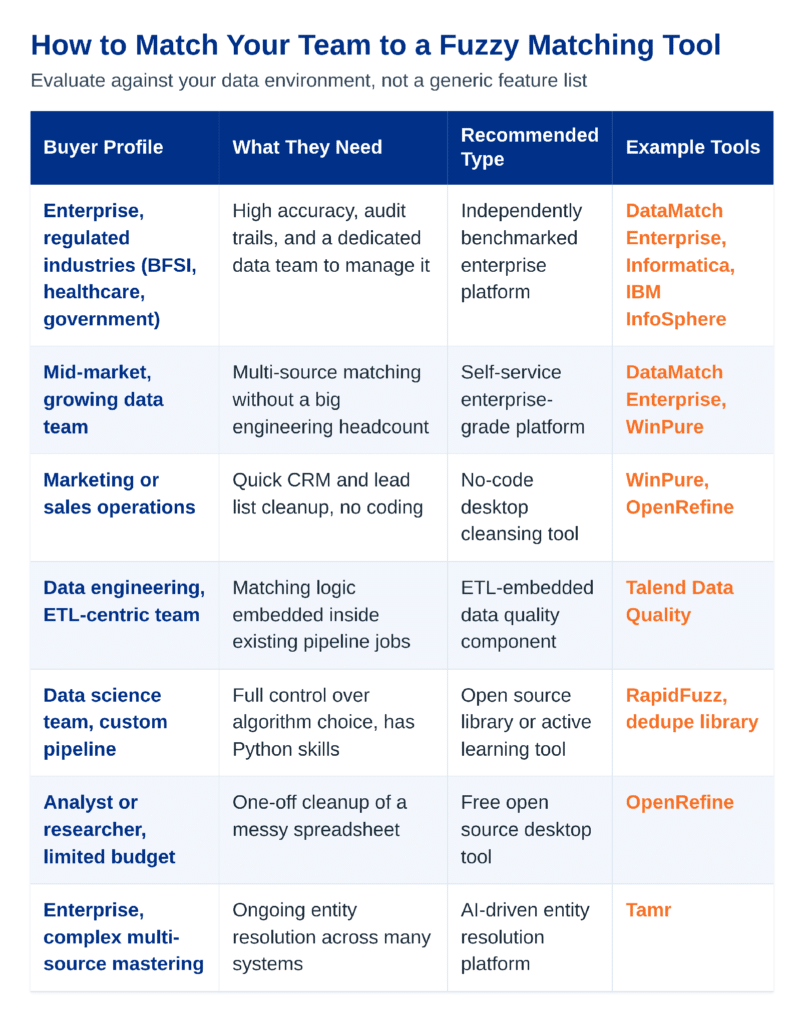
These four factors interact in practice more than they operate independently. A mid-market insurance team with a small IT staff and eight million policy records needs both a wide algorithm set for the mixed name, address, and claim ID matching, and a self-service deployment model, because they don’t have the engineering headcount to babysit an on premise suite. A single-analyst research team cleaning one spreadsheet a quarter has the opposite profile entirely and would be overserved and overspent on the same enterprise platform. The table below maps common buyer profiles to what each one should actually prioritize.
How We Evaluated These Tools
We selected nine tools representing enterprise data-quality platforms, self-service matching applications, AI-assisted entity-resolution products, and open-source libraries. Each product was reviewed using current vendor documentation, public pricing information, integration and deployment details, matching methods, scalability, technical requirements, and independent user feedback.
We assessed every tool against the same criteria: algorithm depth, ease of implementation, technical resources required, scalability, and best-fit use case. Unless specifically stated, this comparison is based on desk research rather than hands-on product testing.
DataMatch Enterprise was evaluated using the same criteria as the other products. Because Data Ladder publishes this guide, readers should independently confirm current features, pricing, and suitability with each vendor.
Information reviewed: July 2026.
The 9 Best Fuzzy Matching Software Tools
1. DataMatch Enterprise
DataMatch Enterprise (DME) is built specifically for data matching, deduplication, cleansing, and enrichment, without requiring a line of code. The matching engine combines deterministic, fuzzy, and phonetic methods including Levenshtein distance, Soundex, Metaphone, and Jaro-Winkler, with configurable field level weighting and threshold controls that let a data steward tune matches without going back to IT.
Key features at a glance
- Code-free drag and drop rules studio for matching, cleansing, and profiling
- Proprietary and standard fuzzy, phonetic, and deterministic matching algorithms
- Field level weighting and configurable threshold controls
- Batch processing plus an Enterprise Server API edition for real time matching
- Native connectors to Salesforce, HubSpot, NetSuite, SQL Server, and similar CRM and database platforms
DME has been independently benchmarked against IBM and SAS across 15 comparative studies, finding 5 to 12 percent more matches with fewer false positives, and in head to head testing found 53 percent more matches than WinPure. A free trial is available and no credit card is required.
Because the interface is no-code, most teams deploy without a dedicated engineering resource, and deployment is typically measured in days rather than the months common with Informatica or IBM implementations. One G2 reviewer working with a large provider dataset noted simply that “the speed is incredible.”
Best fit is mid-market to enterprise data teams managing multi-source environments, CRM, ERP, healthcare, financial, or government datasets, who have already tried scripting a solution or using a lighter tool and hit a wall on accuracy or scale. Teams already fully invested in an existing Informatica or IBM ecosystem may find less incremental value here, since DME is purpose-built for matching rather than a full MDM suite.
2. WinPure
WinPure Clean & Match is a Windows-based desktop tool aimed at non-technical users who need straightforward deduplication and fuzzy matching without an implementation project. It supports phonetic, alphanumeric, and semantic matching, along with name and address parsing, and connects to common sources including Excel, Access, SQL Server, and Salesforce.
Key features at a glance
- No-code desktop interface with cross match, merge, and purge workflows
- Phonetic, alphanumeric, and semantic fuzzy matching algorithms
- Custom abbreviation and name dictionaries for standardization
- API access for CRM and database connections
- Audit trail and non-destructive match review before merging
Winpure offers a free trial to test the tool before buying. Because it’s a desktop tool built for non-technical users, it requires effectively no developer resources to get running, though reviewers note that fuzzy search computing time increases noticeably on very large files. A Capterra reviewer working with large datasets said the tool “does what it’s supposed to do really well and very quickly.”
Best fit is small to mid-market teams that need a no-code desktop tool for CRM and marketing list cleanup. It’s less suited to enterprise scale multi-source matching or workloads that need deep API level integration into a broader data pipeline.
3. Informatica Data Quality
Informatica Data Quality offers enterprise-grade probabilistic matching, deduplication, and entity resolution as part of the broader Informatica Intelligent Data Management Cloud. Algorithm support spans ML powered, fuzzy, exact, configurable scoring, and cluster matching, deployable as cloud native SaaS, on premise, or hybrid.
Key features at a glance
- ML powered and rule based matching with configurable scoring
- CLAIRE AI engine for rule suggestions and data classification
- Cloud native SaaS, on premise, or hybrid deployment
- Centralized rule repository shared across data quality and MDM projects
- Data lineage, profiling, and score carding built into the same platform
Pricing runs on Informatica Processing Units, a consumption based model, with data quality licensing reported to run anywhere from roughly 50,000 to 200,000 dollars or more annually depending on data volume, separate from implementation and training costs. Deployments typically require dedicated ETL developers or architects, and the platform’s own G2 reviews reflect that investment, with one reviewer noting “the biggest downside to IDQ is the relative cost to other tools.”
Best fit is large enterprises already standardized on the Informatica ecosystem for broader data integration, where matching is one module within a much larger platform investment. Teams that need matching accuracy and speed without months of configuration are often better served by a purpose-built matching tool.
4. IBM InfoSphere QualityStage
IBM InfoSphere QualityStage delivers advanced data matching paired with survivorship rules, the logic that decides which value wins when multiple source records disagree, for high accuracy record linkage at large scale. It’s built to operate as part of IBM’s broader information integration stack rather than as a standalone matching tool.
Key features at a glance
- Probabilistic matching with configurable survivorship rules
- Deep data profiling including column analysis and relationship analysis
- Native parallel connectivity to Oracle, SQL Server, Teradata, and DB2
- Integration with IBM Information Server for lineage and governance
- Available for IBM System z environments
Pricing isn’t published and requires a direct quote from IBM, with no free trial offered. Implementation typically requires skilled data engineering resources familiar with IBM’s ecosystem, and reviewers consistently flag the learning curve as the main tradeoff, with one G2 review summarizing that “the main drawback is the steep learning curve.”
Best fit is large enterprises with existing IBM infrastructure and dedicated data engineering resources to manage configuration and survivorship rule design. Organizations without an existing IBM footprint or a data engineering team to support ongoing tuning will likely find the setup cost outweighs the matching capability itself.
5. Talend Data Quality
Talend’s data quality suite embeds fuzzy matching directly into ETL pipeline development, supporting both rule based and machine learning based match logic within the same workflow used for broader data integration jobs. Talend Open Studio, the free open source edition that once introduced many teams to the platform, was discontinued in January 2024, so current access runs through the commercial Qlik Talend Cloud.
Key features at a glance
- Rule based and machine learning based matching embedded in ETL jobs
- Centralized rule definitions shared across integration and quality workflows
- Hundreds of prebuilt connectors to common data sources and warehouses
- Data profiling and standardization components in the same visual interface
- Capacity based pricing across Starter, Standard, Premium, and Enterprise editions
Pricing isn’t published and is quoted based on data moved, job executions, and job duration, so total cost varies significantly by workload. There’s no self-service free tier anymore, and reviewers describe a real ramp up period, with G2 reviewers cited by independent research describing the platform as “very complex even for simplest of tasks.”
Best fit is IT and data engineering teams centralizing multiple data pipelines who want matching logic to live inside the same tool as their transformation jobs. Business users needing self-service matching without engineering support will find the interface built for developers rather than data stewards.
6. Tamr
Tamr is built for entity resolution and data mastering rather than simple string comparison. Its patented active learning approach incorporates human feedback to continuously refine matching models across many disparate data sources, unifying records that reference the same real world entity despite typos, abbreviations, or format inconsistencies.
Key features at a glance
- AI native matching with patented active learning and human feedback loops
- Real time mastering with API based read, write, and search access
- Pre-built data products for customer, supplier, and healthcare entity mastering
- 360 degree entity views linking records across source systems
- Continuous golden record updates that propagate to connected applications like Salesforce
Pricing is quote based and varies by data product and the number of golden records mastered, with Tamr RealTime features priced separately. Deployment requires a dedicated data mastering initiative rather than a quick self-service setup, though the company reports typical time to value in days or weeks rather than the months common with traditional rules-based MDM. One G2 reviewer described the platform as “helping us bring together data from multiple source systems” to build a standardized view.
Best fit is enterprises with complex, multi-source mastering needs, where the goal is an ongoing golden record across dozens of systems rather than a one-time deduplication pass. Teams with a narrower need, cleaning a single dataset or CRM, will find Tamr’s scope larger than the problem they’re solving.
7. dedupe (Python library)
Dedupe.io, the hosted version of this tool, was shut down permanently on January 31, 2023. What remains, and what’s still actively used, is the open source dedupe Python library it was built on, maintained by DataMade. It uses active learning, training a model from as few as 20 to 50 labeled examples to detect duplicates across messy, real world data.
Key features at a glance
- Active learning that trains on a small set of labeled example pairs
- Pure Python library, self-hosted with no vendor SaaS layer anymore
- Support for mixed field types including text, addresses, and numbers in one model
- Open source on GitHub, with paid consulting available directly from DataMade
The library itself is completely free and open source, so there’s no pricing tier to speak of. Since the hosted web app is gone, every bit of infrastructure, from uploading data to reviewing matches, has to be built by whoever implements it, which makes this meaningfully more engineering work than it was when Dedupe.io still existed as a product. DataMade offers paid consulting for teams that want help setting it up.
Best fit is data scientists and engineers comfortable with Python who want a matching model that improves with labeled feedback rather than fixed rules, and who are prepared to build their own interface around the library since no hosted option exists anymore. Teams that need a working tool without engineering time should look elsewhere on this list.
8. OpenRefine
OpenRefine is a free, open source desktop application built for cleaning and transforming messy tabular data through faceted browsing. Its fuzzy matching capability comes from clustering algorithms including key collision, nearest neighbor, and n-gram fingerprinting, which group similar strings together for manual review and merging, plus reconciliation against external sources like Wikidata.
Key features at a glance
- Faceted browsing for exploring and filtering messy data interactively
- Key collision, nearest neighbor, and n-gram clustering for fuzzy grouping
- Reconciliation against external knowledge bases like Wikidata
- Full change history so every transformation can be reviewed or undone
- Completely free with no licensing cost of any kind
There’s no cost at all since OpenRefine is open source, and no vendor to negotiate pricing with. It requires no coding, though reviewers note a real learning curve before the interface feels natural, with one G2 review noting the tool “made it so much simpler to do this and at a fraction of that time” once past that initial learning period.
Best fit is analysts and researchers working with inconsistent, real world spreadsheets who need capable fuzzy clustering on no budget. It’s a desktop tool built around manual review rather than automated production workflows, so it doesn’t scale to the record volumes or unattended batch processing that CRM or ERP level deduplication typically needs.
9. RapidFuzz
RapidFuzz is a Python library and the modern, faster successor to FuzzyWuzzy, built on Levenshtein distance with support for partial and token based matching. It’s optimized for production environments in a way its predecessor wasn’t, making it a common choice for engineers scripting custom match logic directly into an application or pipeline.
Key features at a glance
- Fast Levenshtein distance calculations optimized in C++ under the hood
- Partial ratio and token based matching for messy or reordered strings
- No external dependencies beyond the Python standard library and a compiled core
- Straightforward drop in replacement for teams migrating off FuzzyWuzzy
RapidFuzz is free and open source under an MIT license, so there’s no pricing tier to evaluate. As a library rather than a packaged product, it doesn’t appear on G2 or Capterra since there’s no vendor selling it, and every bit of the surrounding workflow, the interface, case management, threshold tuning, has to be built by the team using it.
Best fit is developers and data scientists who want full control over match logic and are comfortable building the surrounding workflow themselves, since RapidFuzz is a library, not a product. Teams that need a working match interface out of the box within a week will find the engineering lift here heavier than any tool elsewhere on this list.
Comparing the 9 Tools at a Glance
9 Fuzzy Matching Tools Compared
Algorithm support, deployment, and where each tool fits best
| Tool | Algorithm Support | Deployment | Best Fit |
|---|---|---|---|
| DataMatch Enterprise | Fuzzy, phonetic, deterministic, proprietary clustering | Code-free, on premise or cloud | Mid-market to enterprise multi-source matching |
| WinPure | Phonetic, alphanumeric, semantic | Windows desktop | No-code CRM and list cleanup |
| Informatica Data Quality | ML powered, fuzzy, exact, cluster matching | Cloud SaaS, on premise, or hybrid | Large enterprises on the Informatica ecosystem |
| IBM InfoSphere QualityStage | Probabilistic matching with survivorship rules | On premise, IBM stack | Large enterprises on existing IBM infrastructure |
| Talend Data Quality | Rule based and machine learning based | Embedded in Qlik Talend Cloud ETL jobs | Data engineering teams centralizing pipelines |
| Tamr | AI native entity resolution, active learning | Enterprise data mastering platform | Complex multi-source entity mastering |
| dedupe (library) | ML powered, active learning from labeled examples | Python library, self-hosted | Data scientists building custom matching models |
| OpenRefine | Key collision, nearest neighbor, n-gram clustering | Free open source desktop app | Analysts cleaning messy spreadsheets, no budget |
| RapidFuzz | Levenshtein distance, partial and token based | Python library | Developers scripting custom match logic |
Frequently Asked Questions
What are the best fuzzy matching tools?
Leading fuzzy matching tools include DataMatch Enterprise, WinPure, Informatica Data Quality, IBM QualityStage, Talend, Tamr, dedupe, OpenRefine, and RapidFuzz. DataMatch Enterprise is suited to no-code, multi-source enterprise matching; open-source libraries are better for custom development; and broader data-quality suites are most appropriate for organizations already using their respective ecosystems.
What is the difference between fuzzy matching and exact matching?
Exact matching requires two values to be identical character for character, while fuzzy matching calculates a similarity score between values that are close but not identical, such as “Jon” and “John.” Fuzzy matching catches the typos, abbreviations, and formatting differences that exact matching misses entirely.
Which fuzzy matching algorithm works best for personal names?
Phonetic algorithms like Soundex and Metaphone generally outperform character based methods for personal names, since they match how a name sounds rather than how it’s spelled, catching variations like “Catherine” and “Kathryn” that edit distance methods often miss. Jaro-Winkler is also commonly used since it weights similarity at the start of a string more heavily.
Can open source fuzzy matching libraries handle enterprise scale data?
Libraries like RapidFuzz and platforms like the dedupe.io library can process large datasets, but scaling past a few million records typically requires building blocking or indexing logic yourself to avoid comparing every record against every other record. Enterprise platforms usually include this scaling logic out of the box.
Does fuzzy matching software integrate with CRM and ERP systems?
Most enterprise and mid-market fuzzy matching tools connect directly to common CRM and ERP platforms like Salesforce, SQL Server, and Oracle, either through native connectors or APIs. Python libraries typically require custom integration work since they’re built as components rather than complete platforms.
Is fuzzy matching software the same as an entity resolution platform?
No. Fuzzy matching is one technique used within data matching, while entity resolution is the broader process of consolidating records from many sources into a single, ongoing view of an entity. A tool can offer strong fuzzy matching without being built for full entity resolution, and the reverse is also true.
Choosing the Right Fit
The tools in this list solve different problems for different teams, and the honest answer to “which is best” depends more on your data environment than any single benchmark. A regulated enterprise managing multi-source customer data has different priorities than an analyst cleaning a spreadsheet once a quarter, and matching the tool to that context matters more than chasing whichever product tops a generic ranking.
For mid-market and enterprise data teams that need matching accuracy verified against IBM and SAS, deployment in days rather than months, and a code-free interface a data steward can run without pulling in engineering, DataMatch Enterprise is worth a closer look. You can start a free trial without a credit card at dataladder.com, or see how it compares directly against WinPure in head to head benchmark results.
Evidence and Resources
Explore verified user reviews on G2, see how Zurich Insurance applied fuzzy matching, review the DataMatch Enterprise getting-started guide, or test the software using your own data