




































Quick Verdict
DataMatch Enterprise (Data Ladder) is a unified data quality platform combining address verification (CASS certified), data matching, deduplication, entity resolution, and golden record creation in a single product — best for organizations that need full-spectrum data quality rather than separately licensed point tools.
Melissa Data Quality Suite is an address-first data quality vendor with strong international coverage (240+ countries), modular products for email, phone, and address validation, and an API-first delivery model — best for developers and teams whose primary need is address and contact validation across many sources. Choose Data Ladder when matching, deduplication, and integrated data quality matter; choose Melissa when address verification is the primary requirement and your team prefers an API-first toolkit.
Melissa Data is known for one thing: address verification. If that’s all you need, it might seem like a solid choice.
But most teams aren’t just verifying ZIP codes; they are also trying to clean, match, and consolidate customer records across messy, inconsistent data sources. In those cases, address validation is just one step in a much bigger process – and Melissa doesn’t go far enough.
That’s where Data Ladder comes in.
Built for full-spectrum data quality, including cleansing matching, deduplication, survivorship, standardization, and more, Data Ladder helps teams go beyond just validation to actually build trustworthy data sources.
This guide compares both tools across core capabilities to help you choose the right fit for your gata quality goals.
What Is Melissa Data Quality Suite?
Melissa Data Quality Suite is a data quality software product line from Melissa, a US-based vendor founded in 1985. The suite includes a set of modular products focused on contact data quality: address verification (US and international), email verification, phone validation, name parsing, geocoding, and identity verification — typically delivered through APIs, SDKs, and integrations with platforms like Salesforce, Microsoft Dynamics, and Excel.
Melissa’s strongest positioning is in address verification, where the company has built deep US (CASS-certified) and international (240+ country) postal data coverage over 40 years. Adjacent products handle email and phone validation, with matching and deduplication capabilities delivered through a separate product called MatchUp.
This guide compares DataMatch Enterprise (Data Ladder’s unified data quality platform) against Melissa Data Quality Suite across the capabilities most enterprise buyers evaluate: address verification breadth, matching and deduplication depth, all-in-one data quality coverage, deployment flexibility, and total cost of ownership.
Note: This comparison covers Melissa’s Data Quality Suite software products. It does not cover Melissa Direct (Melissa’s consumer and business data file sales for direct mail and marketing), Melissa data files / mailing lists, or other Melissa data-as-a-product offerings. If you’re researching consumer database lists or business data file purchases, this is not the right comparison.
Executive Summary: Data Ladder vs. Melissa Data at a Glance
| Capability | DataMatch Enterprise (Data Ladder) | Melissa Data Quality Suite |
|---|---|---|
| Core focus | Unified data quality platform: matching, deduplication, profiling, cleansing, address verification, and survivorship in one product | Address verification and contact data quality, delivered as modular products (address, email, phone, name, geocoding) |
| Address verification | CASS-certified US address verification, international standardization, ZIP+4, and address appending — included in the platform | CASS-certified US address verification with 240+ country international coverage; signature strength of the product line |
| Matching & deduplication | Native: fuzzy, phonetic, exact, probabilistic, composite-field, and domain-specific matching with configurable rules | Delivered via separately purchased MatchUp product; fuzzy and phonetic matching with predefined logic |
| Survivorship & golden records | Built-in survivorship rules consolidate matched records into golden records | Not a native capability of the Suite |
| Email & phone validation | Available within the platform alongside matching and dedup workflows | Available as separate Email Object and Phone Object products |
| Deployment model | Desktop, on-premises server, and API (DataMatch Enterprise Server) | API-first; cloud-hosted Web Services and on-premises deployments available |
| User interface | No-code drag-and-drop interface for business users plus API for developers | Listware for Excel and Salesforce integrations; developer-led configuration for most workflows |
| Pricing model | Flat subscription licensing — all capabilities included; no per-record metering | Per-product subscription with per-record or per-credit metering depending on tier |
| Best fit | Organizations needing full-spectrum data quality — matching, dedup, address, survivorship — in one platform with predictable licensing | Developers and teams whose primary need is address verification or contact validation, particularly across international datasets |
Core Strengths and Differentiators
1. Depth and Customization in Data Matching
Melissa supports exact, phonetic, and fuzzy matching through tools like MatchUp, which is effective for comparing fields such as names or addresses. However, its capabilities are primarily tuned for contact-level deduplication or mailing compliance.
Data Ladder, by contrast, offers:
- Fuzzy matching with adjustable thresholds
- Phonetic matching (e.g., Soundex, Metaphone)
- Rule-based matching tailored to domain-specific needs
- Support for composite matching (e.g., matching on combinations like Name + DOB + Address)
- Survivorship rules to intelligently select the most accurate value during merges
If your data includes misspellings, nicknames, or unstructured fields – or if you’re matching across multiple sources and formats, Data Ladder’s advanced logic delivers better accuracy and control.
International Address Verification: Melissa vs. DataMatch Enterprise
Address verification is Melissa’s strongest product category, and international address coverage is the specific dimension where Melissa most often outperforms competitors. The product handles address validation across 240+ countries with deep postal data coverage, multilingual address parsing, and country-specific formatting rules — a result of 40 years of investment in international postal datasets.
DataMatch Enterprise takes a different approach to international address quality. The platform includes CASS-certified US address verification, international address standardization and parsing for major commercial regions, and address appending (ZIP+4, county, geocoding) — all integrated with the matching, deduplication, and survivorship workflows that produce a clean, resolved dataset rather than just a verified address list.
When Melissa wins on international addresses
For workflows where address verification is the primary need — direct mail campaigns across many countries, e-commerce checkout autocomplete, logistics routing — Melissa’s country coverage breadth and per-record API delivery are well-suited. Melissa’s autocomplete and bulk list processing for global address lists are mature, well-documented, and developer-friendly.
For high-volume international address validation as a standalone use case, Melissa Data Quality Suite is genuinely among the most accurate options on the market, with deeper country-by-country postal data than most competitors. For organizations whose international address verification is part of a customer-360 or data-quality program — where the resolved customer record matters more than the verified address alone — DataMatch Enterprise produces a more usable end-state because the address verification feeds directly into matching, deduplication, and golden record workflows.
When DataMatch Enterprise wins on international addresses
For workflows where international address verification is part of a broader data quality program matching international B2B customer records, deduplicating across global CRM instances, building a single customer view from disparate regional systems – DataMatch Enterprise produces both verified addresses and a cleansed, resolved dataset in one workflow. The advantage here is integration since matching, survivorship, and golden record creation are part of the same project, not separate tools requiring data movement between systems.
2. Ease of Use: Technical Flexibility vs. Business Accessibility
Melissa offers user-friendly tools like Listware for Excel and integrations with platforms like Salesforce and Microsoft Dynamics, which can be ideal for marketers and CRM admins. However, configuring complex deduplication workflows or matching logic often requires developer support or scripting.
Data Ladder, by contrast, is built to bridge IT and business users with:
- Intuitive drag-and-drop workflows
- No-code/low-code interface with advanced scripting when needed
- Guided configuration wizards
- Visual previews of match results
- Unified platform (desktop + server)
This makes it easier for analysts, operation teams, and data stewards to take control of data quality – without a developer in the loop.
3. Deployment Flexibility and Speed to Value
Melissa’s API-first model works well for developers looking to plug into an existing application stack, especially for tasks like address verification or name parsing. However, for teams that want a full-featured, standalone platform with visual configuration, Melissa’s toolset may be limiting.
Data Ladder offers:
- A unified desktop and server platform
- In-memory processing for high performance
- Drag-and-drop workflows for non-technical users
- Integration with virtually any data source (Excel, SQL, Snowflake, Salesforce, etc.)
- No-code/low-code configuration with the option for advanced scripting
These features enable organizations to go from raw data to clean, deduplicated datasets in hours – not weeks – without building custom code.
DataMatch Enterprise vs. Melissa Data Quality Suite: Full Feature Comparison
The table below compares DataMatch Enterprise and Melissa Data Quality Suite across the capabilities enterprise buyers most commonly evaluate when choosing between the two platforms.
| Evaluation Criterion | DataMatch Enterprise (Data Ladder) | Melissa Data Quality Suite |
|---|---|---|
| Matching & Deduplication | ||
| Matching algorithms | Fuzzy, phonetic (Soundex, Metaphone), exact, probabilistic, composite-field, domain-specific — all tunable | Fuzzy and phonetic matching via separately purchased MatchUp product; predefined logic |
| Match rule customization | Full — users define rules, thresholds, weights, and algorithm selection through no-code interface | Limited rule-level customization; matching logic primarily preconfigured |
| Survivorship & golden records | Built-in survivorship rules produce golden records from matched groups | Not a native capability of the Suite |
| Clerical review (human-in-the-loop) | Native review workflows for borderline matches | Not natively supported |
| Address Verification | ||
| US address verification | CASS-certified; ZIP+4 parsing, county appending, address standardization built into the matching engine | CASS-certified; signature US address verification product |
| International address coverage | International address standardization and parsing for commercial regions | 240+ country coverage with deep country-specific postal data |
| Address appending | ZIP+4, county, city, and missing field enrichment integrated with matching workflow | Available through Address Object and adjacent enrichment products |
| Contact Data Quality | ||
| Email validation | Available within the unified platform | Available as separate Email Object product (mailbox-level deliverability checks) |
| Phone validation | Available within the unified platform | Available as separate Phone Object product |
| Name parsing | Built into the matching and cleansing workflow | Available as separate Name Object product |
| Deployment & Pricing | ||
| Deployment options | Desktop, on-premises server, and API (DataMatch Enterprise Server) | API-first; cloud-hosted Web Services and on-premises options available |
| User interface | No-code drag-and-drop interface for business users plus API for developers | Listware for Excel, Salesforce and Dynamics integrations; developer-led for most workflows |
| Pricing model | Flat subscription licensing — all capabilities included; no per-record metering, no feature gating | Per-product subscription with per-record or per-credit metering depending on tier; modular licensing per Object |
| Best fit | Organizations needing full-spectrum data quality — matching, dedup, address, survivorship, golden records — in one platform | Developers and teams whose primary need is address verification or contact data validation, particularly across international datasets |
Pricing and Value: Melissa Data Quality Suite vs. DataMatch Enterprise Licensing
One of the most common questions buyers ask when comparing Melissa Data Quality Suite to DataMatch Enterprise is whether the total cost of ownership justifies the difference in product architecture. Melissa and DataLadder use materially different pricing models, and the right choice depends on which model matches your usage pattern.
How Melissa Data Quality Suite is priced
Melissa’s pricing is modular and metered. Each product in the Suite — Address Object, Email Object, Phone Object, Name Object, MatchUp — is licensed separately, with pricing structured around credits, records processed, or API calls depending on the tier. The model is designed for predictable per-product budgeting and scales linearly with the validation types used and the volume of records processed. For a single, bounded use case (e.g., address verification on a known number of records per month), the per-product structure is transparent and easy to budget.
How DataMatch Enterprise is priced
DataMatch Enterprise uses flat subscription licensing. All capabilities — matching, deduplication, profiling, cleansing, standardization, survivorship, address verification, email and phone validation — are included in the base license, with no per-record metering, no per-credit consumption, and no feature gating between tiers. The same license covers a one-million-record deduplication and a hundred-million-record matching run.
Is Melissa Data Quality Suite the most cost-effective data quality solution?
For organizations whose data quality need is well-defined and bounded — a specific volume of records, a single validation type, predictable monthly throughput — Melissa’s per-product pricing can be the most economical entry point, particularly for teams that don’t require matching, deduplication, or survivorship workflows. The “most cost-effective with premium features” framing fits Melissa best when the premium features in question are specifically address, email, or phone validation depth.
For organizations whose data quality need spans matching + dedup + address + email + phone validation — or grows in volume over time — DataMatch Enterprise’s flat licensing typically produces lower total cost of ownership. Three factors drive the difference:
- No data volume scaling penalty. Per-record metering scales cost with data growth; flat licensing does not. For organizations with growing datasets, flat licensing eliminates the budget exposure that per-record models create.
- No multi-product stacking. When a use case requires more than one Melissa Object (e.g., address + email + phone + matching), the per-product licensing model multiplies cost across the modules used. DataMatch Enterprise includes all of these in one license.
- No platform overhead. Operating multiple Melissa Objects across a data quality workflow requires orchestration between products. A single platform reduces that operational and integration cost.
For a quote tailored to your deployment, contact our team
4. Data Quality Across Addresses, Records, and Identities
Address verification is a critical data quality capability — and both Melissa and DataMatch Enterprise deliver it. The distinction is what each platform does around address verification: where Melissa positions address quality as a standalone capability with adjacent products, DataMatch Enterprise treats address verification as one step in a unified data quality workflow that also resolves identities, deduplicates records, and produces golden records.
Address verification capabilities, compared
DataMatch Enterprise includes CASS-certified US address verification, international address standardization and parsing, ZIP+4 and county appending, and address matching for records with inconsistent or partial location data — all integrated with the matching engine. Melissa Data Quality Suite includes US (CASS-certified) and international (240+ countries) address verification with deep country-specific postal data coverage, delivered through API and through tools like Listware for Excel.
oth products handle US address verification competently. Melissa has broader country coverage for international addresses. DataMatch Enterprise has tighter integration between address verification and the matching, dedup, and survivorship workflows that produce a usable cleansed dataset
Where DataMatch Enterprise extends beyond address quality
For organizations that need clean addresses and resolved customer records — merging “John A. Smith, 123 Main St” with “J. Smith, 123 Main Street”, or reconciling customer records spread across five regional databases — address verification alone is insufficient. DataMatch Enterprise extends beyond Melissa’s address-and-contact focus with:
- Entity resolution across systems – matching the same customer, vendor, or patient across CRMs, ERPs, billing systems, and operational databases
- Household and entity matching – grouping related records (family members at a shared address, multiple contacts at the same business) into resolved entities
- Duplicate suppression and survivorship logic – consolidating matched records into a single trusted version with documented rules for which values win
- Golden record creation – producing the single, authoritative version of each customer, vendor, or product record that downstream systems can trust
- Custom cleansing rules – beyond address standardization, the platform handles special character removal, value normalization, parsing, and domain-specific data transformations
- Address matching with inconsistent or partial location data – aligning records where the address is partial, formatted differently, or contains errors that pure verification alone cannot fix
- Address appending – enriching partial records with ZIP+4, county, city, and other missing fields
Which Platform Should You Choose?
DataMatch Enterprise and Melissa Data Quality Suite are built for different primary use cases. The right choice depends on whether your need is contact data validation as a focused capability, or full-spectrum data quality including matching, dedup, and golden record creation.
Choose DataMatch Enterprise if you need:
- Matching, deduplication, and survivorship as core capabilities — not just contact data validation
- A unified platform covering matching, dedup, address verification, email and phone validation, profiling, cleansing, and golden record creation in one product
- Flat, predictable licensing — all capabilities included, no per-record metering, no per-product stacking
- No-code workflows that business users, data stewards, and analysts can operate without developer support
- Resolved customer records as the deliverable — clean, deduplicated, survivorship-applied data ready for analytics, MDM, and downstream operational systems
- Address verification integrated with matching — for example, matching customer records where addresses are partial, inconsistent, or formatted differently across sources
Choose Melissa Data Quality Suite if you need:
- Address verification as the primary requirement – particularly across 240+ international country postal datasets
- API-first delivery for application integration – checkout flows, lead capture forms, logistics platforms, CRM integrations where each validation is called independently
- Per-product, per-record pricing for bounded use cases with predictable validation volumes
- Deep contact data validation as separately-managed capabilities — Email Object’s mailbox deliverability checking, Phone Object’s number validation, Address Object’s postal verification, each operated independently
- Existing investment in Melissa products — when your organization has standardized on the Melissa Object architecture and the operational pattern works
- Developer-led integrations where the data validation is embedded inside applications rather than orchestrated through a central data quality platform
When this matters
If address verification is the entire requirement, Melissa’s product line — particularly for international workflows — is purpose-built for that use case. If address verification is one step in a broader data quality program where the deliverable is resolved, deduplicated records rather than just verified addresses, DataMatch Enterprise’s unified workflow produces a more complete end-state with less data movement between tools.
5. Scalability and Enterprise Readiness
Melissa can handle large datasets through tools like Clean Suite and MatchUp, but its performance varies with complexity and setup. It’s best optimized for transactional use cases, such as verifying an address during checkout, and mid-sized batches.
Data Ladder’s in-memory processing engine and multi-threaded architecture are built to handle:
- Tens to hundreds of millions of records
- Multi-threaded, in-memory deduplication
- Parallel processing for enterprise throughput
If you’re reconciling millions of CRM records, merging purchase history across ERPs, or building a data warehouse, you need infrastructure that won’t buckle under load. Data Ladder delivers that without needing a full MDM system.
6. Support, Services, and Regulatory Alignment
Melissa operates primarily as a self-service platform, with a rich API library and developer docs. While this works well for tech-savvy teams doing straightforward contact cleanup, it may fall short for organizations needing guidance on complex data scenarios.
Data Ladder combines robust documentation with:
- White-glove onboarding
- One-on-one consultations
- Custom rule configuration and tuning
- Privacy and compliance readiness with support for HIPAA, GDPR, and internal data governance policies
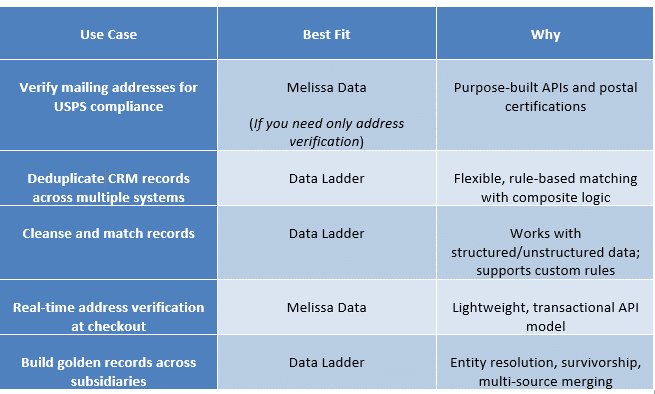
Use Cases: Which Tool Fits Where?
Final Word
Melissa is a highly capable tool for what it was built to do, i.e., verifying addresses and prepping contact lists. But when your data quality challenges do beyond mailing accuracy – when you need to identify who someone is, not just where they are, that’s when the limitations of a postal verification engine start to show.
If your goals include reconciling identities, deduplicating records across systems, and/or building trusted customer profiles, Data Ladder offers a more complete, flexible, and scalable solution. Its depth of matching capabilities, ease of use, and speed to value make it a better fit for enterprises and midsize businesses seeking fast, reliable improvements in data quality – without the overhead of full MDM suites or the limitations of field-level API tools.
Frequently Asked Questions
What is the difference between DataMatch Enterprise and Melissa Data Quality Suite?
DataMatch Enterprise is a unified data quality platform that combines matching, deduplication, profiling, cleansing, standardization, survivorship, and address verification in a single product with flat licensing. Melissa Data Quality Suite is a modular set of products focused on contact data validation — Address Object, Email Object, Phone Object, Name Object, and MatchUp — each licensed separately and primarily delivered through APIs. DataMatch Enterprise is best for organizations needing full-spectrum data quality in one platform; Melissa is best for developers and teams whose primary need is address or contact data validation across many sources.
How does Melissa Data Quality Suite pricing compare to DataMatch Enterprise?
Melissa uses per-product, per-record subscription pricing — each Object (Address, Email, Phone, Name, MatchUp) is licensed separately and metered by records processed, credits, or API calls. DataMatch Enterprise uses flat subscription licensing with all capabilities included and no per-record metering. For bounded single-product use cases, Melissa’s per-product pricing can be more economical at entry; for organizations needing multiple validation types or matching at scale, DataMatch Enterprise’s flat licensing typically produces lower total cost of ownership because it eliminates data volume scaling penalties and multi-product stacking.
Does DataMatch Enterprise offer a real-time API for address verification?
Yes. DataMatch Enterprise Server provides API access for real-time data quality workflows, including address verification, matching, deduplication, and validation. The API supports both real-time per-record validation calls and bulk list processing, making it suitable for application integrations (lead capture, CRM data entry, checkout validation) as well as scheduled batch workflows.
Is DataMatch Enterprise an enterprise-grade data quality platform?
Yes. DataMatch Enterprise is deployed across Fortune 500 organizations including Deloitte, GE, and HP, US federal and state agencies, and regulated industries spanning healthcare, financial services, insurance, and government. The platform is built for enterprise scale — optimized for 100M+ record workloads, with audit-grade rule traceability, on-premises and API deployment options, and compliance support for regulated environments.
Can I migrate from Melissa Data Quality Suite to DataMatch Enterprise?
Yes. Migration typically involves connecting your source data to DataMatch Enterprise, recreating the validation and matching outcomes currently delivered through Melissa Objects within DME’s unified workflow, and validating results in a parallel run before cutover. Because Melissa Objects are typically called as separate API integrations, migration is often an opportunity to consolidate multiple Melissa products into a single DataMatch Enterprise project. Most migrations complete in weeks.
Which solution is better for large-scale data matching and deduplication?
For reconciling millions of records across systems (CRM, ERP, marketing, etc.), Data Ladder’s in-memory processing, multi-threaded architecture, and flexible matching logic are typically more scalable than Melissa’s offerings.
Which platform offers better flexibility for business users versus developers?
Data Ladder emphasizes a no-code/low-code interface with visual workflows that empower analysts, data stewards, and business users. Melissa provides API-driven tools often used within developer workflows or integrated into apps like Salesforce.
How do these platforms help with building a “single customer view”?
Data Ladder is designed to consolidate customer records across many sources, with sophisticated survivorship and golden record creation logic. Melissa also builds golden records but is typically more limited to contact and address-centric use cases.
Which solution scales better for large enterprise datasets?
Data Ladder’s in-memory processing and multi-threaded architecture are built to handle very large datasets — tens to hundreds of millions of records — without requiring a full MDM system. Melissa can process large datasets but is often optimized for transactional address verification and mid-sized batches.
Does either platform support customizable matching rules?
Yes — Data Ladder allows customizable rule-based matching, adjustable thresholds, and composite field logic. Melissa also allows matching configurations but is generally more focused on fuzzy and phonetic matching for contacts.
Is coding experience required to use these platforms?
Melissa offers developer-friendly APIs and tools that may require scripting for complex matching workflows. Data Ladder’s drag-and-drop interface and guided configurations make it more accessible for analysts and business users without extensive coding skills, while still providing advanced scripting options when needed.
Can DataMatch Enterprise replace Melissa Data Quality Suite?
For most data quality workloads, yes — particularly when matching, deduplication, and survivorship are part of the requirement. DataMatch Enterprise covers the core capabilities of Melissa’s Address Object, MatchUp, Email Object, Phone Object, and Name Object within a single platform, plus matching and survivorship capabilities not native to the Melissa Suite. For workloads where deep international address coverage across 240+ countries is the primary requirement, Melissa’s specialized international postal data coverage remains a differentiator that should be evaluated against your specific country mix.